

Love & Hate
Words: Kieran Longworth | Pitch Issue 17
After three decades of presenting sports radio, Brent Dougherty speaks to Pitch about broadcasting the tribal, tortured, and unshakeable relationship the American South has with football.
“Everything in the South is football-driven,” evocatively opens the talk-show host. All the way from Tennessee, Brent Dougherty is sitting in a branded baseball cap, Latin cross hanging around his chest. In sitting down and talking to the 52-year-old, it’s clear that he has a voice for radio. The ‘Mayor of Middle Tennessee Sports’ speaks clearly, with a hint of southern optimism, is wholly compelling to listen to, and appears well-practised in telling a compelling narrative.
His pride and joy is 3HL – or Three-Hour Lunch to give the programme its full name – a popular drive-time sports radio show on Nashville's 104-5 The Zone in Tennessee. Together with co-hosts Ron ‘Big’ Slay and Dawn ‘Babs’ Davenport, they broadcast to 2.5 million ticket-wielding sports fans in Tennessee. And there’s nobody around who knows the region’s sport – in particular Gridiron – better.
“The NFL is king in terms of ratings and money, sure,” the quarterback of the show resumes, “but college football – and the passion that goes with it – is incomparable to anything else around here. The passion, the rivalry, even the hatred at times, is real.
Summing up what it means to those listeners, Brent says, “The Southeastern Conference – that’s the 16-team league competing for $38 million in prizes and local honours annually – has a saying: ‘It just means more.’ And it really does. College football is a way of life here. For a lot of people, it's football, God, and then family,” he says, visually listing the ‘holy trinity’ on his left hand. “We try to be there for everyone, all the time. It’s a little escape from the day-to-day where everyone can come together and talk about their collective love, or hate, for sport. On any given day.”
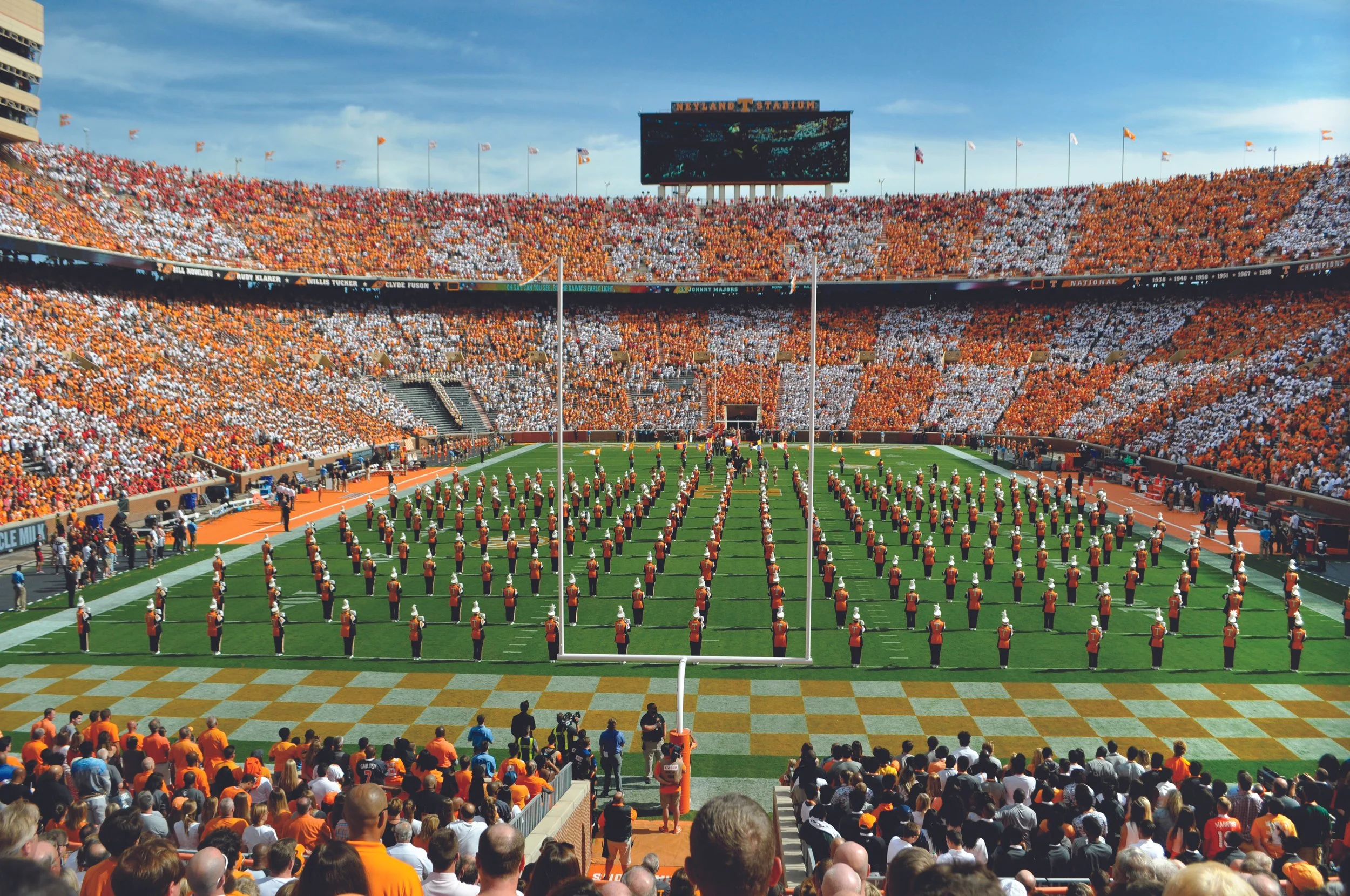
To understand why Dougherty talks about the game the way he does, you have to start with Neyland Stadium, home of the University of Tennessee Volunteers. As an architectural prospect, it sits on the banks of the Tennessee River in Knoxville, holding just shy of 102,000 people; it is the sixth-largest stadium in the United States and one of the most impressive gamedays in sport. The monolith is also, in a roundabout way, a family heirloom.
“My great-grandfather hired Robert Neyland as head coach, which is where the ground – previously Shields–Watkins Field – got its name in 1962.” Now officially ‘Neyland Stadium. Home of the Vols. Proudly preserved by Pilot’ – and a bit of a mouthful – Tennessee struck a multi-year deal with the travel centre giant in 2024, securing $337 million in upgrades.
Across three coaching stints interrupted by military service, the General built the programme that would come to define the region. Four national championships after taking charge in 1926, the stadium grew from a single 3,200-seat grandstand into the concrete colossus that stands today. Shaking, as it does, with the bluegrass chant of the Osborne Brothers’ “Rocky Top” on autumn Saturdays.
“For the best part of a century, college football wasn't competing with anything down here. It was the only show in town,” Dougherty continues, “When I started sports radio in Nashville, we didn't have any professional sports teams. We had a minor league baseball team, and that was it. Just the Vols, with a little coverage of the (Vanderbilt) Commodores because they're in Nashville.” He says, with a rose-tinted view of the pre-Titans years.
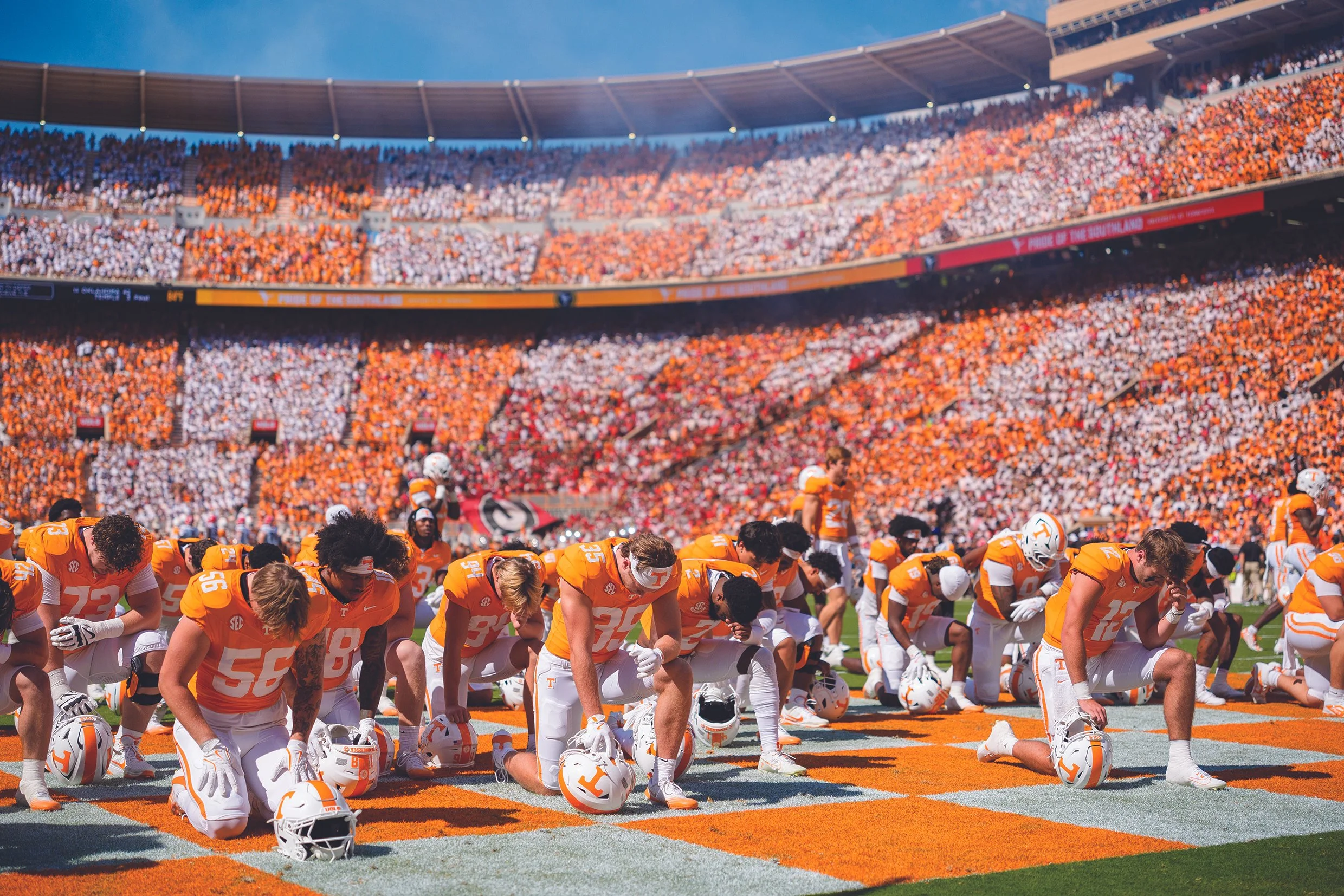
The Vols have six national championships (1938, 1940, 1950, 1951, 1967, and 1998) to their name and 13 Southeastern Conference (SEC) titles. Against rivals Auburn, Alabama, LSU, and Ole Miss, their most recent major wire-service championship and SEC title came during the 1998 season. The year the Oilers – now Titans – came to town.
“College football is all about families, generations and traditions. That part of it is completely different from professional football. Nobody went to the University of Titans. The NFL, as hard as it may be to believe, just can’t compete emotionally. Despite bringing in the billions in television rights that it does.
“As a radio programme, we need up and down. We need love or hate. We don’t need indifference. That kills everything.”
“This is a peculiarly Southern condition, too. Head north and east, and the balance of power flips entirely. I've got a friend who played for the Titans who’s from New York,” The 52-year-old – phone book as long as his arm – adds. “They played their high school football games on Saturdays, because up there, nobody was competing for the oxygen on a Friday night, let alone Saturday afternoon. In the South, high school owns Friday, college football owns Saturday, and the NFL has to make do with Sunday leftovers – at least for the soul of the region, if not the accompanying bank balance.”
Nashville has changed since the fanatic in conversation first sat behind a microphone in 1996. The city now has an NFL team in the aforementioned Titans, an NHL side in the Predators, and MLS football with Nashville SC. “We'll probably get Major League Baseball before too long,” he predicts, in reference to Nashville’s likelihood to land one in the league's next round of expansion, the MLB planning to grow from 30 to 32 teams in 2029.
The broadcaster’s own career has been a study in stability amid all that growth. What has kept it alive, Dougherty argues, is a refusal to be a wall-to-wall ‘hot-take’ shop. “My personality type is not to be that guy anyway. I'm a little more measured than a lot of people, whilst remaining completely free to say whatever I want. We're in the opinion business, so we have to bring something every day, which can get tiresome, but that's part of the creative angle of the job. What I like is covering the same topics in different ways.
“We're open as far as who we are as people and what we go through in life. Because, for me, with radio, if you can't connect with your audience and they don't feel a connection from you, you're dead. Between the football, we happily chase whatever oddity crosses the wires – a mass cobra escape in China, a missing kangaroo in Guntown, Mississippi – you name it!”
But if there is one subject guaranteed to divide his callers cleanly by generation, it is money. Since the NCAA's 2021 ruling permitting Name, Image and Likeness (NIL) compensation, college athletes across America have gone from strictly amateur status to, in some cases, multimillion-dollar earners before they've played a single down of college football. For a region that built its identity on the romantic idea of the ‘student-athlete’, it has welcomed a shift.
“I think the older generations struggle with the idea because they romanticise the whole existence of the collegiate athlete,” Dougherty says. “That's just not the way it is anymore. I'm all for Name, Image and Likeness and players being able to control their own brand. There’s 100,000 at each game; universities were making all kinds of money off these kids. They might not put a player's face on a billboard or their name on the back of the jersey, but they'd put their number on it, and everybody knew who they were. So, I'm glad they're getting paid.
“That being said, there is a clear lack of structure. It's like the Wild West right now. They're going to have to come up with some kind of organised system to control it all – whether that's a salary cap, collective bargaining agreement or something else – because at the moment it's out of control.” He points to the example of David Gabriel Georges, a blue-chip running back from Chattanooga, by way of Quebec. Choosing between Ohio State and Tennessee on the strength of an NIL package reportedly worth $6 million – that figure is attached to a player yet to graduate high school.
“He's going to be the highest-paid running back coming out of high school ever. I've heard that Adidas is Tennessee's shoe apparel sponsor, and they have put money in for this kid if he were to go to the Vols. Nike, on the other hand, have reportedly told Ohio State – the other interested party – that they don't invest in high school athletes. So they’re caught a little bit behind the times.”
The politics of it, Dougherty reckons, are equally tangled. “Colleges are reluctant to formally classify players as employees, which would open the door to collective bargaining, but without that step nobody has quite worked out how to install guardrails. Even lawmakers have got involved, but they're trying to win elections and all that. So, I don’t tend to listen.”
What it has done for his own show, at least, is “create a second football season. The transfer portal – the mechanism through which players move between programmes, often chasing the best NIL offer – has created interest in times where people wouldn't normally be focusing in on college football. It’s created more talking points for us. Which can only be good for business.
“As a radio programme, we need up and down. We need love or hate. We don't need indifference. That kills everything.”
It is the defining condition of his current beat. The Titans have endured back-to-back 3-14 seasons – and just six wins from a possible 34 games – complete with a coaching change and a rookie quarterback learning on the job, in Cam Ward, the first overall pick in the 2025 draft. The 24-year-old’s first year yielded just five touchdowns against six interceptions, before a turnaround from Week 10 onward produced ten further touchdowns to just one single interception. Such a season closed the year on a note Titans fans have chosen to interpret as a genuine sign of life. Now, according to Dougherty, “with a new coaching staff built around three former head coaches, Nashville is choosing, again, to hope.
“The NFL does a great job of providing that. Hope. Through free agency, trades, and the draft, no matter how bad it’s been, fans around this time of year believe. It is a mechanism college football and European soccer don't fully share – there is no relegation to punish decline permanently. Lose thirty of your last thirty-four games, and the league still hands you a shiny new quarterback and tells you this is the year.
“Personally, I would prefer to go back and forth week to week,” Dougherty again talking about ‘the business’ of radio. “When you go 3-14, it's like the world has fallen. I do get tired of that narrative because it’s easy to come across like you're defending the team, even though I’m only ever trying to be logical in an illogical situation.”
If Nashville needs a reminder of what love and hate can coexist around a single player, it need only reach back to the franchise's first great quarterback. Steve McNair, drafted third overall by the now-defunct Houston Oilers in 1995, moved with the team through its relocation to Tennessee and became the face of the newly rechristened Titans. “Even when Steve was playing, early on, people were wanting Neil O'Donnell, who was the backup quarterback at the time,” Dougherty recalls. “People always want the backup.”
In 1999, McNair delivered the single greatest season in franchise history. Just two years into their existence, and the first under the Titans’ brand. The franchise, led by coach Jeff Fisher, reached the postseason on the back of the ‘Music City Miracle’ – a lateral play against the Buffalo Bills – before beating the Jacksonville Jaguars to reach Super Bowl XXXIV.
There, against a St. Louis Rams team built around QB Kurt Warner's (a former grocery store shelf-stocker) ‘Greatest Show on Turf’ offence, McNair produced a performance still spoken of in reverent tones in Tennessee today. “Two-hundred-and-fourteen passing yards, 64 rushing yards, and a frantic final drive in which he escaped a certain sack before finding Kevin Dyson with the clock at zero,” Dougherty recalls, almost instinctively. Dyson was stopped a single yard short of the tying touchdown, and the Rams held on, 23-16. Tennessee has never been back to a Super Bowl since.
McNair went on to share the NFL's MVP award with Peyton Manning in 2003 – a career capped in Tennessee before injury, and a trade to Baltimore brought it to a close. “That goodwill still shapes how our callers judge every quarterback who has worn the jersey since. It's why Cam Ward's name gets attached, fairly or not, to a legacy that has gone unfulfilled since those early days.” It concludes a run of high draft picks – Vince Young (third overall in 2006), Jake Locker (eighth in 2011), Marcus Mariota (second in 2015), Ryan Tannehill (eighth in 2012) – who never quite carried the franchise back to where ‘Air McNair’ once had it.
As Dougherty speaks, the sporting calendar turns its page from one obsession to the next. The World Cup has briefly filled Nashville's football-shaped hole this summer – “it's been different this year for what I do, but it all comes back to football, our football.
“The promise is that this year might be different. Somewhere between the love and the hate, hope always seems to find its way back to the South,” this professional talker concludes. For Brent Dougherty and co., three hours a day, five days a week, that's the whole show.