

I wanna be a Cowboy, Baby!
Andy Afford sets out the key moves in the making of a global sporting dynasty.
The story begins in 1960,when the National Football League finally granted the US city of Dallas an expansion franchise. Professional football was spreading across America, television was transforming the reach and potential scale of the sport, and as a consequence, football’s ability to attract supporters in every corner of the States went up exponentially. And teams, old and new, wanted in.
Supported by Texas’s per capita wealth – and its state-wide appetite for backing a major sports team – it made for a compelling story. Especially with that confidence reinforced by an engaged and proud local population that totalled around 10 million. That number hovers around 31 million today.
It began with Clint Murchison Jr., the almost-by-design named oilman and investor whose singular force of personality effectively drove the franchise into existence. He was a man in step with the times, and emboldened by the potential reach of the new-fangled television network, he saw the potential for some form of personal legitimacy, that the aforementioned countrywide connection, local, regional and national influence would give him. He saw it all on the table through ownership of this new club. It was then all about fitting his ‘ten-gallon’ ambition into a Stetson-sized opportunity, all possible within the contours of the generously proportioned Lone Star state. It would be this drive that would shape the organisation from day one.
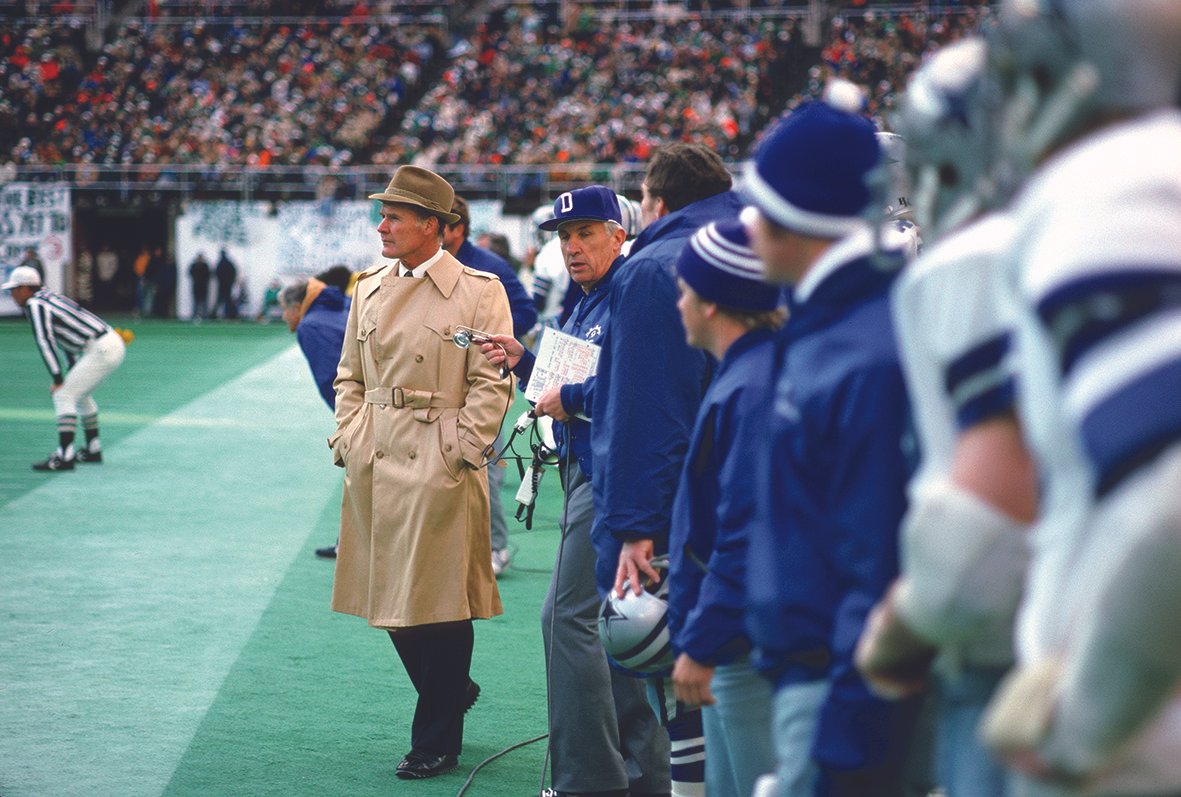
Next, Tex Schramm. He was the man appointed as the first general manager and future co-owner. And he understood the modern business of football, where few others did. Gil Brandt, in charge of personnel, helped transform scouting and recruitment into a sharp and analytical operation. Which left Tom Landry, the first coach, to supply his own unmistakable brand of discipline and buttoned-up composure; all packaged in a trilby hat and flasher mac. By combination these men came together to create something more durable. Which, again, was the ambition from the off. Murchison said of these appointments, “I’d rather let the folks who know what they are doing run things.” And he was true to his word.
Their talent was that they first built a structure, not a team. Because the Cowboys’ rise was not merely about talent accumulating on the roster and the odd kind bounce of an odd-shaped ball, it was about an organisation learning to operate like a serious institution under clear direction from the get-go. In this, the franchise was way ahead of its time. And to many, it remains so. And, once more, such an institution was the goal from the blocks.
The early years were difficult, and there were long stretches when Dallas looked like any other expansion side, with that vulnerability to the newness of it all seeing them outmatched on the gridiron. But the framework was in place. As was the vision. As was the planning. With hindsight, they were just waiting for results to catch up.
“Texas Stadium has a hole in its roof so God can watch His favourite team play”
Those early seasons also helped create an allegory that still clings to the team. The Cowboys were new, but they did not behave at the time like a small or fragile operation, as often is the case. Even in defeat they were cocky. With the city sharing that ‘cock’.
Dallas in the 1960s was modern, expanding, self-assured, and increasingly central to the economic mythology of the American Southwest. The football team mirrored that energy. It was polished to the point of gleaming, well-financed, and unafraid of attention. As the skyscrapers went up – when there was no apparent shortage of space – the city dominated its locale, where the wider sporting landscape was still dominated by older Eastern power centres. Such a scene left the Cowboys to represent a different kind of American dream. It was younger, louder, and much better looking. It was also less interested in seeking permission to be part of the ‘big show’. The movement associated with the Cowboys was one of its own making.
Eventually, Landry turned promise into practice. He was by no stretch of the imagination ‘flamboyant’, but as a coach in the league at that time, that was precisely the point. No one was. And Landry was the stoney-faced middle-aged man getting shit done. He would do the same for 29 seasons, he said, when he took over, that his simple ambition was to give the city of Dallas a team to be proud of. He would also say that his whole leadership style was about “getting someone to do what they don't want to do, to achieve what they want to achieve."
In this quiet coercion, he projected control, intellect, and precision. His trademark fedora and unemotional presence on the touchline became visual shorthand for a franchise that aimed to sit above any perception of chaos that was often associated with newbies’ arrival in the league. He rose above any cause for panic, and played above the levels of improvisation and fingers-crossed hope that would usually define the early attempts of a start-up. And under Landry, the Cowboys developed a distinct football identity rooted in some degree of on-field flexibility, under the coach’s sense of discipline.
The defence was often inventive, as opposed to the offence. Where in attack, they were no better than efficient. The team under their coach valued preparation and composure in a way that made the most of its best years. Despite all of this, it would be 1966 before the Cowboys finally secured a winning season (more wins than losses during any given competition calendar). And it marked the beginning of something far greater than a play-off run. It was the start of a standard of performance expectation. And that standard would become gold. With a copper bottom.
Between ’66 and ’85 the Dallas Cowboys recorded those 20 consecutive winning seasons, and in the process set an NFL record. During that run, the organisation claimed divisional titles, reached conference championship games, and remained forever relevant and at the forefront of America’s sporting conversation. National audiences came to expect Dallas in the post-season in January. Opponents measured themselves against Dallas. The Cowboys became a team to beat, not an expansion team not to lose to.
Logistically, the Cowboys moved from the Cotton Bowl (92,000 capacity) to Texas Stadium (68,100), both in Dallas, in 1971. The latter was the club’s home until 2008. Whereupon moving for the first time, owner Murchison said without irony, “Texas Stadium has a hole in its roof so God can watch His favourite team play.” The latest home, the 80,000-seater, $1.3 billion monolith, AT&T Stadium in Arlington, Texas, can also accommodate 100,000 souls for major non-football events.
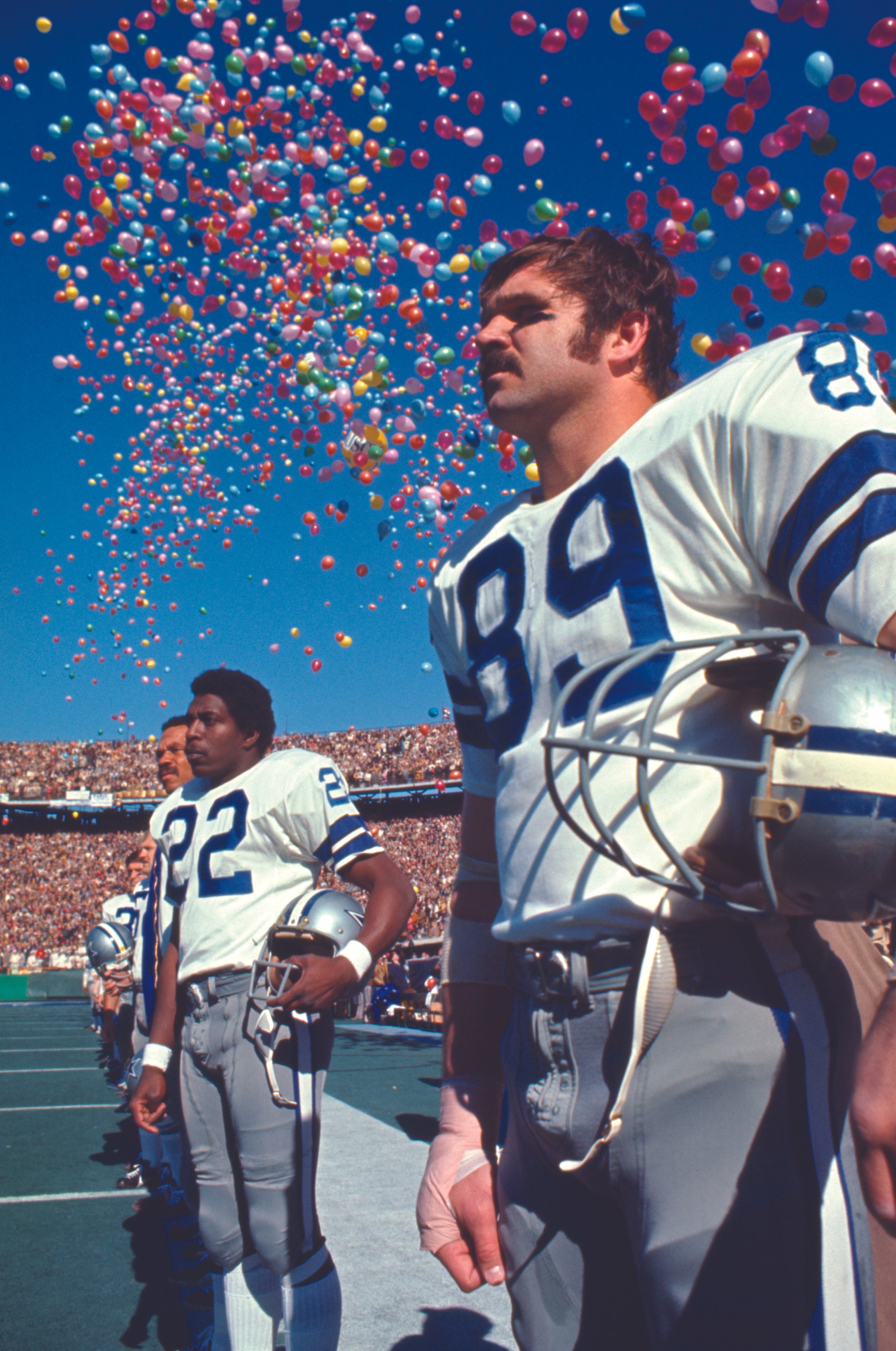
The 1970s are where the foundations for this now-brick-and-mortar legacy were truly solidified. Roger Staubach emerged as one of the defining quarterbacks of his or any era. He was a player whose military background, composure, and reliability in decisive moments gave Dallas a bit of an aura. Bob Lilly anchored the defensive front and became a foundational figure in the club’s identity. Mel Renfro, Rayfield Wright, and other stalwarts provided depth and durability. Whilst the rocket-legged Tony Dorsett brought speed and a level of elegance to the backfield. The franchise’s first Super Bowl victories came during that golden period. Super Bowls VI and XII ensured that television schedules now favoured the Cowboys. Timing-wise, this period is where the “America’s Team” label took hold. NFL Films helped circulate the phrase, and by the late 1970s, it had become inseparable from the Cowboys’ image. Much to the franchise’s pleasure. And it endured because it aligned.
As the league was expanding its television presence, the Cowboys were among the most-watched and most heavily merchandised franchises in the sport. Made easier still through instant on-screen recognition. The star logo was simple, yet distinct and distinctive. Their kits proved classic and unmistakable. Their cheerleaders – an element no-one saw coming – became a cultural talking point in their own right. As a consequence, Cowboys’ matches were broadcast with a frequency and prominence that made Dallas feel less a club and more the home of the national broadcaster.
But with that exposure, “America’s Team” became as much a provocation as a compliment. To the point where people were hoping to see the Cowboys lose, every bit as much as seeing their own team win. And recognition, though bankable, is not the same as permanence.
By the late 1980s, the Cowboys were drifting. The old Landry system of football had undeniably grown stale. The league had evolved into something more approximating sports entertainment, with the Cowboys now not holding up their end of the bargain. Leaving football’s prevailing image of East Coast teams grinding it out in the mud and snow, as one of attrition and abrasion, over their injection of the inspirational and brazen. Simply, the league aspired to more.
The first losing season in two decades arrived in 1986, and the downturn soon worsened. By 1988, Dallas finished with a 3–13 record. For a franchise built on consistency, the comedown was striking. And it revealed that despite the glamour, the sunshine, and the oddities of its region, the Cowboys’ identity was tied closely to success. The brand remained powerful. But their on-field presence – curated over the years from start-up to Super Bowl winners – had dissipated. The league had not stopped paying attention to Dallas – the opposite. It was that Dallas had allowed focus to fall elsewhere.
That, in a nutshell, was the context in which businessman Jerry Jones acquired the franchise in 1989, hocking everything – including the family silver – to get his hands on what he felt was the dominant brand in sports. “I felt like a freshman walk-on in a room full of All-Americans,” he said at the time.
His arrival altered everything, not simply because he controlled the team, but because he recognised that its identity could be reshaped. And needed to be. Jones’ first decisive move was to dismiss Tom Landry, in the process ending one of the most recognisable touchline tenures in sport. The decision was as stark as it was symbolic. It signalled that the organisation was entering a new era, one in which any level of sentiment would yield to Jones’ authority, and his desire for ‘more’. When Jones appointed former college teammate Jimmy Johnson, he began rebuilding with speed and decisiveness. It was undeniably out with the old and in with the new. “I wanted Jimmy Johnson,” Jones said of the appointment at that time. “I wanted someone I knew, someone I wanted, someone I knew well, I wanted someone who I knew could get it done to be our coach.” He would go on to conclude, “I said he’d be worth five first-round draft choices or five Heisman Trophy draft picks. I should have been laughed out of town when I said it.”
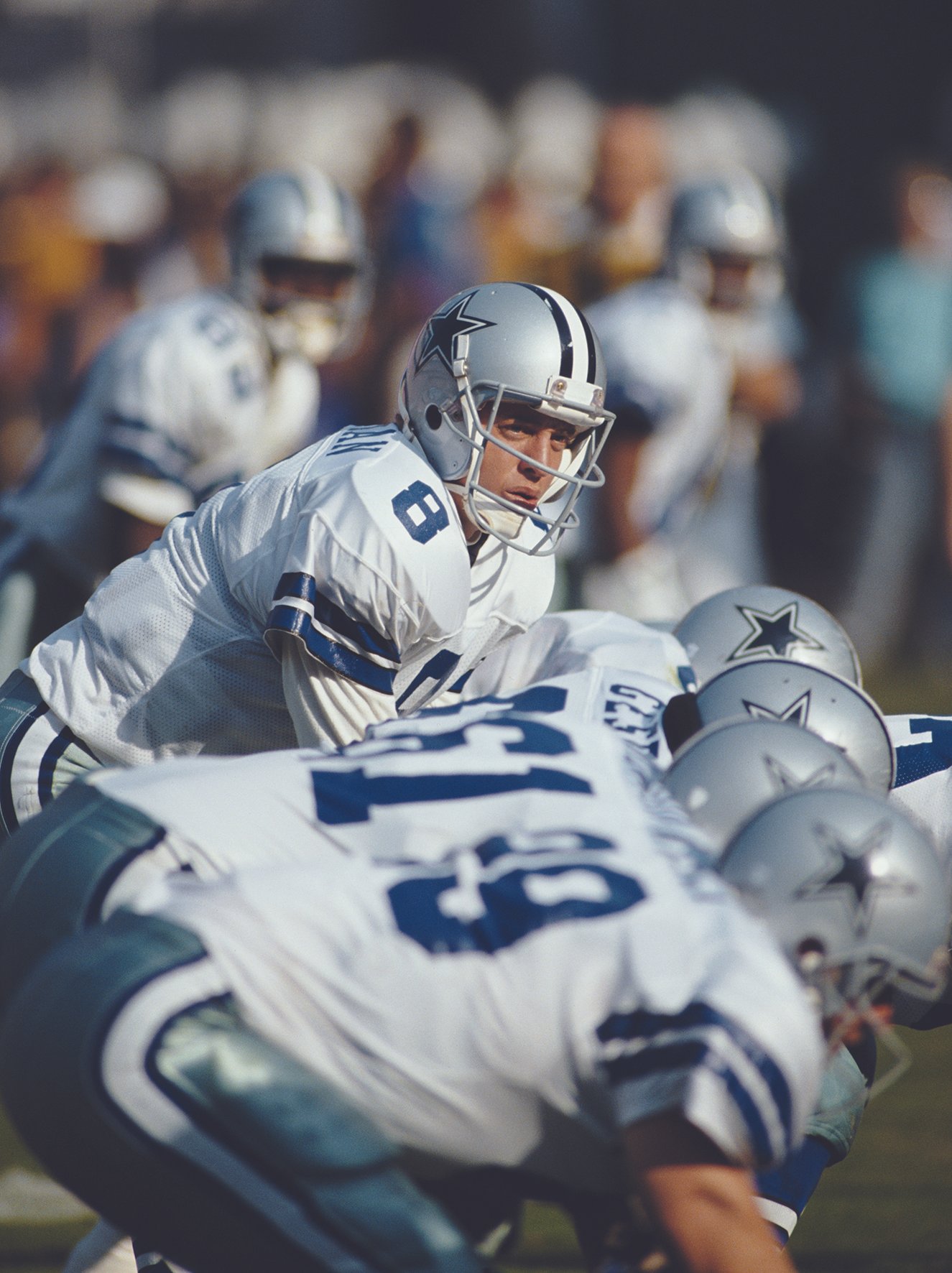
The early Jones era was contentious from the outset, but clearly not without fanfare, combining some astute football decisions with a willingness to provoke. Yet it would be the football that ultimately succeeded. As it needed to. When Dallas drafted quarterback Troy Aikman and acquired other key pieces of the puzzle, it did so through aggressive squad management. It rebuilt with a confidence that reflected Jones’s approach. Jimmy Johnson introduced a hard edge and even more exacting and uncompromising standards. Winning was to be once again the yardstick. The only true measure of this Cowboys era.
California-born Aikman provided calm and control behind the line of scrimmage, after a difficult baptism for the college football all-star. Emmitt Smith became the engine and focus of the attack, a running back whose balance, vision, and durability made him one of the finest in league history. Michael Irvin added physicality, charisma, and a confrontational energy that would go on to embody the team’s swagger, all despite multiple brushes with the law. The ‘Great Wall of Dallas’, the offensive line that protected and powered the attack, became one of the defining on-field ‘structural’ achievements of the era. Suddenly, the Cowboys were doing more than successfully navigating the transition from Coach Landry. They were off again. And running. Galloping, even.
The 1990s Cowboys were perhaps the clearest expression of the franchise’s dual nature. On the field, they were exceptional. They won Super Bowl XXVII and Super Bowl XXVIII under Johnson, then secured Super Bowl XXX under Barry Switzer, completing a three-title run in four years. Switzer was a switch that demonstrated Jerry Jones’ power of ownership. Made obvious when clearing out his former college team-mate, Johnson, as a gesture to the media as to who exactly was responsible for the Cowboys’ restoration to winning ways.
The team’s roster was deep, talented, and physically dominant. It could control matches on the ground, dictate terms defensively, and outmanoeuvre opponents in the key moments. The 1992 side in particular felt like a declaration that Dallas had reclaimed the centre of the sport and the heart of the nation. But it was not enough for Jones just to return his team to the top. The new Cowboys intended to be unmistakably restored. And better than ever.
Off the field, the 1990s Cowboys were rarely quiet. There were controversies, suspensions, jail time, tensions between players and management, and a constant presence in the headlines. That was not separate from the franchise’s identity; it was part of it. As in previous eras – good and bad – Dallas had always attracted more scrutiny, more attention, and more public appetite than most. Now, with better reason. In many respects, the noise only amplified the club’s cultural reach. In an era of flaunted wealth and ‘loadsa money’, the Cowboys, like the world it commanded, were not a discreet dynasty.
The tension between sporting excellence and tolerated excess is central to understanding why the Cowboys remain so divisive. Many teams become widely admired because they are underestimated or arrive without baggage. Dallas has rarely had that advantage outside of its early days of operation, and then only to a point. Its ‘problem’ is that it has been too prominent for too long. Each era of Cowboys football carries its own standard of internal and external benchmarking. Behaviours and expected levels of success that sit outside of the norms of convention.
It’s arguable that as the world of the ’80s and ’90s became increasingly ‘brand focused’, the Dallas Cowboys became to sport what Gucci was to luxury fashion and Ferrari to the luxury motor industry. In 2025, the five most highly-valued sporting franchises are all American-owned. They are basketball’s LA Lakers ($10 billion), the NFL’s New York Giants ($10.1 billion) and LA Rams ($10.5 billion), ’ballers the Golden State Warriors in second place, pulling $11 billion, and the Cowboys out front with an unlucky-for-some valuation of $13 billion. With those numbers only going in one direction.
The players who shaped that identity deserve attention, because the franchise’s mythology is sustained by more than slogans. Roger Staubach delivered early championship credibility and an image of composure under pressure. Emmitt Smith provided extraordinary offensive production and one of the most relentless careers in football. Troy Aikman offered structure and restraint at quarterback, ideal for a side built on control. Larry Allen set a standard of power and technique that defined Dallas at its most imposing. Bob Lilly, the original defensive cornerstone, gave the franchise its first enduring anchor. These figures are not simply well-known. They are structural elements of a long-running institutional narrative. Each contributing to that aforementioned valuation. All firm; but flexible.
If the Cowboys are still called America’s Team, it is because the label has outlasted the circumstances that created it. The franchise has moved through transitions, changes in control, coaching turnover, and extended periods of underperformance relative to its own history. Yet the brand persists because it has become distinct from results. Dallas now represents visibility, ambition, the frustrations of sport, glamour, and controversy simultaneously. It is one of the rare sporting institutions large enough to command attention regardless of form and flawed enough to resist universal admiration. Haters still gonna hate.
The modern NFL has produced other teams capable of challenging Dallas for attention, but none have fully replaced it in the national imagination. Kansas City has built the most successful recent dynasty and possesses the star power to command the sport’s centre. San Francisco retains historical weight and a traditional sense of authority. Philadelphia has transformed intensity and regional identity into a national presence. New England, at its peak, defined a modern era of sustained success. Yet the Cowboys remain distinct because their prominence extends beyond recent performance. They are not simply a strong or struggling team. They are a constant barometer.
That permanence is rooted as much in the city as in the football. Dallas has long been a place where image and substance coexist. The Cowboys align naturally with that environment. They have been bold without apology, prominent without being purely ornamental, and successful for long enough to convert perception into inheritance. When other franchises win, they collect titles. When the Cowboys win, they reinforce an identity already operating on a national scale. When they lose, that identity does not vanish; it becomes more contested, more debated, and more difficult to ignore.
There is a reason the Cowboys provoke such lasting reactions. They are one of the few franchises in American sport that people grasp instinctively, even without close attention. The star logo signals meaning before the game begins. The cheerleaders high-kicking their way through AC/DC’s “Thunderstruck”, a spectacle to sell tickets in its own right. In short, the club’s history provides a shorthand for football’s evolution from a muddy-field sport into a spectacle.
In the end, the Dallas Cowboys became America’s Team because they learned how to turn football into its own language. With no regional dialect. They arrived early enough to help shape the television era, succeeded on the field enough to become aspirational, generated enough debate to remain constantly under discussion, and understood the power of their own identity well enough for it to become a competitive advantage.
Jerry Jones is one of 16 owners enshrined in Pro Football’s Hall of Fame, inducted as he was in 2017. He’s the second from Dallas, joining Tex Schramm (1991). In Jones’ 37-minute inauguration speech, somewhat uncharacteristically, he said that hiring Jimmy Johnson was the best decision of his career and that he was “a great teammate and a great partner,” before going on to say that it wouldn't have been possible without Johnson leading those early teams. This was, and remains, a conciliation that didn’t ever appear possible, such was the ire it took to fire Johnson, and rage in which it was received. Jones also spoke of the trading of superstar running back, Herschel Walker, to the Minnesota Vikings, for a first-round draft pick and 12-player trade concessions – and the grace in which the player took the news – as another catalystic moment in need of a mention.
For completeness, Johnson joined his co-conspirator in the Pro Football Hall of Fame as a member of the Class of 2020, becoming the third Cowboys head coach to be enshrined alongside Tom Landry (1990) and Bill Parcells (2013), although Parcells was inducted largely for his work with the New York Giants.
In total, 32 Hall of Famers made their primary contribution to football in Dallas. They include Bob Lilly (1980), Roger Staubach (1985), Tony Dorsett (1994), Randy White (1994), Mel Renfro (1996), Troy Aikman (2006), Rayfield Wright (2006), Michael Irvin (2007), Bob Hayes (2009), Emmitt Smith (2010), Deion Sanders (2011), Larry Allen (2013), Charles Haley (2015), Cliff Harris (2020), Drew Pearson (2021), Chuck Howley (2023) and DeMarcus Ware (2023). Only the Chicago Bears (41) and the Green Bay Packers (35) have more. Both are founding members of the league. A 40-year head start.