

Soccer reaches boiling point
The year is 1994 and America is preparing to host its first World Cup. The soccer kind. Football writer Robert Wilson pens a tribute to the time, and it all begins in Rotterdam. With a team otherwise uninvolved. Was this to be a World Cup that changed everything or just another fork in the road? You can read everything about this wonderfully winding tale in print, and now online. Enjoy.
“He is going to flick one now. He is going to flick one, he’s going to flick one. And it’s in.”
The legendary ITV commentator, Brian Moore, had fully anticipated what Holland’s Ronald Koeman was going to do with his re-taked free-kick. England’s David Seaman had not. He wasn’t hard to spot, clad in orange, ginger locks, and all.
With one clipped free-kick in Rotterdam, the Oranje ended England’s hopes of reaching the 1994 World Cup and sent Graham ‘Do I Not Like That’ Taylor’s side home packing. Koeman’s retaken effort, curled beyond Seaman and into the corner, sealed England’s fate. Twenty-eight years after winning their first World Cup, the Three Lions would not be going to the game’s latest and greatest commercial opportunity in the United States.
The decisive moment had already been preceded by controversy. An Andy Sinton long ball had sent David Platt (born in 1966) racing through on goal, only for Koeman to haul him down. Referee Karl-Josef Assenmacher showed yellow. Taylor never quite got over it. “I could not believe what I was seeing,” he said later. “It was a goalscoring opportunity and Koeman should have gone.” The FIFA guidance at the time was plain enough: denying a clear chance meant a straight red. As it does now.
“Hating soccervis more American than mom’s apple pie.”
Dennis Bergkamp added the finishing blow six minutes later and England were out. Taylor, vilified after the failure, carried the pain to his eventual grave in 2017: “It sticks with you for life,” he added posthumously, “If you say ‘Holland’ to me, to this day I see David Platt running through on goal. I can’t help it.”
England were not the only home nation to miss out. Scotland, Wales, and Northern Ireland were also absent from the final tournament. As well as other notable absentees in France, Portugal, and two-time winners, Uruguay. For much of the British and Irish audience, USA ’94 would be watched rather than lived. The exception was Jack Charlton’s Republic of Ireland, who went to America with a directness that seemed, on paper, ill-suited to the conditions awaiting them.
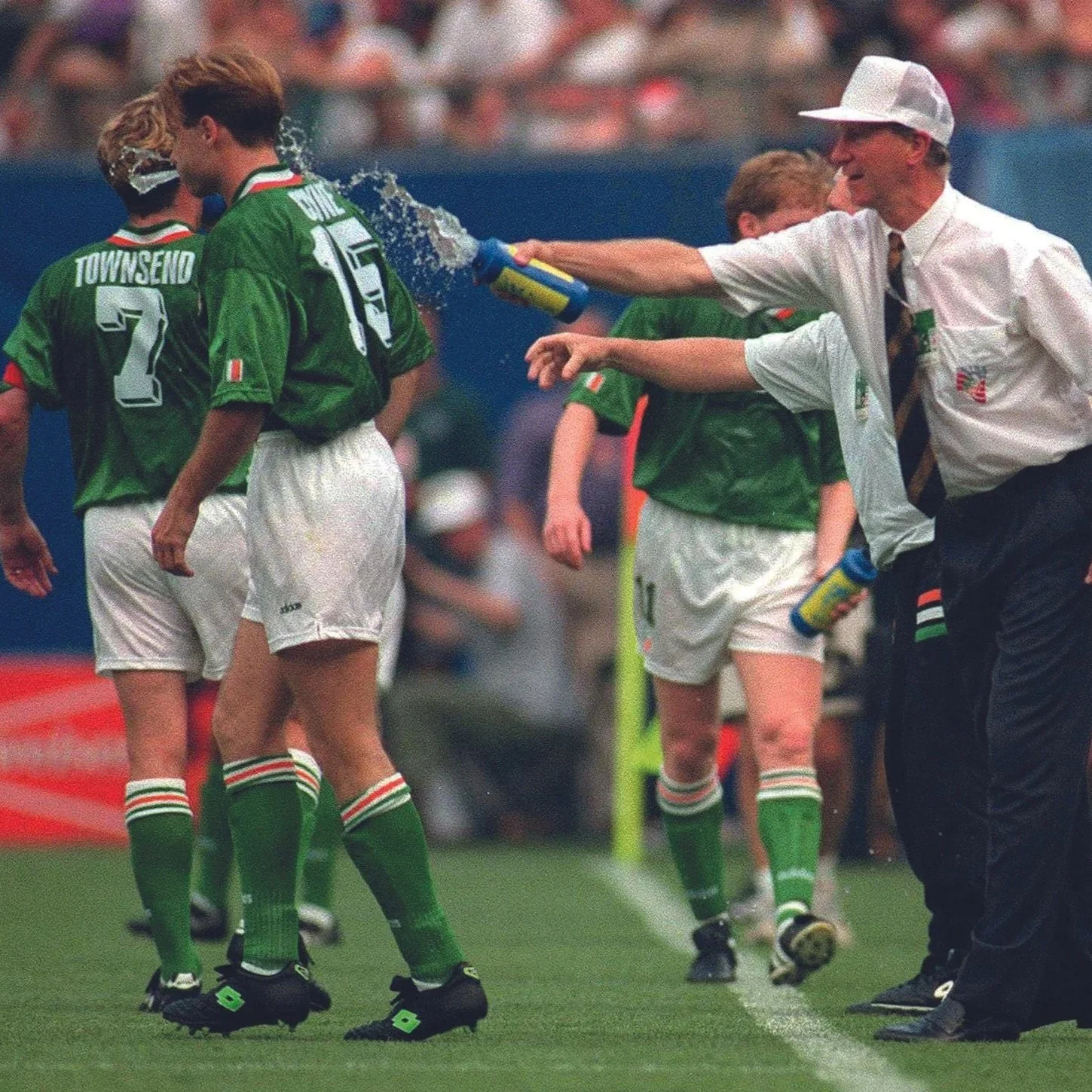
What they found was a World Cup played in blazing heat, on huge pitches, with kick-off times set largely in the middle of the day for prime-time European TV. It was football in weather that felt almost hostile to the game. Charlton’s Ireland, organised, stubborn and physically committed, had to adapt quickly just to survive.
And yet they did more than that. In East Rutherford, New Jersey, the Boys in Green produced one of the great World Cup shocks, beating eventual runners-up, Italy, in the Giants Stadium. An early goal from West Ham’s Ray Houghton was enough to better Arrigo Sacchi’s well-drilled – and better-groomed – side, and the Republic of Ireland’s players held on through pressure, nerves, and fatigue to claim one of the tournament’s defining results, a 1-0 group stage win. Their day in the sun. For a team whose style leaned heavily on stamina and structure – and who’s ‘preferred’ climate were the dirty British skies of home – the heat was a constant adversary. Players suffered dehydration, exhaustion, and weight loss. Charlton seemed to spend as much time managing bodies as tactics.
Against Mexico, local stations had temperatures reaching 110 degrees Fahrenheit (43 Celsius), at pitch level. And with Charlton wanting to withdraw a now-burnt-orange Tommy Coyne – then of Motherwell, previously Celtic and Tranmere Rovers – and bring on John Aldridge, also of Rovers, the delay became an ugly side-line flashpoint. Aldridge swore at FIFA official Mustafa Fahmy on live television, then later suggested the episode had hardened the squad’s resolve. Whatever the immediate effect, Ireland went on to finish second in the group and reach the last 16, where they eventually fell to Dick Advocaat’s aforementioned Netherlands side. Charlton was absent from the bench after the row, and their campaign ended with a sense of what might have been, but also with genuine pride. All with the carried support of the nation’s close – if not always friendly – neighbours.
That mix of discomfort and achievement mirrored the wider story of the tournament itself. When FIFA awarded the 1994 World Cup to the United States in 1988, scepticism was – however understandably – immediate and widespread. America, the argument went, was a place for baseball, basketball, and American football. What did it know about football? Or soccer, as it insisted on calling it? How would a tournament work across such a vast country? And, most importantly, would the public care?
There was reason for the doubt. The North American Soccer League had collapsed in 1985 (read about that on page 76). The United States had played in only two World Cups since the Second World War. And most recently, at Italia ’90, had lost every one of its games against the Azzuri hosts, Austria, and Czechoslovakia to finish bottom of their group. To contemporary observers, FIFA’s choice looked less like a sporting decision than a commercial one. Both at home, and overseas.
Internally, all was not ‘sweet as pie’ either. New York Times columnist George Vecsey summed up the suspicion neatly when he wrote that the United States had been chosen “because of all the money to be made, not because of any soccer prowess. Our country,” Vecsey immortalised in print, “has been rented as a giant stadium and hotel and television studio.”
On the day of the draw, USA Today ran a piece telling Americans they were right not to care about the World Cup, sneering at the tournament as the biggest event in places such as Cameroon, Uruguay, and Madagascar. “Hating soccer,” wrote columnist Tom Weir, “is more American than mom’s apple pie.”
There were even suggestions, soon rejected, that FIFA might tweak the game to suit the domestic audience: larger goals, commercial breaks (which with drinks breaks we will see in 2026), and quarter-length matches. Those ideas did not survive. But other changes did. Player names were printed on the back of shirts. Television coverage became more open and more sophisticated. Journalists were given a greater level of access than they had enjoyed at previous tournaments. And overall, the presentation was unmistakably American, even if the kicking of ze balls itself remained unchanged.
As far as wider events go, the World Cup in question, held in North America some 32 years ago, was perfectly book ended by two iconic penalty misses. One by Chain Reaction singer, Diana Ross, from three yards. The other from Italy’s golden boy, Roberto Baggio, with the final touch of the tournament in the Pasadena Rose Bowl.
In between, there was plenty of the to-be-expected American razzmatazz and glamour. But the tournament was not without its controversy. A few weeks after its close, unprecedented tragedy arose with 27-year-old Colombian defender, Andres Escobar, gunned down outside a Medellin nightclub, as apparent vengeance for his own goal in a decisive 2-1 defeat by the host nation. Escobar was on the verge of a move to Italian giants, AC Milan, that summer.
Humberto Castro Muñoz, a drug cartel bodyguard in Colombia, was arrested on the night of 2 July 1994, confessing the next day to the killing of Escobar. Castro also worked as a driver for Santiago Gallón, who had allegedly lost heavily having bet on Colombia. The bodyguard was found guilty of the centre-backs murder in June 1995.
On the pitch, reigning world champions Germany opened with a narrow win over Bolivia. Off it, the World Cup unfolded against a backdrop of another very different American drama: the slow-motion chase of O.J. Simpson along the 405 freeway in Los Angeles, which dominated television screens across the country on the eve of the tournament’s opening weekend.
Football was not yet America’s first language. But the tournament quickly proved it could hold attention. More than 3.5 million supporters attended matches, with an average gate of nearly 69,000, a record for the competition. The World Cup generated billions rather than millions, and FIFA’s commercial instincts were vindicated. For all the scepticism beforehand, the United States had provided scale, spectacle, and money. It had, against expectation, put on a show.
In fact, according to the Guinness Book of World Records, the largest television audience for a finals was during said World Cup. A record 32,115,652,000 viewers in 188 broadcast countries watched a total of 16,392 hours 37 minutes of transmission during the finals. Roughly 6 times the world population at the time.
The football, too, delivered. Diego Maradona arrived in the States leaner, sharpened and visually determined to make one last major statement. Banned for cocaine use after the previous World Cup and long since cast as football’s most dazzling troublemaker, he had shed weight rapidly in order to be fit in time. At 33, this was meant to be his final international swansong.
He began brightly enough, scored against Greece, and celebrated with a stare that seemed to challenge the world itself. Argentina then edged Nigeria in a hard-fought group game, with Claudio Caniggia scoring both goals after a clever Maradona set-piece routine helped create the winner. But the story was already turning. After Argentina’s second match, Maradona was escorted for a drugs test. Soon after, it emerged that he had failed, with ephedrine found in his sample. FIFA suspended him immediately. Argentina’s tournament collapsed soon after. And El Diez would never play for his country again.
The number 10 protested his innocence, claiming he had taken a banned stimulant only through a confusion over a version of the energy drink Rip Fuel and insisted that FIFA had previously given him permission to use it in his preparation. Whether that version of events was true, partial, or convenient hardly mattered. El Diego’s World Cup was over, and the world had to move on.
With other players stepping into the spotlight, the elegant and inventive Gheorghe Hagi became Romania’s talisman. Hristo Stoichkov helped drive Bulgaria to the semi-finals. Romario carried Brazil’s attack with a striker’s instinct that seemed almost disarmingly simple – scoring in ways that looked as though only he could have thought of them – often from close range, and with barely a touch wasted. He would finish the World Cup as Player of the Tournament, ahead of Roberto Baggio, who was doing God’s work for Italy.
The attacking midfielder was carrying a team almost single-handedly. The then-27-year-old scored in the knockout stages against Nigeria and again against Spain, he seemed to drag Italy deeper into the tournament by force of will. But he was also carrying injury. By the time the final arrived, his hamstring and thigh were giving him serious trouble. The doctor’s advice was not to play. Arrigo Sacchi took the risk anyway. Many thanks to the five knockout game goals scored by the Italian.
But in the heat of Pasadena, with the tournament reaching its closing act, the game barely caught fire – despite the heat at the 94,000-seat Rose Bowl. Brazil were an enigmatic bunch – quarterbacked by the defensive-minded Dunga, Mauro Silva, Mazinho, and Zinho in the midfield– organised, patient and physically composed. Italy were resilient, but blunt. Chances were scarce. Gianluca Pagliuca was nearly embarrassed by a long-range effort from Mauro Silva, but the woodwork rescued him. And that was all she wrote.
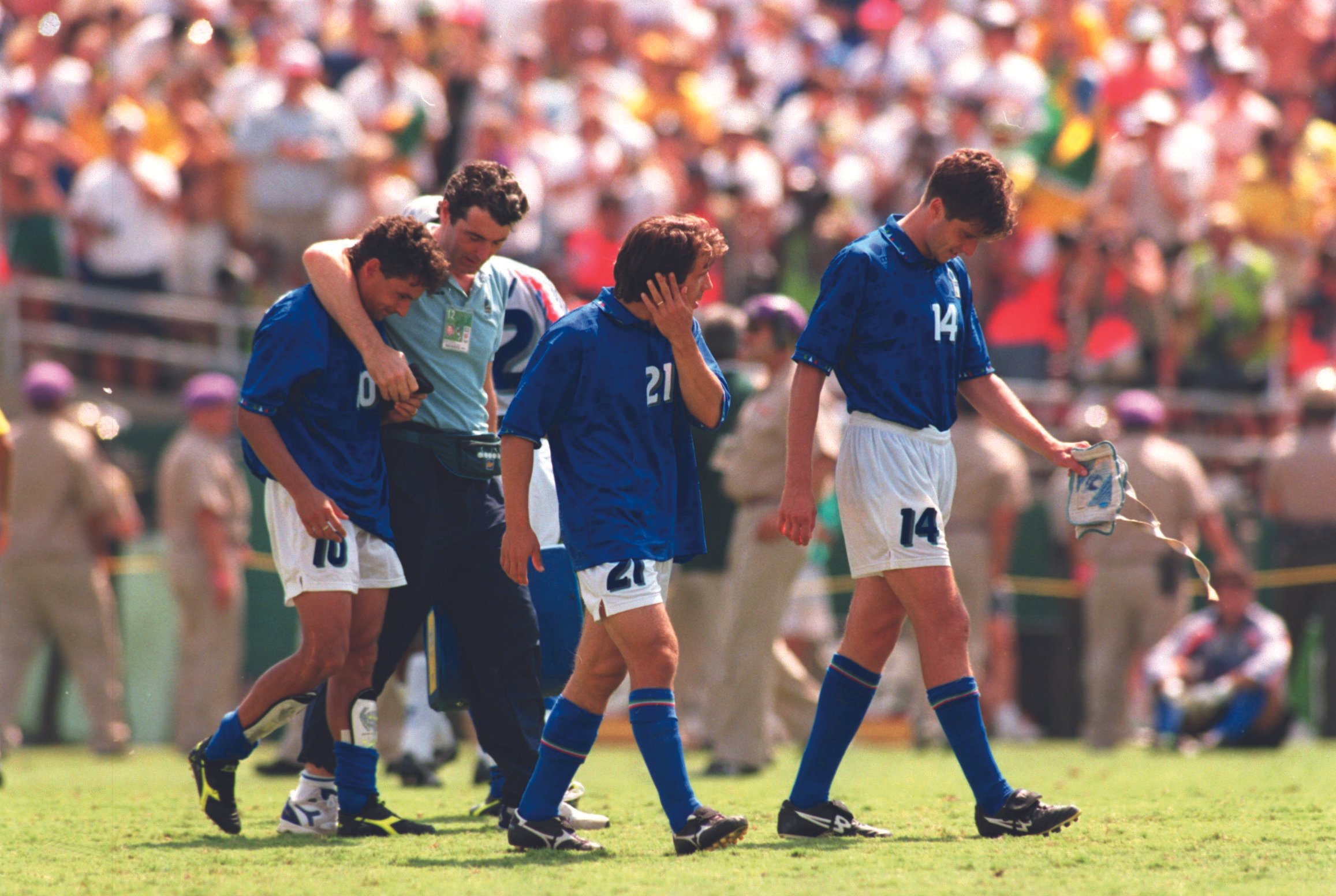
After 120 goalless minutes, the final became the first to be decided by a penalty shootout. And the nerves showed. AC Milan’s Franco Baresi missed. As did teammate Daniele Massaro. Brazil captain Dunga converted. Then came Baggio, the player who had carried Italy thus far, World Cup on the line blazed his penalty into orbit.
As Franco Baresi broke down in tears, members of the Brazilian backroom staff performed somersaults in shell suits befitting of the time. Brazil were world champions for the fourth time, and Baggio stood alone, a tragic figure in the centre of the celebration. It was a painful ending to an otherwise extraordinary campaign, but it was also a fittingly human and colourful one. For a tournament that had mixed showmanship with hardship, brilliance with absurdity, and glamour with genuine danger, the final offered no neat football romance. Only consequence.
And yet, for all that the final disappointed as a spectacle, bookending the event with another missed pen – this time not by the ‘Queen of Motown’, but the tournament’s leading light. The fact that football (soccer) is back in 2026 suggests USA ’94 made a decent punt of it. In the round.