

Elvis, Nixon, American Football
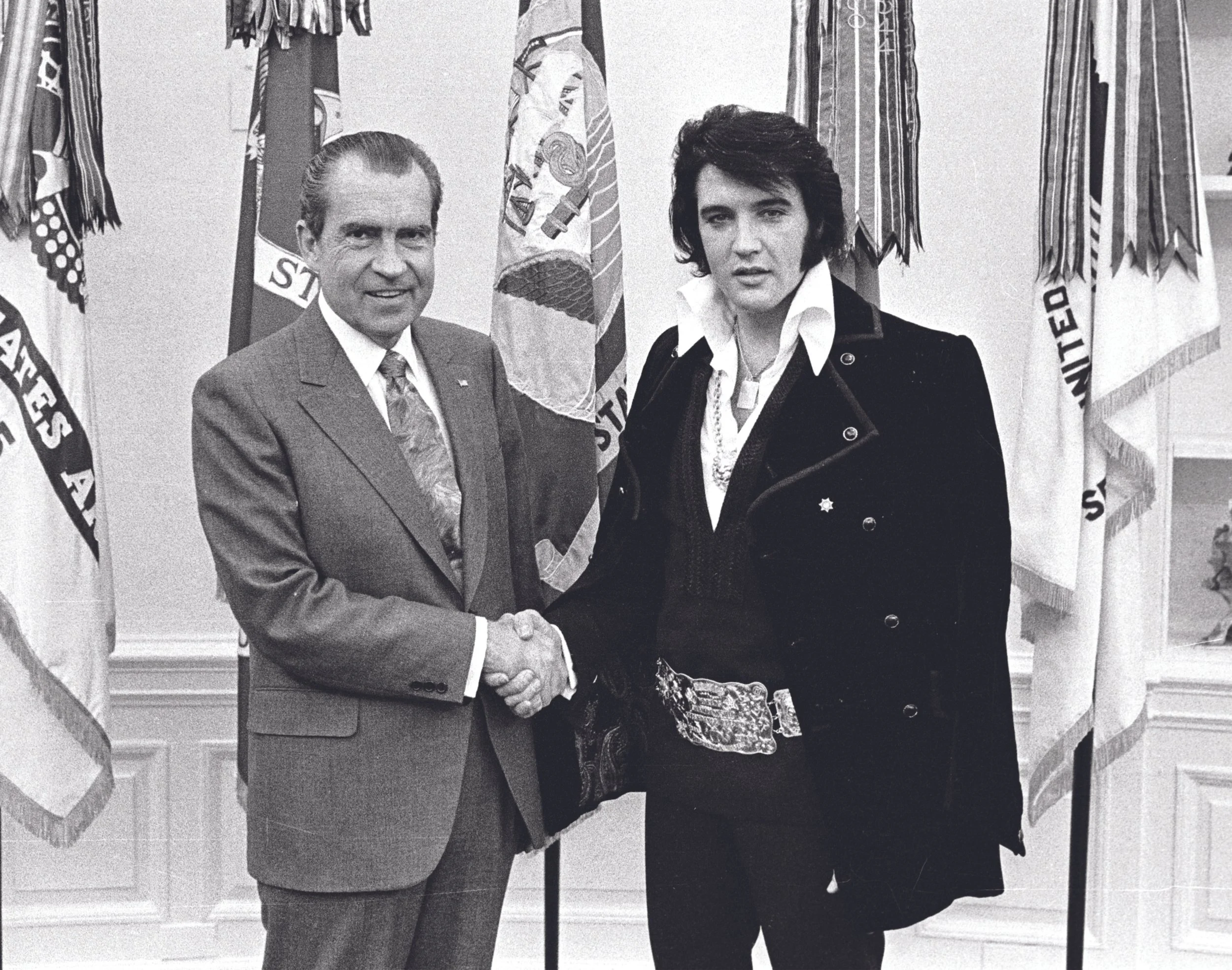
The King of Rock ‘n’ Roll meets the 37th President of the United States in the Oval Office. In this coming together of worlds, Paul Simpson builds a story of politics, pop culture, and a shared love of gridiron. It all starts with one famous photograph.
Words: Paul Simpson | Pitch Issue 17Elvis Presley was a king on a mission. After storming out of Graceland, his Memphis home, angered by yet another row over his free-spending ways – he had just spent $100,000 on guns and Mercedes cars as Christmas presents – he, and two of his aides, Jerry Schilling and Sonny West, met in Washington DC to see if he could persuade someone in power to give him a Drug Enforcement Agency badge. An avid collector – of guns, books, women, and memorabilia (particularly if it was connected to the police and American football, his favourite sport) – he was determined to get a real agent’s badge, not one of those phoney honorary ones.
On the flight to the capital, he met George Murphy, the Republican senator for California, who said the request shouldn’t be a problem and offered to help. Encouraged, Presley wrote a handwritten appeal to President Richard Nixon for a badge, offering to warn young Americans about the evils of drugs. The irony – that he was already probably hooked on prescription drugs to treat his various health problems – didn’t trouble him because, much like Nixon, he was a complex, contradictory man who easily passed F. Scott Fitzgerald’s intelligence test: he could hold two opposed ideas in his mind at the same time and still function. That said, fearing he might be out of his depth, he showed the letter to Schilling and asked for his suggested changes. As his aide told me in an interview for a book I wrote on Presley in 2002, he read it, was tempted to say something, but then reflected: “It was just so sincerely Elvis, I told him it was fine.”
That letter would lead, on 21 December 1970, to one of the most remarkable meetings in the cultural and political history of America. The photograph of Presley and Nixon shaking hands is the most requested document from the American government archives – even more popular than the US Constitution – but, in one sense, the encounter was a missed opportunity, because American football, the sport that president and singer were most passionate about, was never mentioned. Both men had divided loyalties. Nixon supported the Washington Redskins and Miami Dolphins, while Presley loved the Cleveland Browns and Pittsburgh Steelers, but they both knew the sport inside out.
Instead, they discussed the Drug Enforcement Agency badge (which Presley got), social divisions in America and the Beatles. Nixon was surprised to hear his guest suggest that the Fab Four were “promoting anti-American spirit”. It’s not clear if the singer sincerely believed this, but it didn’t stop him welcoming George Harrison’s frequent visits to his dressing room, nor did it deter Harrison, John Lennon and Ringo Starr from subsequently watching him in concert.
When Nixon remarked on his guest’s outfit – he had arrived resplendent in a velvet suit, high-collared shirt, amber sunglasses, gold buckled belt and cane – Presley replied: “Well Mr President, you’ve got your show, and I’ve got mine.” After presenting his host with signed family photos and a vintage Colt 45 pistol, he was a bit underwhelmed by the gifts offered to his aides. As Schilling told me: “He just went behind Nixon’s desk and pulled the drawer out, saying ‘They’ve got wives, Mr President’.” Embarrassed, the president found some more suitable souvenirs.
This historic encounter, which still, 45 years later, feels like a snapshot from a parallel universe, had been pencilled in for five minutes but they got on so well it lasted for half an hour. Schilling felt that, in that time, president and star had bonded emotionally, possibly because, in his words: “They were two middle-aged men who were at the top of their field but slightly past their professional peak who shared a certain loneliness.”
Presley’s attachment to American football ran too deep to be a gimmick. He would never, as self-proclaimed Everton superfan Sly Stallone notoriously did, predict that the Toffees would beat Norwich City 17-0 and ask: “Is that too much?” The most compelling physical evidence of the singer’s passion is the TV room at Graceland, the mansion in Memphis, Tennessee, purchased in 1957 at the behest of his parents, Vernon and Gladys, who had come to resent being called “white trash” by their previous neighbours in the suburbs. In the mid-1970s, Presley and his then girlfriend Linda Thompson, refurbished almost every room in the house. The centrepiece of the TV room, decorated in startling blue and yellow, were three TV screens on which, with the sound turned off, he could watch games simultaneously. He got the idea when he heard that former president Lyndon B. Johnson used to watch all the main news networks at once on three TV sets in the White House.
In a 1962 interview, Presley said: “I know all the players, I know all their numbers, who they play for. I’ve had people quiz me on it, but the thing I keep up most with is professional football.” That was no off-hand remark. Although Gladys, according to Angie Marchese, who manages the Graceland archives, wouldn't let him play at Humes High School, this didn’t stop him organising matches on Guthrie Park, a patch of grass in north Memphis, where, as a rule, he played quarterback.
He loved the Cleveland Browns – the team sent him a tape after every game – and, in particular, full-back Jim Brown, who hung around on the set of Roustabout, one of his better 1960s movies, and guard Gene Hickerson, a childhood friend from Mississippi. When they left the Browns, he adopted the Pittsburgh Steelers, once calling legendary quarterback Terry Bradshaw to invite him to join his team either in Memphis or Los Angeles. “I was sceptical at first,” Bradshaw recalled. “But there is that specific way he spoke, and it was definitely him. Yep, Elvis. Elvis called me up and wanted me to go play football with him. And man, I still think about it now. I mean, I turned Elvis down. Not even Tom Brady can say that.”
Presley’s greatest gridiron hero – and a good friend – was legendary quarterback Joe Namath, winner of the 1969 Super Bowl with the New York Jets, who often visited him in Las Vegas. After bringing his father into the singer’s dressing room, he was astonished to see how eagerly the two men talked about football. As Namath said later: “Elvis treated my dad like he was royalty.”
In 1965, when a Nashville reporter asked Presley if he had any hobbies, he replied: “I play touch football most weekends – whether I’m in Memphis or Los Angeles – with a team of fellows. You might say that’s something I’ve always wanted to be – a football player.” He even bought the kit (also blue and yellow) for his own team(s), EP Enterprises, which played in both cities. The Sunday afternoon games were no holds barred – at Graceland, they once raised the stakes by playing with fireworks in a game which he, and the members of his entourage, the infamous ‘Memphis Mafia’ called War.
He spent much of the 1960s in Hollywood making almost interchangeable musical comedies which he described as “the Presley travelogues” – many were set in exotic locations like Acapulco, Hawaii and Las Vegas – and when the movie studios heard of his hobby, they ordered Parker to make sure he wore a helmet. This precaution didn’t have quite the desired effect. As Marchese said: “Elvis hated it, but he wore it. Then when he started wearing it, he said ‘Let’s get some pads on’ and a game that was already rugged became even more rugged.”
Among those who played regularly in these games in Los Angeles were Ricky Nelson, the 1950s heartthrob; Lee Majors, who came to fame as the eponymous hero of the Six Million Dollar Man; and Presley’s close friend Jack Lord, best known as Steve McGarrett, the incorruptible detective in the original Hawaii Five-O. In Memphis, there was a slightly different cast, including his bodyguards but also John Bramlett, a high school friend who would later play for Nixon’s beloved Miami Dolphins. As he recalled: “Elvis was a great guy, but he was just an average athlete. I thought he kind of ran like a girl. It was just a funny way he ran.”
Much like Gladys, his Machiavellian manager Colonel Tom Parker (who was actually an illegal Dutch immigrant called Andreas Cornelius van Kuijk) didn’t approve of Elvis’s hobby, and was particularly infuriated after a match in which his client broke a little finger. The singer was actually rather proud of his injury, telling the press: “I got my man – and he was just a yard or two away from the touchline – and after diving for him, my hand got buried in some mud. At first, I didn’t notice - it didn’t hurt at all – until someone told me my little finger was bent over all of the other fingers.”
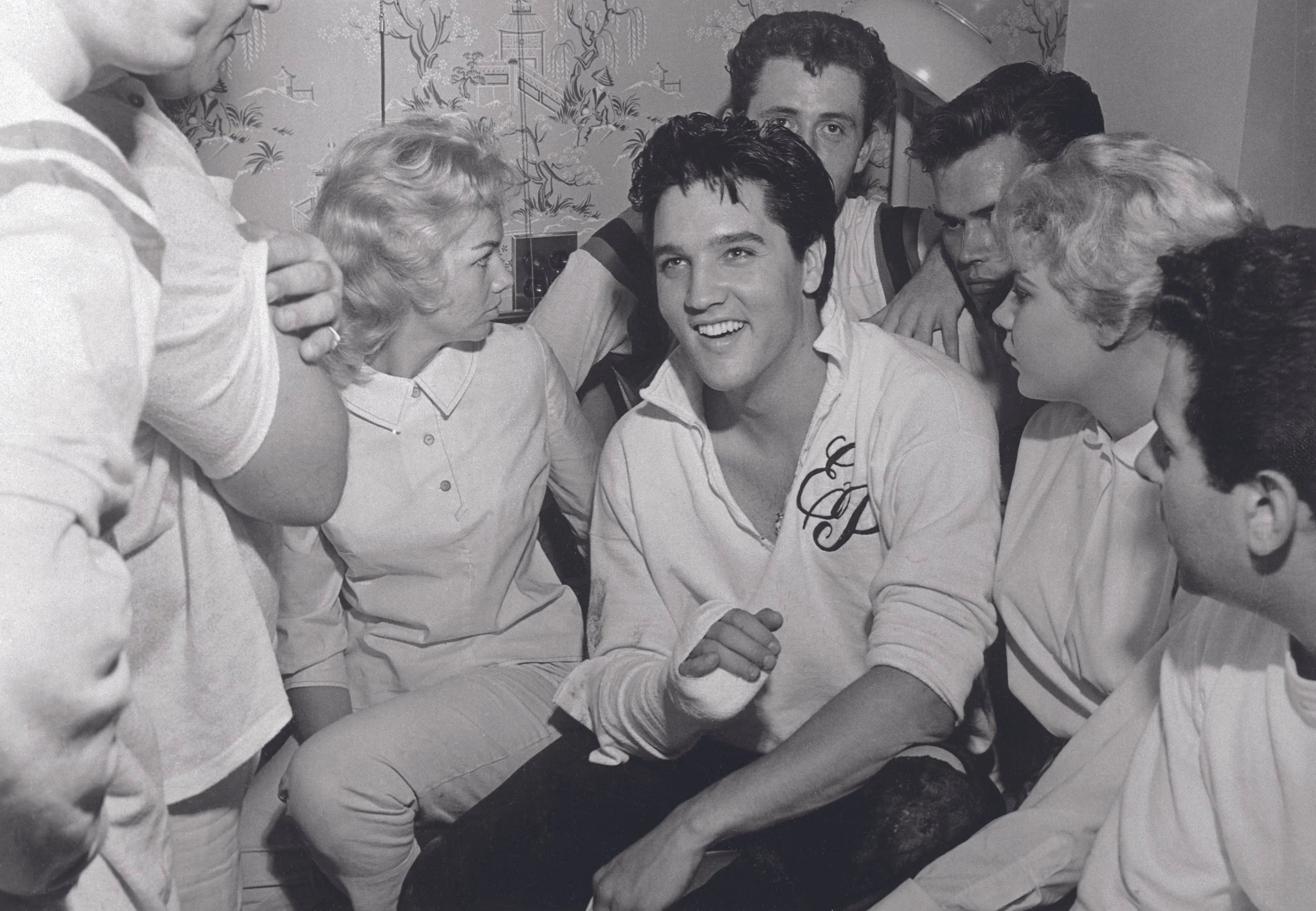
Although he added, “No, this won’t affect me strumming my guitar”, Parker was determined to make sure ‘his boy’ would never be put in such jeopardy again. As Buddy Wilson, who played on Presley’s team, recalled: “After that time, no one ever laid a finger on him.” It’s not clear whether he recognised that he was being treated with kid gloves, but what didn’t change, as Marchese noted, was that “football, and listening to gospel music, were his releases from pressure.”
Drafted into the US Army in 1958, Presley settled his nerves by playing football and was delighted to be voted the Most Valuable Player on his base in Germany. In two of his later less conventional movies – The Trouble With Girls and Change of Habit – he looks most at ease organising impromptu football matches. In the latter – his final feature film – the game scenes in Magnolia Park, North Hollywood, proved problematic for director William Graham. Presley’s co-star Mary Tyler Moore was scheduled to take part – one of Graham’s assistants said “she only has to run a bit” – but when the plot was explained to her, she looked puzzled and said: “Is that the game where the funny-shaped ball is?” A stunt double – a blonde actress wearing a black wig – was hastily hired for the long shots.
“Whatever else can be said about Nixon – and there is still serious doubt in my mind that he could pass for human – he is a goddam stone fanatic on every aspect of professional football.”
Presley’s passion for the game never dimmed, not even in the 1970s when he devoted more time to karate and the concert tours became even more of a treadmill than the movies had been. In 1974, he performed 158 times in 43 venues but still found time to invite Memphis Grizzlies players – who competed in the World Football League, a short-lived rival to the NFL – to Graceland. In return, the team’s Canadian owner John F. Bassett invited Presley to watch a game in his private box. When the star arrived, one of the Grizzlies’ staff presented him with a closed-circuit TV so he could watch instant replays. Amused, and slightly irritated, Bassett asked him: “I own this team. How come you’ve got a television for instant replays, and I don’t?” Presley just smiled and said: “It’s who you know, John.”
He enjoyed watching the Grizzlies so much that he chartered buses from Graceland to the Liberty Memorial Stadium. Their opening game against the Detroit Wheels attracted 30,000 fans. Country singer Charlie Rich, who had started out as a session musician at Presley’s first record label, Sun Studios, was hired to sing The Star-Spangled Banner before kick-off. When Rich returned to his seat, Presley, sitting next to him, remarked: “That’s a tough song to sing, isn’t it?”
Memphis has never had an established NFL team so the city’s most famous resident was never tempted, as Marchese believes he certainly would have been, to offer his tactical advice to the coach. He was, in her words, a “serious student of the game” who loved to replay key moments – not that easy when video was in its infancy – and filled notebooks with his own hand-drawn plays. One of them reads: “Center, delay, 2 counts, overshift to right, everybody go down hard, QB has to block, LBB gets the ball.”
In 2020, former NFL quarterback Peyton Manning persuaded some Memphis high school students to put these plays into practice for his ESPN series Peyton’s Place. He was intrigued that most worked. Presley died on 16 August 1977, at the age of 42. Sixteen years later, a local consortium unsuccessfully bid to join the NFL under the name Memphis Hound Dogs.
“Dingbat” That was how Hunter S. Thompson – best known as the author of the classic, possibly part-fictional, memoir Fear and Loathing in Las Vegas – habitually referred to Nixon on the Republican candidate’s press bus during the 1968 presidential campaign. As the only member of the press corps wearing a ski jacket, Levi’s, smoking marijuana and describing himself as an “openly hostile” Peace Freak, the gonzo journalist was stupefied when Nixon’s speechwriter Ray Price invited him to accompany the candidate on a drive across New Hampshire.
“We want the boss to relax,” Price told Thompson, “and he can’t do that if you start yelling at him about Vietnam, race riots and drugs. He wants to ride with somebody who can talk football. I checked around, but the other [journalists] are hopeless, so I guess you’re it.” It was hardly the most flattering offer the journalist had ever had, but he eagerly accepted, partly because, as he recalled, “I’d figured Nixon didn’t know any more about football than he did about the Grateful Dead or ending the Vietnam war.” Although the Republican had alluded to “end runs” and “power sweeps” in his speeches, Thompson’s scepticism was understandable. Nixon’s boast that he was “America’s number one football fan” sounded like the usual posturing by a politician desperate to prove he was ‘relatable’ (did that term even exist then?). It didn’t take the journalist long to conclude that: “Whatever else can be said about Nixon – and there is still serious doubt in my mind that he could pass for human – he is a goddam stone fanatic on every aspect of professional football.”
Thompson knew his stuff too. He was a fervent fan of the Oakland Raiders (who subsequently, somewhat ironically, relocated to Las Vegas), although he notoriously described his fellow fans as “beyond doubt the sleaziest, rudest and most sinister mob of thugs and wackos ever assembled in a single ‘roof’, so to speak, anywhere in the English-speaking world”. In the back of that yellow sedan with Nixon, and determined to hold his own, he mentioned a pinpoint pass in the 1968 Super Bowl (in which the Green Bay Packers beat his beloved Raiders 33-14) to Oakland’s little-known second-string receiver Bill Miller.
As Thompson recalled in his book Fear and Loathing on the Campaign Trail 1972: “Nixon hesitated for a moment, lost in thought, then he whacked me on the thigh and laughed: “That’s right, my god, the Miami boy!” The writer was left stunned that his famous fellow passenger not only knew Miller’s name but remembered where the player had gone to college.
Nixon’s passion for American football began at high school and Whittier College in his home state, California. As he recalled: “As a 150-pound seventeen-year-old freshman, I hardly cut a formidable figure on the field, but I loved the game. There were only eleven eligible men in the freshman team so despite my size and weight I got to play every game and wear a team numeral on my sweater. But for the rest of my college years, the only times I got to play were in the last few minutes of games that were safely won or hopelessly lost.”
He gave up football for law and politics, but there is a sense in which, like Tom Buchanan, the careless villain in F. Scott Fitzgerald’s novel The Great Gatsby, he drifted on “seeking, a little wistfully, for the dramatic turbulence of some irrecoverable football game”. In July 1971, 11 months before the Watergate burglary that ultimately led to his downfall, Nixon told ABC TV sports commentator Frank Gifford, “I have often thought that if I could live my life over again and did not go into politics - I would have your job, you know a sportscaster or sportswriter.”
An aficionado of the Washington Redskins, Nixon began supporting the Miami Dolphins after buying a house in nearby Key Biscayne in 1969. He was so committed to his new team that, in 1972, at around 1:30am on the day of the Super Bowl, he rang Dolphins coach Don Shula to suggest a slanted pass to gifted wide receiver Paul Warfield. Shula had already pencilled in the move, but it failed, and the Dallas Cowboys cruised to a 24-3 victory. The president did, at least, have the grace to dictate a letter assuring Shula that he would never subsequently trouble him with tactical advice before such a critical game.
One year later, he intervened, more successfully, persuading the NFL that, if the Super Bowl between his favourite teams, the Redskins and Dolphins, sold out in Los Angeles, the match could be shown live on local TV stations, a concession which, when it became official policy, boosted ratings significantly. Unfortunately for Nixon, by the time Miami won the 1973 final 14-7, he was embroiled in the Watergate scandal, which meant that the winners never paid the traditional visit to the White House.
Although the Vietnam War overshadowed – and quite possibly destroyed – Nixon’s presidency, he was so heavily influenced by his strict Quaker mother Hannah that he was convinced it was his mission to be a peacemaker. This belief inspired his historic rapprochement with Mao Zedong’s China, a startling gambit given that he started out as a vitriolic opponent of Communism and anyone he suspected of being a fellow traveller, a category which, by a strange coincidence, seemed to include every candidate who ran against him.
Kind, inhibited, paranoid and vengeful, with a severe phobia of psychiatrists (possibly because he was secretly consulting one), and, unless the subject was football, completely devoid of small talk, Nixon was almost chronically unsuited to his chosen profession. In 1968, in one meeting, keen to break the ice with the agency team managing his campaign advertising, he asked them: “Did any of you guys fornicate at the weekend?”
Thompson was not alone in wondering whether Nixon was completely human; his chief of staff Bob Haldeman privately shared the same concern. One way to obscure the politician’s eccentricities was to position him as a dedicated and discerning football fan (which, to be fair, he was). Elected to Congress in 1946 – the same year as John F. Kennedy, who would defeat him in the 1960 presidential election – Nixon seldom missed an opportunity to be photographed with a ball, player, coach or team owner, a PR strategy that became even more pronounced after 1952, when he began his eight-year tenure as vice-president, and November 1968 when he won the presidential election. At that point, as he saw it, America’s chief football fan had become the country’s commander in chief.
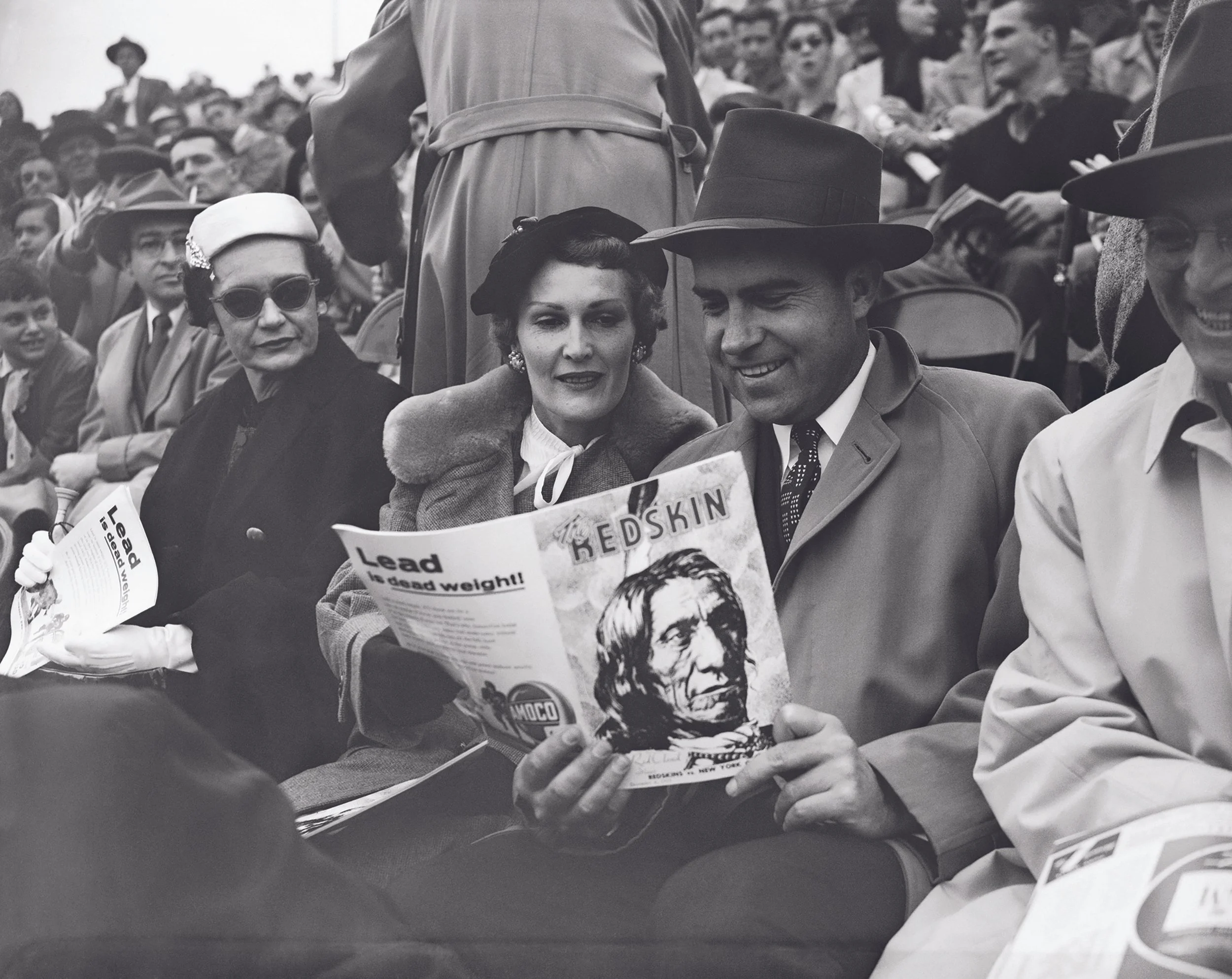
One of the few public events at which Nixon appeared completely relaxed was a Redskins game against the New York Giants in December 1955. The vice-president, sitting alongside his wife Pat, and revelling in the programme, looks, although somewhat formally attired in a hat, tie and white shirt, on the cusp of being cool, which is something he would never achieve again. As was their wont, the Redskins lost 27-20.
Almost 26 years later, the Redskins were on the verge of reaching the Super Bowl play-offs for the first time since World War II, when they lost 13-0 to the Dallas Cowboys. After being booed by their own fans, the team was in turmoil. Two days after that defeat, Nixon took up coach George Allen’s long-standing invitation to give the despairing players a pep talk. He told them to ignore the boos, adding: “A great majority of people in this town support this team. You have been good for our city.”
Over the years, he was photographed alongside the likes of New York Giants star Frank Gifford, Green Bay Packers’ quarterback Bart Starr, Chicago Bears running back Gale Sayers and a once-legendary running back called O.J. Simpson. When it comes to agony and ecstasy – and, to be honest, there was much more of the former than the latter – supporting the Washington Redskins through the 1950s to the 1970s must be akin to following the Chicago Cubs baseball team, of whom one former manager said: “Every team has a bad century.”
Nixon was a huge admirer of legendary NFL coach Vince Lombardi, who won the Superbowl twice with the Green Bay Packers in the late 1960s and, with his mantra “Winning isn’t everything, it’s the only thing” was a constant inspiration for Manchester United manager Sir Alex Ferguson. That was the kind of credo that Nixon could endorse, and in 1968 he briefly considered asking Lombardi to run as his vice-president. That tantalising prospect evaporated when an aide discovered that the coach was a Democrat.
Two years later, shocked to hear that Lombardi had been stricken with colon cancer, the President rang him to assure him that the whole of America was on his side. Touched by the call, the coach promised to fight on, but the illness was terminal, and he died, aged 57, on 3 September 1970. Giving a moving tribute at the funeral, Nixon praised his hero for building “his teams - and his life – around basic values.” That was probably, in essence, how he saw his own life and career but, less than four years later, his betrayal of “basic values” forced him to resign as president when even his own party’s senators and congressmen were threatening to impeach him.
It is at least arguable that Nixon was more scrupulous as a football supporter than as a politician. The tally of ‘enemies’ his aides prepared, although shorter than Donald Trump’s self-authored hit list, is broad enough to feature Presley’s friend Joe Namath. Contrast that to his conduct at the 1969 Rose Bowl college football final in Pasadena where he spent the first half with Ohio State Buckeyes fans and, to underline his impartiality, then crossed over to the University of South California end (Ohio triumphed 27-16). Maybe Nixon would have been better off as a sportswriter after all.
At around 6.30 am on 21 December 1970, a limo pulled up outside the White House, and Presley jumped out to hand over his handwritten letter at an entrance gate. The missive soon landed on the desk of Egil ‘Bud’ Krogh, an Elvis fan who happened to be Nixon’s deputy assistant and was trusted enough to help organise the Plumbers, a group of conspirators who disguised themselves as tradesmen to mount illegal raids on the administration’s critics (some of whom – but not Krogh – took part in the Watergate burglary).
Krogh liked the idea so much that he reportedly persuaded Chief of Staff Haldeman that Presley, who was even less likely not to be carrying a gun than travelling without a football, could bring a pistol into the White House. With Nixon lagging a long way behind every likely Democratic rival in the polls – less than two years before election day – this was too good a photo opportunity to miss.
Presley, Schilling and West arrived at the White House around noon when Krogh interrogated the singer about why he wanted to meet the president and what exactly he planned to talk about. Even though the aide accompanied Presley, Schilling and West into the Oval Office, the principals developed such a rapport that the meeting overran by 25 minutes, which would have seriously disrupted the president’s timeline. In a way, Krogh got off lightly: who knows how long their conversation would have lasted if they had discussed American football?
After the meeting, plans to give the singer a whirlwind tour of the White House were scrapped because so many staff – including one secretary who snatched a cheeky kiss – ran out of their offices to catch a glimpse of him. Things only calmed down when Elvis literally left the building.
Nixon and Presley could well have resumed their friendship in 1974. With the president’s Republican colleagues in the Senate and House contemplating impeachment over Watergate and the subsequent cover-up, the administration desperately needed an event to change the narrative. Inviting the singer to perform at the White House seemed an attractive option. True, he wasn’t topping the charts as often as he used to, but he was selling out concerts across the South, West and Midwest, regions in which Nixon retained some support, and he was still the most famous living American.
Such wishful thinking foundered on Parker’s insistence that ‘his boy’ be paid $25,000 for this appearance. Although the Nixon administration had paid much smaller fees, frequently, to people for various nefarious activities, officials baulked at this. It is not clear what Presley thought of this idea – or even, given Parker’s secretive methods, whether he was aware of it – or whether his manager really wanted the money (he usually did) or to distance his client from a president who resigned in disgrace on 9 August 1974.
One particular memory of that extraordinary meeting of strangers in December 1970 has always stuck in Schilling’s mind: “Nixon was a very private man and, at the end, when Elvis walked across and hugged him, I thought his aide [Krogh] was going to pass out.” With that simple, expansive gesture, Presley had done something Nixon’s mother Hannah never had: give the 37th president of the United States a hug.