

Moving House
Words: Kieran Longworth | Pitch Issue 17
The very concept of a sports team changing its location and moving onto pastures new – sometimes overnight, and often to another city or state entirely – feels wholly unsettling to a viewer from the other side of the Atlantic. And, it seems, those who are well used to the happenstance. Commissioner of the NFL, Roger Goodell, said moves like this “are painful for our fans,” on the dawn of the Chargers moving from San Diego to Los Angeles in 2017. “They're painful for the communities in general, they're painful for the NFL, and so we always work to avoid that, and tried in San Diego.” To no avail.
Despite the NFL offering $300 million into the Chargers’ coffers to bridge the gap and build a new stadium, on January 12, 2017, the Spanos family left their home of 51-years and became the 21st franchise to move in the league’s then-97-year history. Leaving the wider community “disappointed”, according to Goodell. And according to them, the fans – a Steven Johnson burning memorabilia – “broken-hearted”.
There has, of course, been the occasional relocation outside of North America, though these are few and far between. The relocation of Wimbledon FC to Milton Keynes in 2003 is the most obvious example in the British Isles. The south London club's 56-mile move to Buckinghamshire eventually resulted in its rebranding as MK Dons. Transplanted to a distant location, the Vinnie Jones-inspired 'Crazy Gang' – 1988 FA Cup winners – now lives on in the fan-owned AFC Wimbledon, formed in its wake, and still playing at SW17. The Wombles now play a division above their usurpers in Milton Keynes, having won promotion to League One via the play-offs in May 2025. A marker of the younger sibling’s ongoing struggle to find their feet.
Second on this fabled naasughty list – second being the worst in this case – are six-time English champions, London Wasps. Their fateful move up the M1 to Coventry in December 2014. Which also landed on deaf – if not cauliflowered – ears. Another financially inspired move, the club was operating at a heavy loss while playing at Adams Park in High Wycombe. And following their departure, said finances didn’t get much better. The two-time European champions went into administration in October 2022 and have not played professional rugby since.
Examples outside of those ‘big two’ are few and far between. You have to go back as far as Woolwich Arsenal’s shift from Plumstead in south-east London to Highbury in the north to find a move that could genuinely be deemed as successful. Facing near-bankruptcy and dwindling attendances at the isolated Manor Ground, chairman Sir Henry Norris orchestrated the move to secure the club's financial survival and tap into a larger fanbase. A collective that has since welcomed 49 major domestic and international trophies – their latest the Premier League in 2026; the first was the 1930 FA Cup.
Such winds of change blow much stronger across the Atlantic. Of the 22 teams to uproot and move house since the NFL's founding, roughly half have done so after the AFL-NFL merger in 1970. Several teams have done it more than once. The Oakland Raiders – who have called Oakland, Los Angeles and Oakland home again before arriving in the Nevada desert – are the sport's most experienced relocators. And yet, unlike their English counterparts, the franchise’s strategy – for want of a better word – seems to be proving a fruitful one.
Their latest move in 2020 to Las Vegas was part-inspired by $750 million in public subsidies (the largest stadium contribution in American history at the time), raised via a hotel room tax rather than any direct levy on local residents. No doubt hastened by years of failed efforts to replace the ageing Oakland Coliseum, such an offer was presented to help build Allegiant Stadium – the $1.9 billion state-of-the-art, 65,000-seater positioned just off the Las Vegas Strip. And with seasonal returns of $832 million, owner Mark Davis will be counting his lucky stars. Or chips for that matter.
In more recent advancements, and exactly 105 years since they became the first team to ‘move house’ (from Decatur, Georgia) in 1922, there exists a very real possibility that the Chicago Bears will relocate to Hammond, Indiana in the not-too-distant future. And that’s despite the city of Chicago throwing its considerable weight behind an attempt to keep the Bears at Soldier Field, the NFL team’s base since 1971.
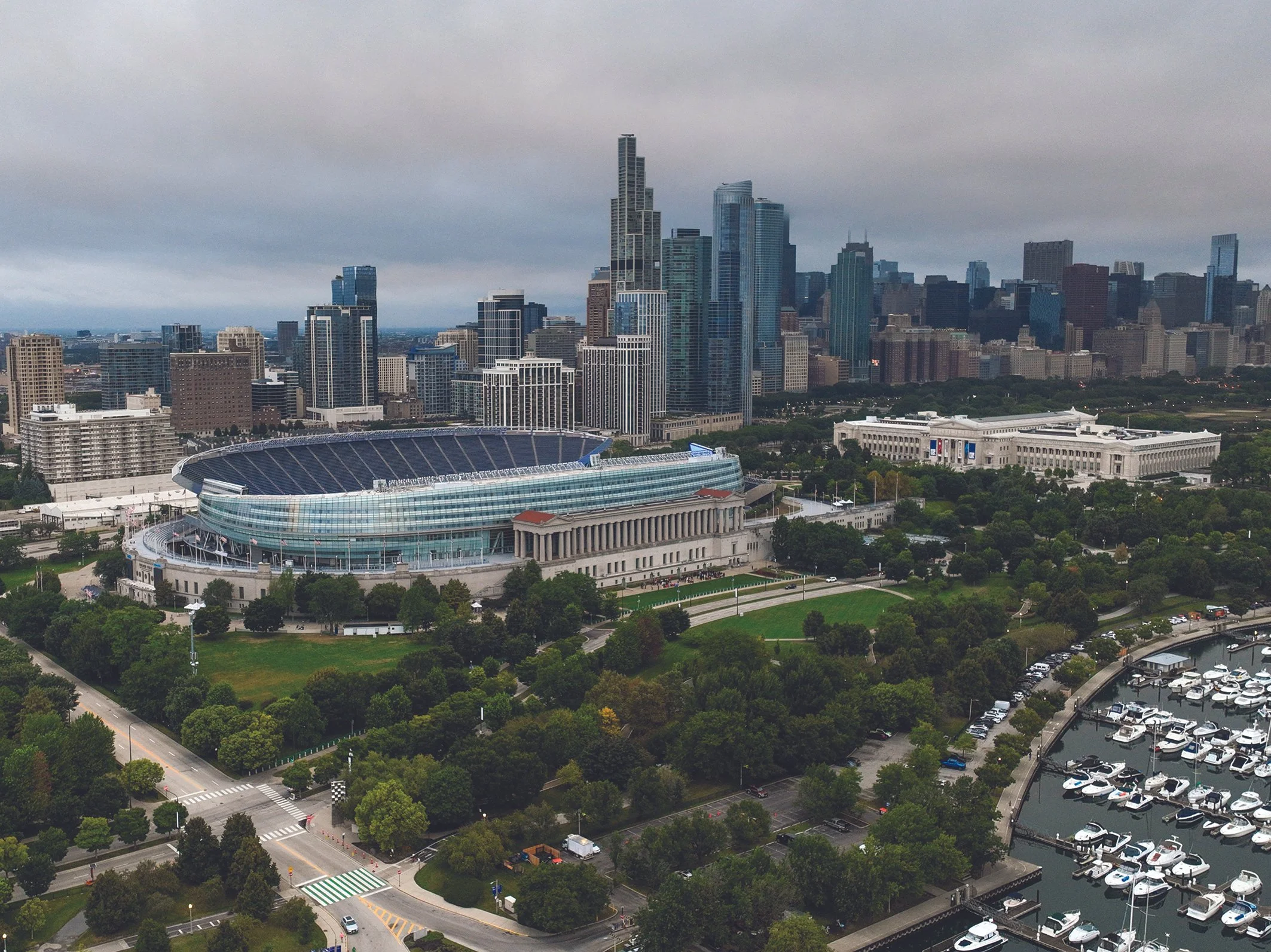
For some more history, the Bears started life in the NFL as tenants at Wrigley Field, sharing the baseball cathedral with the Cubs for 50 seasons before the league insisted all teams play in a stadium with a capacity of at least 50,000.
So, in 1971, the then-George Halas-owned franchise decamped to Soldier Field, where they’ve been ever since – save for a season-long sabbatical in 2002 to the University of Illinois during renovations. And much like London Wasps were, they are renting their space.
“Sports in America should be about more than just making billionaire owners even richer”
Prime football real estate, ‘The Mistake by the Lake’ is neoclassical by design, on the downtown lakefront, with impressive views of one of America’s most recognisable skylines. Whilst appealing, the lease terms say otherwise; the city park district (which owns the stadium) has offered little to sweeten the deal over the past 50 years, and the Bears – playing in the league’s oldest and smallest stadium while representing its third-largest market – have, ultimately, outgrown the place.
So, the Monsters of the Midway are doing what anyone else would do in this situation: exploring their options, searching for a forever home outside the city. Over state lines. In Indiana.
It will cost the Bears $84 million to break their 2033 release clause early and, unsurprisingly, the proposed move – despite it being only 30-minutes down the I94 – has garnered attention from higher powers.
If US Senator Bernie Sanders and US Congressman Greg Casar have their way, the Bears’ ownership – or any major professional sports ownership group considering relocation – would have to think twice.
In March 2026, Casar and Sanders proposed the Home Team Act, which would require owners of professional sports teams to give local communities a one-year opportunity to buy the team before relocating it. The model, it must be said, shares (albeit more litigious) parallels with the aforementioned formation of AFC Wimbledon. And perhaps closer to home, the Green Bay Packers, who have been a publicly owned, non-profit corporation since 1923.
“Sports in America should be about more than just making billionaire owners even richer,” Casar said upon launching the bill in March 2026, having heard the news of the Bears’ proposed migration. “Far too many Americans know the pain of losing a team, and far too many communities have had to fork over billions in subsidies just to keep an already profitable team home. Our bill is about creating a level playing field so leagues work for fans and taxpayers, not just owners.”
One of those Americans is Sanders, a Brooklyn native and a childhood fan of the Dodgers. In 1957, the team announced it would move to Los Angeles. “There was a joke in my Flatbush neighbourhood that the three worst people in modern history were Adolf Hitler, Joseph Stalin and (former Dodgers owner) Walter O’Malley, and not necessarily in that order,” he said earlier in 2026.
Sanders was only 16 when the Dodgers packed up for the West Coast, and it's not hard to draw a line from that Flatbush heartbreak to the anti-corporate streak he's since built a career on in Washington. The Home Team Act is, in many ways, that scar tissue made into legislation. Owners would be required to give a full year's warning before relocating, with ‘relocating’ defined broadly enough to catch any move across state lines or into a new metropolitan area – shielding fans from the shock of losing a franchise overnight, and taxpayers from being strong-armed into bankrolling the next big subsidy.
As it stands, for almost every sporting franchise in the US apart from the Green Bay Packers, relocation remains a very real possibility. For the most part, it’s a calculation made by billionaire owners in pursuit of the profits of tomorrow, with little thought given to those left behind. To give more weight to the winners and losers, here’s a breakdown of five of the NFLs infamous moves, fought – as often as they have been – both in the courtroom, at stadiums, and over state lines. With this being in chase of a greater slice of the American Dream, and a greater slice of the proverbial pie. Or pigskin, for that matter.
Midnight Mayflower
The Indianapolis Colts
Relocation: Baltimore to Indianapolis (1984).
Let this be the platonic ideal of an American sports relocation – making the Chicago Bears’ quiet trudge down the I94 look almost courteous by comparison. On the night of 28 March 1984, with snow coming down over Maryland, fifteen Mayflower removal trucks rolled into the Baltimore Colts' Owings Mills complex. By sunrise, the franchise had left the city that it had called home for the best part of three decades.
The trigger for such a heist was legislative. Baltimore's stadium had grown old, talks of a replacement had grown older, and the Maryland Senate was about to pass a bill letting the city seize the Colts by eminent domain – essentially nationalising the football team to stop it leaving. Owner Robert Irsay – already courted by Indianapolis with the Hoosier Dome stadium and loan of $15 million – wasn't, in his words, “about to find out if the threat was serious.”
The American businessman got on the phone to a friend of the Indianapolis State, and owner of Mayflower Trucks John B. Smith. And the rest, as they say, is history.
That fateful night, the trucks left by separate, circuitous routes to dodge state troopers – some drivers reportedly didn't know their soon-to-be-famous destination, some 600 miles away, until they'd loaded the van. Such a level of secrecy had everyone in the dark. Even Smith told Indianapolis Mayor William Hudnut – then neighbours – at the time, “I feel just like Dwight D. Eisenhower on D-Day. I know my troops are out there. I just don’t know where they are.”
The emotional fallout was instant and, in Baltimore's case, generational. At Johnny Unitas's bar, ‘The Golden Arm,’ a local TV reporter sent to gauge reaction found the waitresses in tears before she'd even ordered a coffee. Mayor William Schaefer, hearing the new owners intended to keep the Colts name, sniped that there was “something obnoxious” about the idea of an Indianapolis Colts at all. Indianapolis, for its part, simply hadn't dared believe its luck – Mayor Hudnut made the move official at a press conference with what amounted to, by all accounts, an ear-to-ear grin. The team's name and colours, he said, had been chosen, in part, because the Hoosier Dome's seats already happened to be blue and white.
The Colts wouldn't win a Super Bowl in their new home until 2007, by which point an entire generation of Hoosiers had grown up with Peyton Manning rather than Johnny Unitas as the face of the franchise. Baltimore, meanwhile, spent twelve years as America's most prominent footballing widow before the NFL essentially apologised with the Browns' relocation in 1996 – a franchise that itself won two Super Bowls within Baltimore's first two decades back in the league.
Dithering
The Baltimore Ravens (formerly the Cleveland Browns)
Relocation: Cleveland to Baltimore (1996).
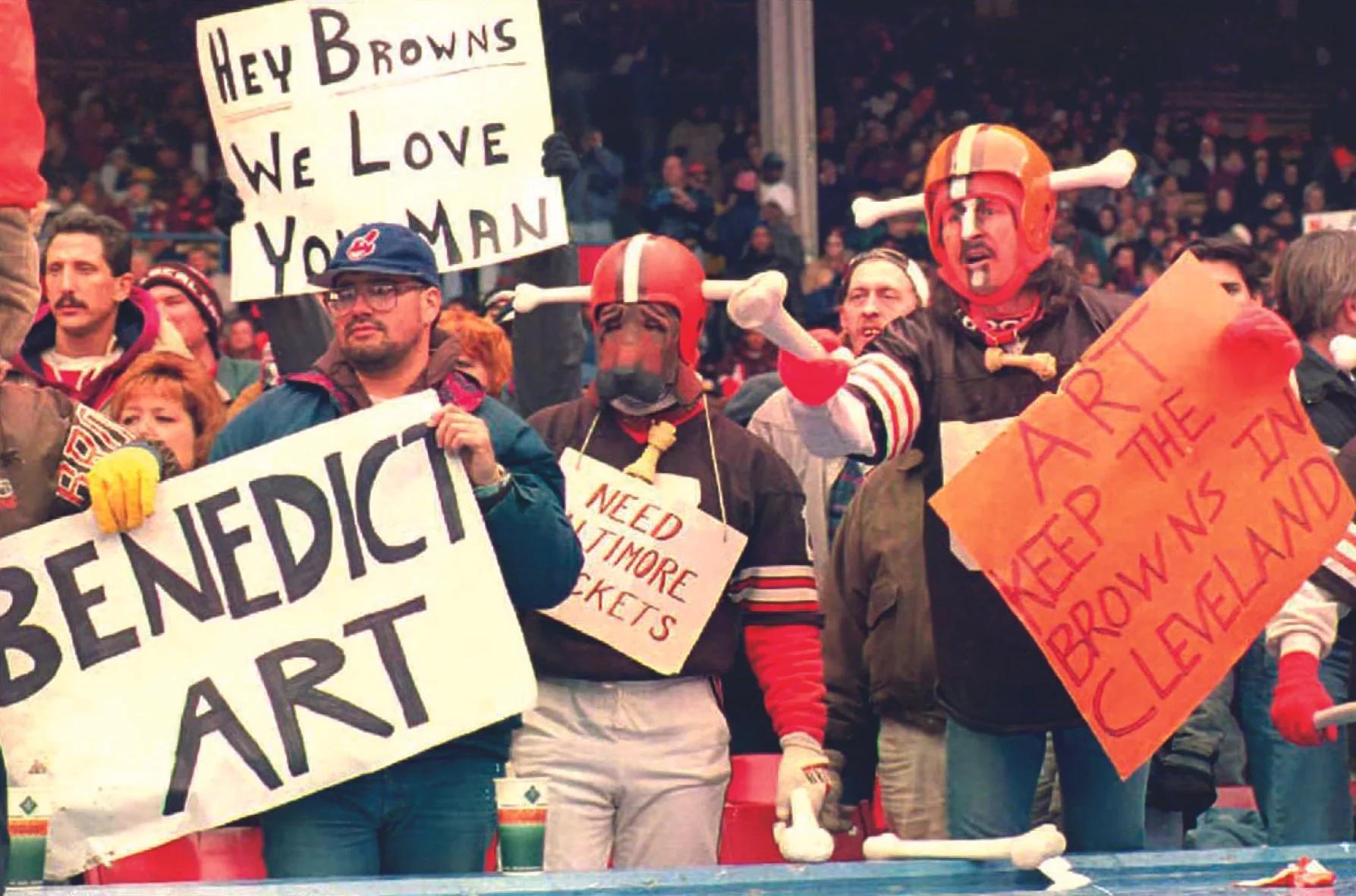
Where Irsay moved in a single, snow-blown night, Art Modell took the agonising route. After years of stadium negotiations, at a $20 million annual operating loss that the Cleveland state had failed to address, the advertising executive had had enough. That’s despite his rather nasty habit of publicly insisting he had no intention of leaving right up until the moment he announced he had already signed the paperwork to go.
The killer detail, and deciding factor, was that Cleveland voters had approved a tax increase to fund stadium renovations the day after Modell's announcement. He pressed ahead regardless, telling reporters “the bridge is down, burned, disappeared. There's not even a canoe there for me.”
Lawsuits, congressional hearings, a Sports Illustrated cover depicting Modell punching a fan drawn as a dog (a nod to the Browns' famous ‘Dawg Pound’), of course followed. Such legal fallout produced one of the stranger compromises in American sports history. The NFL let Modell take his players and staff to Baltimore as the new ‘Ravens’, but forced him to leave the Browns' name, colours and history behind, frozen in trust until Cleveland got a replacement expansion team in 1999.
It also produced Ohio's ‘Modell Law’ – a legislation requiring any team using a tax-funded stadium to give a city six months’ notice, and locals first refusal to buy the franchise, before relocating. It's the closest State precedent yet to the Home Team Act now working its way through Congress, decades ahead of its time and entirely too late for Cleveland.
Baltimore, naturally, didn't share the heartbreak; this was a city still nursing its own Colts-shaped wound from 1984, suddenly handed a fully formed roster for free. The Ravens drafted eventual 11-time Pro Bowl offensive tackle Jonathan Ogden and linebacker Ray Lewis in their inaugural 1996 class, and were lifting the Lombardi Trophy by January 2001.
Modell, despite engineering arguably the most successful relocation in modern NFL history by results, never escaped Cleveland's verdict on him – he sold the team a few years later for $600 million, died in 2012, and remains, to this day, conspicuously absent from the Pro Football Hall of Fame. Proof, perhaps, that winning the business case and winning the argument are two entirely different contests.
Westward Expansion
The Los Angeles Rams & Los Angeles Chargers
Relocation: St Louis to Los Angeles (2016); San Diego to Los Angeles (2017).
Geography aside, the Rams’ and then Chargers’ respective moves were something closer to a gold rush, two franchises independently deciding, within twelve months of each other, that the most sensible business strategy was to go and stand in the same Californian field. The ever-impressive So-Fi Stadium.
The Rams, it must be said, are one of the most frequently relocated franchises, moving four times across three cities. The franchise originated in Cleveland in 1936, relocated to Los Angeles in 1946, moved to St. Louis in 1995, and returned to Los Angeles in 2016.
They went first, and went hastily. Owner Stan Kroenke's (who you might also know from his occupation of Arsenal FC) relocation application – the document NFL owners actually vote on – seemingly eviscerated the place on the way out. Branding St. Louis a ‘struggling’ city with no real population growth, days after the home of Anheuser-Busch had agreed to fund a $1.1 billion replacement stadium specifically to keep him.
Reaction was, unsurprisingly, brisk and undignified. Local podcast host, Manno & Co., crowdfunded $250 worth of manure to be mailed to Kroenke’s offices, hit their target in six hours, and followed through. Quite literally.
Owners voted 30-2 to let the Rams go anyway. Five years and one lawsuit later, the NFL and Kroenke agreed to pay St Louis $790 million in compensation. It was vindication, of a sort, though not the kind that buys back a fanbase.
The Chargers followed a year later, with considerably less fanfare and rather more discomfort. San Diego had spent over a decade failing to agree terms to a new stadium, and when the Chargers finally left, attendance at their temporary 27,000-capacity StubHub Centre often ceased to reach even that.
The City of Angels was largely indifferent to a team it hadn't asked for – them having just inherited the Rams. And in paying $645 million relocation fee for the privilege of playing to a half-empty stadium, the entire venture was eloquently dubbed a ‘post-fan experiment’ by Rodger Sherman of The Ringer in 2017. That a test of whether an NFL team really needs supporters at all to turn a profit.
In looking at the numbers, the Rams' Forbes valuation more than doubled within a few years of the move, and in 2022 they won Super Bowl LVI, at home, in their own $5.5 billion-dollar stadium. The Chargers, on the other hand, share that same stadium as tenants, and are still chasing anything resembling a home advantage.
Finances, in fairness, look better charged, the franchise generating an operating profit of $105 million in 2025, warranting a valuation of $6 billion. Snooze. And as it turns out, you might be in with a chance of winning. San Diego, for its part, has gone the post-Chargers era without NFL football and shows little appetite to fund anyone's way back.
Vegas Baby
The Las Vegas Raiders
Relocation: Oakland to Las Vegas (2020).
No franchise has moved house more than the Raiders – Oakland to LA, LA back to Oakland, and finally Oakland to the Nevada desert – and no fanbase has had more practice grieving. The Black Hole, Oakland's notoriously theatrical end-zone congregation of face-painted superfans, had already survived one departure in the 1980s. In confirming such a feeling, “it's like a spouse saying they are leaving you, again and again,” said longtime fan Marie Duplessis after the 31-1 owners' vote confirmed the move to Vegas in 2020.
The financial logic, by contrast, was almost embarrassingly straightforward. And it's worked, by the only metric ownership groups seem to care about: the Raiders were valued at $1.43 billion the year before relocation chatter began in earnest; by 2025, that figure had climbed past $9 billion.
What's odd is how thoroughly attendance is decoupled from results. The Raiders posted a 3-14 record in 2025 and still saw attendance tick upward, with roughly 63 per cent of fans at Allegiant Stadium travelling in from outside Nevada.
Inheriting the franchise from his self-made father, Al – who earned his wealth through a career in football and eventually became controlling owner of the franchise – the billionaire, on relocating, offered: “My father always said, ‘the greatness of the Raiders is in its future,’ and the opportunity to build a world-class stadium in the entertainment capital of the world is a significant step toward achieving that greatness.” Sporting or otherwise.
It's the ‘post-fan’ finance-first logic taken to its natural conclusion: a franchise that's worked out how to earn money regardless of whether the people in the seats actually bleed silver and black. On the field, the Raiders haven't reached a conference title game since their 2002 Super Bowl run. Off it, by Davis's own arithmetic, the move has been close to perfect.