

Not Operating Normally

From madness in Mexico to catastrophe in Cape Town, Paul Simpson charts the World Cup’s most curdled campaigns. We start in Cheshire with Roy Keane. Obviously.
“Mick, you’re a liar, a f***ing wanker, I didn’t rate you as a player, and I don’t rate you as a person or a manager”
This is not what any manager wants to be told by a player, let alone a talismanic midfielder and captain such as Roy Keane in the build up to a World Cup, but it is possible – let’s not put it any more strongly – that, in 2002, Republic of Ireland manager Mick McCarthy could have defused tensions with a joke, something along the lines of:
“Okay Roy, but why don’t you tell us what you really think?”
In the media-induced hysteria that precedes any mundial, such detachment is almost impossible, leaving Keane and McCarthy, as Argentinian writer Jorge Luis Borges said of the combatants in the Falklands War, resembling “two bald men fighting over a comb”. This tragicomedy prompted Keane to quit the squad. Even though Irish prime minister Bertie Ahern offered to act as a mediator, he refused to reconsider and so, when he ought to have been leading his team out against Cameroon in the Japanese port of Niigata, he was walking his dog Triggs in Cheshire, a daily ritual streamed live on various rolling news channels.
Although this clash has been interpreted as a conflict between old and new Ireland, pragmatism and purity, and the financial gulf between international and club football, it may have been sparked by the choice of location. Saipan, the largest island in the Northern Marianas, and an unincorporated part of the United States, was supposed to help McCarthy and his squad focus, far away from the madding crowds in co-hosts Japan and South Korea, but, in Keane’s view, the dearth of facilities – and cheese sandwiches every day for breakfast – was getting on players’ nerves.
To be fair to the Football Association of Ireland, many other countries have wrestled with that dilemma. Is it best to base players in the centre of the action – which could excite or distract them? Or somewhere more remote so they could bond with each other, and their coaches – or find the isolation enervating rather than energising. Indeed, you could make a case that England’s most daunting opponent in America won’t be any of the other pre-tournament favourites – Argentina, Brazil, France and Spain – but sheer boredom.
In 2010, based in the remote South African mining town of Rustenburg, England players became so fed up that John Terry complained, privately and publicly. Although coach Fabio Capello dismissed these grumbles as a one-off, Jermaine Defoe was so desperate for entertainment that he watched his strike partner Wayne Rooney’s entire wedding DVD. It didn’t help that Capello behaved like an old school sergeant major. The players were weighed every day and, by the time England were thrashed 4-1 by Germany in the last 16, goalkeeper Robert Green reckoned that three out of four of them had been told they were too fat. Only Frank Lampard’s goal – a foot over the line but not given by the officials (this was in the good-bad old days before VAR) – helped the Italian keep his job until February 2012.
The other dilemma many teams struggle with before a World Cup is selecting the right squad. If you managed Argentina in 2010, the choice between Esteban Cambiasso and Javier Zanetti, who had just won Serie A, Coppa Italia, and the UEFA Champions League with José Mourinho’s Inter, and Fabricio Colocini and Jonas Gutierrez, in decent form for Newcastle United in the Championship, seemed like a no brainer. Unfortunately for the Albiceleste, the coach making that decision was Diego Maradona. Neither Colicini nor Gutierrez featured when Germany thumped them 4-0 in the quarter-final and, given the ease with which Argentina’s defence was eviscerated, it is hard not to wonder what difference having Cambiasso in central-midfield and Zanetti as full-back or wing-back might have made.
That said, El Diego’s call looks almost rational compared to the Swedish FA’s squad for the 1950 World Cup. Sweden had won the 1948 Football Olympics in London – still the country’s only international success at senior level – but the patriotic gesture of banning players at foreign clubs deprived them of one of the most gifted attacking trios of all time – Gunnar Nordahl, Gunnar Gren and Nils Liedholm – and centre-forward Henry Carlsson. Remarkably, English coach George Raynor assembled a new side, which finished third in Brazil, giving a starring role to left-winger Lennart Skoglund who, ironically, would join Inter months later.
When a country badly disappoints at a World Cup, their coach will often, after admitting full responsibility, say it is unfair to make them the scapegoat for everything that went wrong. That is true – and, sometimes, exactly what they deserve.
Glen Hoddle being a case in point. At France 98, as Dave Bowler reveals in devastating detail in his book Three Lions on the Shirt, the manager’s shenanigans sabotaged his own team. Leaving out Paul Gascoigne was controversial but, given the star’s form, fitness, and attitude, absolutely right. Compelling players to consult his personal healer Eileen Drewery was more perplexing, as was Hoddle’s attitude to some young players. He was reluctant to play Michael Owen, describing him as “not a natural finisher who has a lot to learn” – he said much the same about Andy Cole – and telling David Beckham, who was rehearsing a difficult free-kick in training ahead of that fateful last 16 game against Argentina: “Obviously, you’re not good enough to do that skill”.
The future ‘Goldenballs’ could be petulant – as he proved when he was sent off for flicking his foot at Diego Simeone – but, after playing in every qualifier, he was mystified to be on the bench for England’s opener when Hoddle played two holding midfielders against Tunisia, a team that wouldn’t score once from open play in the entire tournament. Still reeling from being dropped, Beckham was then paraded in front of the media. After England’s defeat on penalties, Hoddle alternated between saying “Don’t persecute Beckham” and “David’s sending off cost us dearly”. That dismissal might have been less traumatic if the manager had bothered to decide who would take which penalties and made the players practice them. He insisted that you couldn’t replicate the pressure of a shootout in training in which case, as Bowler asked, “why bother training anything?”
The World Cup remains the most charismatic event in sport – almost 1.4 billion people watched the 2022 final – partly because of the mysterious alchemy it exerts on players, coaches and us as fans and partly because, as British journo John Lanchester wrote ahead of the 2006 tournament, it acts as a glorious reminder that “football is beautiful and difficult – and the two are related”. Over the history of the World Cup, geniuses such as Ferenc Puskás, Pelé, Bobby Charlton, Johan Cruyff, Diego Maradona, Zinedine Zidane, Lionel Messi and Kylian Mbappé have made the extraordinary look easy and, although we don’t quite compute all the subtleties in real time, we are still enchanted.
One thing that 22 World Cups have taught us is the importance, as Rudyard Kipling observed, of being equally unimpressed by the twin impostors of triumph and disaster. Given the mind-bending, almost inconceivable pressure teams are under, that advice can be hard to follow, as these six teams discovered to their cost.
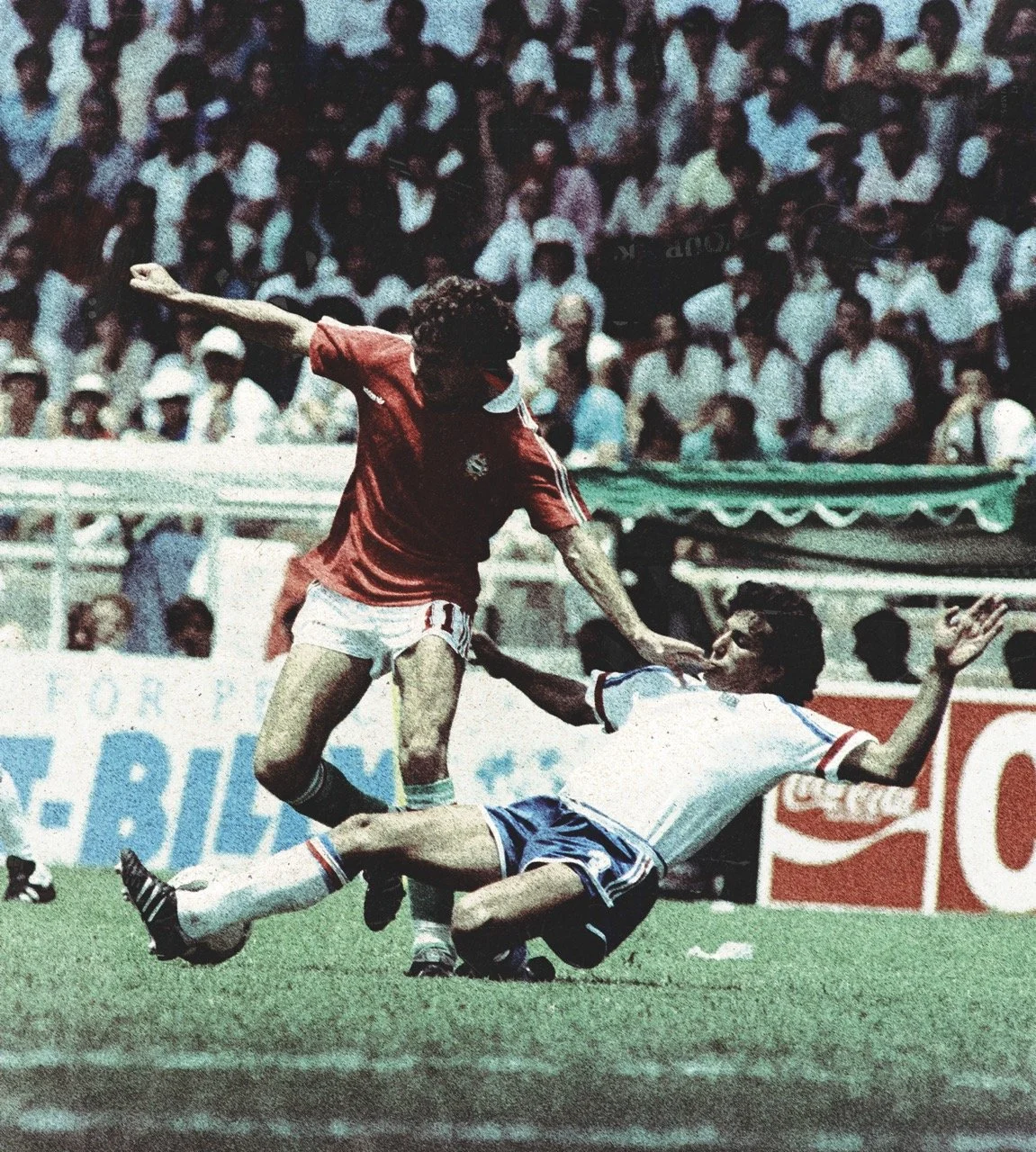
The expectations game
Hungary, 1986
Who was World Soccer’s international coach of the year in 1985? Not England manager Bobby Robson who hadn't lost a game in qualifying for the 1986 World Cup. Nor Franz Beckenbauer, who would steer West Germany to the final in Mexico. No it was – give yourself a pat on the back if you already knew this – Hungary’s György Mezey.
The choice was not as quixotic as it now sounds. The Hungarians had qualified convincingly in a tough group including Austria and the Netherlands, beaten Brazil and West Germany and, for a time, topped the FIFA rankings. In his mid-forties, with an enviable record for discovering and developing talent, Mezey was a thoughtful coach, not much given to making bombastic predictions. Unfortunately, Hungary’s media and fans were eagerly making them for him.
This was a proud football nation still traumatised by failure of its greatest team, graced by a magic quartet of geniuses – József Bozsik, Nándor Hidegkuti, Sándor Kocsis and Ferenc Puskás – to win the 1954 World Cup. The Mighty Magyars, playing in a revolutionary style that inspired Rinus Michels’ Total Football at Ajax with the Netherlands, lost the final 3-2 to West Germany (who they had beaten 8-3 earlier in the tournament). Hungarians had several, not mutually exclusive, explanations for this shock result: German centre-half Werner Liebrich had deliberately kicked Puskás (who was still unfit when he was recalled for the final); the ‘Galloping Major’s’ equaliser in the final was chalked off for an offside that no one except Welsh linesman Mervyn Griffiths could see and that Sepp Herberger’s team were given performance enhancing drugs (a charge which, dismissed as sour grapes at the time, has now been confirmed by German research).
For Hungarian fans, Mexico 1986 was the perfect opportunity to correct that historic injustice. For forward Márton Esterházy, plying his trade in Athens, 1954 certainly felt like unfinished business. He belonged to the eponymous aristocratic family and his brother, the novelist Peter, had even repeated the drugs claims in an essay for the official programme for the 1974 World Cup in Germany. In those more innocent times, his brilliant polemic was published without any FIFA mandarin even noticing.
Three factors helped to crush Hungary’s hopes in Mexico. The squad simply wasn’t as talented as their illustrious predecessors in 1954, especially after captain Tibor Nyilasi withdrew through injury. They also suffered from a powerful inferiority complex about their first opponents in Group C, the Soviet Union, which had sent the tanks to Budapest to crush the Hungarian uprising in 1956. And the players rebelled against Mezey’s dietary regime – which they regarded as pasta, pasta, and more pasta – and gleefully smuggled sausages into their hotel (in this respect, at least, they were the true heirs of Puskás who loved his food and never went anywhere without a packet of peanuts).
Hungary’s status as dark horses to win the World Cup lasted precisely five minutes, by which time Pavel Yakovenko and Sergei Aleinikov had put the USSR 2-0 up. Mezey’s team collapsed so swiftly and dramatically that he substituted defender Antal Róth in the 13th minute. If anything, the final scoreline – Soviet Union 6, Hungary 0 – flattered the losing side, with midfielder Vadym Yevtushenko hitting a penalty so high above the bar that commentators interpreted it as an act of solidarity between members of the Communist bloc. They did beat Canada 2-0 – Esterházy got on the scoresheet – only to lose 3-0 to a France team inspired by the legendary ‘Magic Square’ – Michel Platini, Alain Giresse, Luis Fernández and Jean Tigana.
The players and coaches returned to Hungary in disgrace. Mezey lost his job and when officials began clearing out his office, they were astonished at how many unopened bags of pasta they unearthed. After coaching abroad, he did return to Hungary, winning the league with Videoton in 2010/11. Looking back on 1986, he once said ruefully that he wished Hungary hadn’t qualified so easily.
A country that had high, albeit unrealistic, hopes of conquering football has never reached the World Cup finals since, which means that, depending on how you measure these things, Hungarian football is suffering from at least 40, but quite possibly 72, years of hurt.
Of mice and men
England, 2014
When England were drawn against Costa Rica, Italy, and Uruguay in Group D it was clear that D stood for death. Greg Dyke, the then FA chairman certainly thought so. Sitting alongside manager Roy Hodgson at the ceremony in the Brazilian tourist resort of Costa do Sauipe, he was caught on camera pretending to slit his own throat. Yet by the time the England squad arrived in Brazil in June 2014, the mood had changed. Normally circumspect in public, Hodgson declared that: “Anyone who thinks we can’t win the World Cup has to be barking up the wrong tree”.
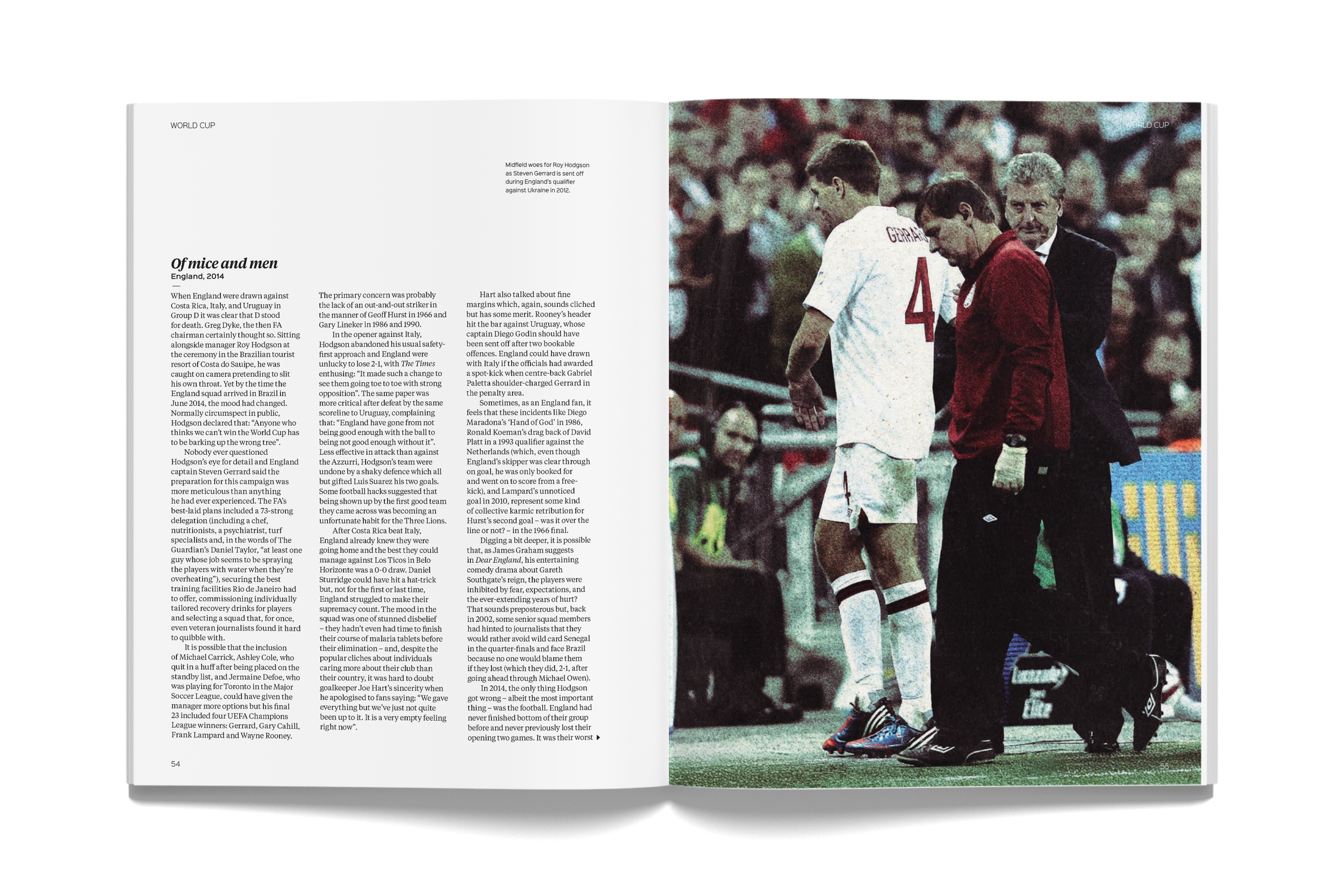
Nobody ever questioned Hodgson’s eye for detail and England captain Steven Gerrard said the preparation for this campaign was more meticulous than anything he had ever experienced. The FA’s best-laid plans included a 73-strong delegation (including a chef, nutritionists, a psychiatrist, turf specialists and, in the words of The Guardian’s Daniel Taylor, “at least one guy whose job seems to be spraying the players with water when they’re overheating”), securing the best training facilities Rio de Janeiro had to offer, commissioning individually tailored recovery drinks for players and selecting a squad that, for once, even veteran journalists found it hard to quibble with.
It is possible that the inclusion of Michael Carrick, Ashley Cole, who quit in a huff after being placed on the standby list, and Jermaine Defoe, who was playing for Toronto in the Major Soccer League, could have given the manager more options but his final 23 included four UEFA Champions League winners: Gerrard, Gary Cahill, Frank Lampard and Wayne Rooney. The primary concern was probably the lack of an out-and-out striker in the manner of Geoff Hurst in 1966 and Gary Lineker in 1986 and 1990.
In the opener against Italy, Hodgson abandoned his usual safety-first approach and England were unlucky to lose 2-1, with The Times enthusing: “It made such a change to see them going toe to toe with strong opposition”. The same paper was more critical after defeat by the same scoreline to Uruguay, complaining that: “England have gone from not being good enough with the ball to being not good enough without it”. Less effective in attack than against the Azzurri, Hodgson’s team were undone by a shaky defence which all but gifted Luis Suarez his two goals. Some football hacks suggested that being shown up by the first good team they came across was becoming an unfortunate habit for the Three Lions.
After Costa Rica beat Italy, England already knew they were going home and the best they could manage against Los Ticos in Belo Horizonte was a 0-0 draw. Daniel Sturridge could have hit a hat-trick but, not for the first or last time, England struggled to make their supremacy count. The mood in the squad was one of stunned disbelief – they hadn’t even had time to finish their course of malaria tablets before their elimination – and, despite the popular cliches about individuals caring more about their club than their country, it was hard to doubt goalkeeper Joe Hart’s sincerity when he apologised to fans saying: “We gave everything but we’ve just not quite been up to it. It is a very empty feeling right now”.
Hart also talked about fine margins which, again, sounds cliched but has some merit. Rooney’s header hit the bar against Uruguay, whose captain Diego Godin should have been sent off after two bookable offences. England could have drawn with Italy if the officials had awarded a spot-kick when centre-back Gabriel Paletta shoulder-charged Gerrard in the penalty area.
Sometimes, as an England fan, it feels that these incidents like Diego Maradona’s ‘Hand of God’ in 1986, Ronald Koeman’s drag back of David Platt in a 1993 qualifier against the Netherlands (which, even though England’s skipper was clear through on goal, he was only booked for and went on to score from a free-kick), and Lampard’s unnoticed goal in 2010, represent some kind of collective karmic retribution for Hurst’s second goal – was it over the line or not? – in the 1966 final.
Digging a bit deeper, it is possible that, as James Graham suggests in Dear England, his entertaining comedy drama about Gareth Southgate’s reign, the players were inhibited by fear, expectations, and the ever-extending years of hurt? That sounds preposterous but, back in 2002, some senior squad members had hinted to journalists that they would rather avoid wild card Senegal in the quarter-finals and face Brazil because no one would blame them if they lost (which they did, 2-1, after going ahead through Michael Owen).
In 2014, the only thing Hodgson got wrong – albeit the most important thing – was the football. England had never finished bottom of their group before and never previously lost their opening two games. It was their worst World Cup campaign since their first, in 1950, also in Brazil, when they lost 1-0 to a scratch USA team which included a postman, a schoolteacher, and a goalkeeper, Frank Borghi, who drove a hearse for his uncle’s undertaking firm. The scene of that humiliating defeat – “never before has an England team played so badly” reported The Times – was Belo Horizonte, the very city where, 64 years later, the Three Lions played out their dead rubber against Costa Rica, an ironic footnote which Hodgson, a keen student of football history, would have been aware of.
Political football
Adolf Hitler didn’t like football much. The historical records suggest that he only attended one match in person: a 2-0 defeat for Germany against Norway at the 1936 Berlin Olympics. When the Norwegians went ahead, propaganda chief Joseph Goebbels began to regret inviting his boss, noting in his diaries: “The Führer is very agitated. I’m almost unable to contain myself”. After the “football dwarfs” – as his acolytes had described the visitors – scored a second against the run of play in the 85th minute, the leader of the Third Reich had had enough, leaving the Olympiastadion at once.
Football’s sheer unpredictably infuriated Hitler but he still understood the sport’s political power. In March 1938, three months before the World Cup was due to kick off in France, Nazi Germany annexed his homeland Austria. Both countries had qualified for the finals but it was decided that only one combined team would compete. Felix Linnemann, head of the German FA, explained the situation to national coach Sepp Herberger: “In our sphere, as well as in others, a visible expression of our solidarity with the Austrians, who have come back to the Reich, has to be presented”.
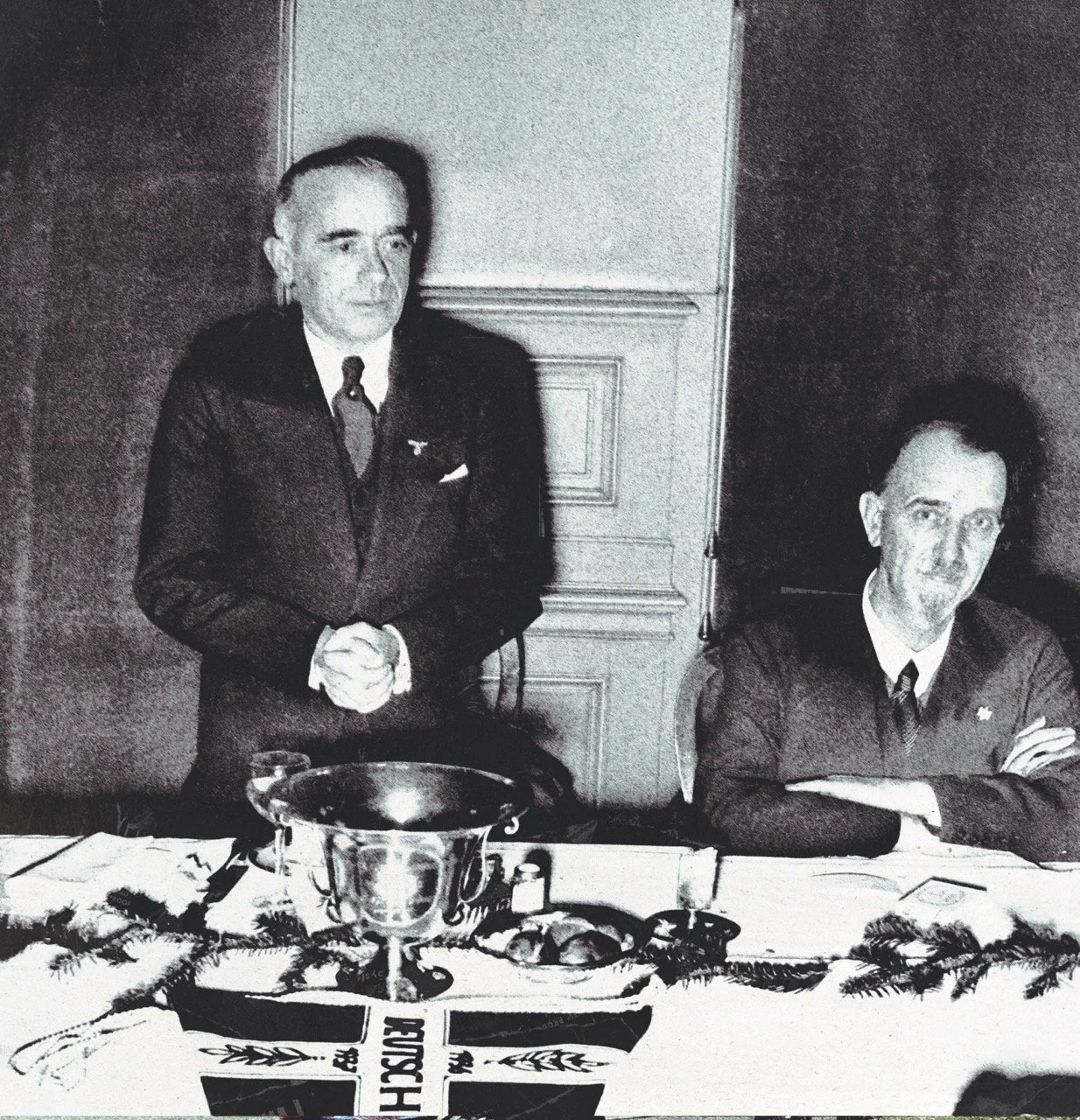
“The session turned into a polarising keepy-uppy contest between Austria Vienna’s Josef Stroh and Schalke’s Fritz Szepan which ended with the German midfielder volleying the ball against the wall just over the Austrians’ heads and whispering “You arseholes”.”
Even as a guiding principle, Herberger knew this would be a Sisyphean task. The German and Austrian footballers didn’t just come from different countries, they had graduated from different schools of football. Inspired by their legendary coach Hugo Meisl, who had suffered a fatal heart attack at work in February 1937 – he was only 55 – the nine squad members from Viennese clubs regarded football as a cerebral contest in which it was their job to out-think, out-pass, and out-manoeuvre opponents. The German style was more direct, even English, although Herberger did mix things up a bit when he took over as coach from Otto Nerz, who had paid the price for that debacle against Norway.
The squad’s first practice match was the stuff of nightmares. The coach had intended to “get the Austrians down from their high horse of superiority” but the session turned into a polarising keepy-uppy contest between Austria Vienna’s Josef Stroh and Schalke’s Fritz Szepan which ended with the German midfielder volleying the ball against the wall just over the Austrians’ heads and whispering “You arseholes”.
Despite Herberger’s earnest entreaties, playmaker Matthias Sindelar, the greatest Austrian footballer of the era (and probably of all time), refused to join the World Cup squad citing his age (he was 35) and a mysterious injury. Less than six months after the tournament, he and his girlfriend were found dead in their Viennese flat, a tragedy caused, depending on your point of view, by carbon monoxide poisoning, a suicide pact, or the Gestapo.
Officially, according to the Führer’s diktat, the new Reich’s unity was to be symbolised by a 6:5 or 5:6 ratio between Germans and Austrians in the teams. Herberger did his duty – the 16 players he used in the first knockout round against Switzerland, a country that had come to deeply resent their expanding Nazi neighbour, were divided equally between the partners in this shotgun marriage. His selections succeeded politically but not tactically. After the team had squandered a 1-0 lead to set up a replay, German journalist Christian Eichler wrote: “Germans and Austrians prefer to play against each other even when they’re in the same team And to be fair, they may have been distracted by the bottles being hurled at them by French fans. That pattern was repeated in the replay: 2-1 up with 26 minutes to go, Germany contrived to lose 4-2, and were eliminated in the first round for the first – and so far only - time.
Disgusted, dejected, and desperate, Herberger blamed this debacle squarely on the Austrians, telling his FA boss Linnemann: “During a game, they prefer to give in, rather than fight for victory”. Sixteen years later, the Austrians exacted revenge on World Cup hosts Switzerland, beating them 7-5 in a thrilling quarter-final during which their centre-back Ernst Happel sat on the ball for a laugh. Herberger - and Germany – then repaid their former compatriots by thrashing them 6-1 in the semi-final on the way to lifting the Jules Rimet trophy for the first time.
“Korea! Korea!”
Italy, 1966
If Azzurri coach Edmondo Fabbri learned one lesson from the 1966 World Cup, it should have been that, as American sci-fi novelist Robert Asprin remarked, “When things are at their blackest, I say to myself ‘Cheer up, things could be worse. And sure enough they get worse”.

After beating Chile and losing to the Soviet Union, Italy only needed a point at Middlesbrough’s Ayresome Park against North Korea to reach the quarter-finals. Having drawn against Chile, the Asian outsiders were in a confident mood but the consensus among the experts writing FIFA’s technical report on the tournament was that their greatest competitive advantage was speed. As Fabbri shared that view, his decision to select two sluggish defenders Francesco Janich and Aristide Guarneri (when he could have played Sandro Salvadore, widely regarded as one of calcio’s greatest centre-backs) and gamble on his unfit captain and right-half Giacomo Bulgarelli, struck journalists as inexplicable.
The doubters were vindicated after 30 minutes when Bulgarelli was stretchered off, injuring his knee in an attempted foul. As substitutes were not introduced until the 1970 tournament, this left Italy with ten men against a team which watching Middlesbrough fan Dennis Barry told the BBC, “Moved the ball around really well and played attacking football. They were small and that was a novelty in itself, it was like watching a team of jockeys”. Twelve minutes after Bulgarelli’s departure, Pak Do Ik – not a dentist, as the Italians claimed for years, but a print-worker – tackled the great midfielder Gianni Rivera and swept the ball into the net. Although Bologna winger Marino Perani had a hatful of chances, there were no more goals and Italy were out, to the surprise of BBC commentator Frank Bough who said: “Good heavens, they’ve won. What is going on here? This is fantastic”.
When the Azzurri landed in Genoa, they needed police protection as 700 fans hurled insults and tomatoes at them, a welcome home ritual that has since become traditional. For the next season, cries of “Korea! Korea!” could be heard on the terraces whenever any squad member was in action while Fabbri laboured under the nickname “then man called Korea”. Did this ridicule so enrage him that he lost the plot even more comprehensively than at Ayresome Park? Quite possibly. He might also have been haunted by the realisation that if Italy had played the entire game with 11 men, they would probably have reached the quarter-finals.
In a desperate attempt to salvage his reputation, Fabbri persuaded many players to sign suspiciously similar statements they had been given strange tablets, mysterious injections, or both. He then leaked this testimony to the media, horrifying many of the signatories, in an attempt to prove that officials within the Italian FA had plotted to sabotage the team to discredit Artemio Franchi, who didn’t even run the organisation at the time. After being banned for 11 months, Fabbri coached Bologna and Torino reasonably well and, until he died in July 1995, aged 73, insisted he was right, saying: “If there is no justice on this earth, then our lord will sort things out”.
Out of Africa
France, 2010
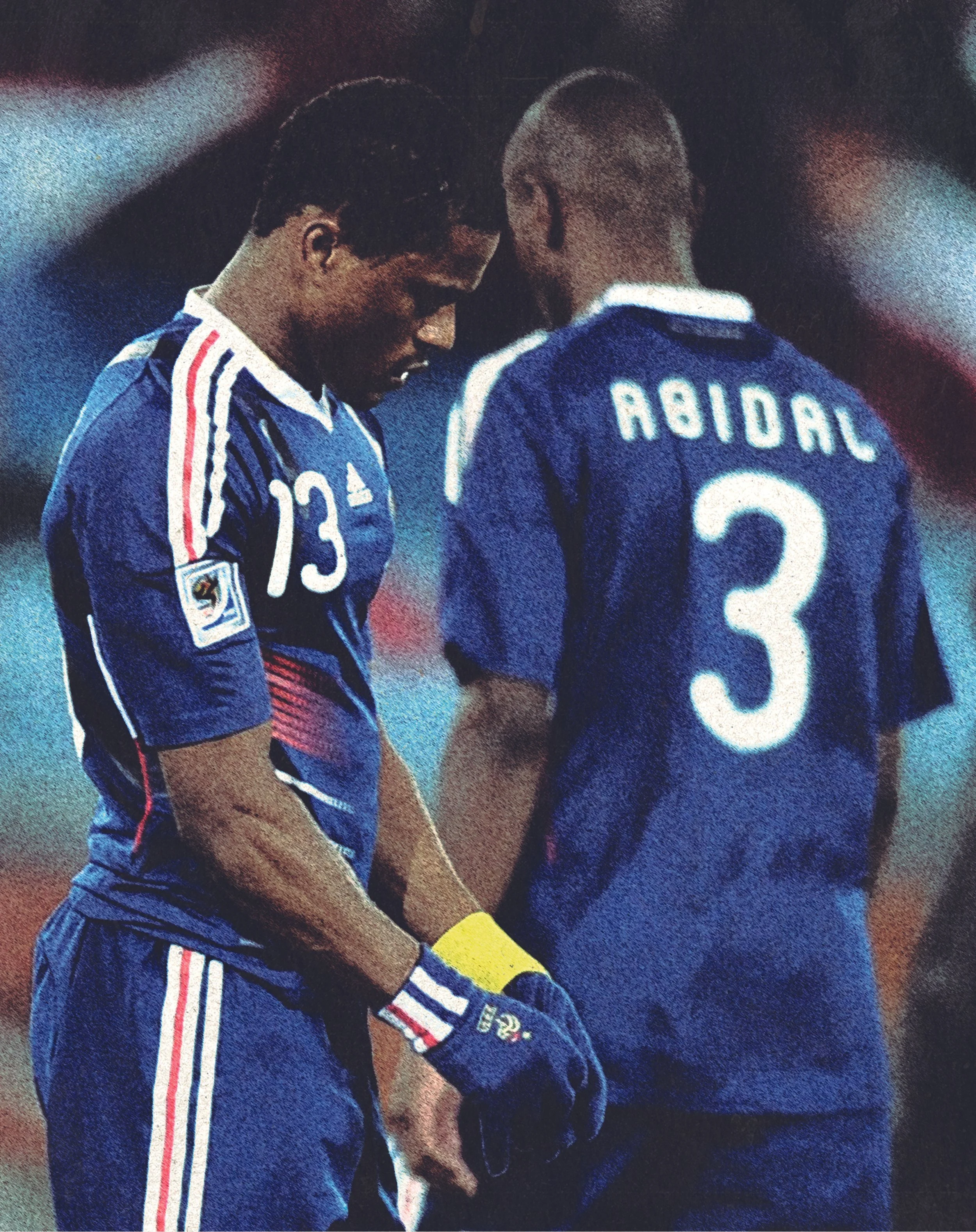
“Dad, are you going to prison?” That is what France coach Raymond Domenech’s three-year-old son asked him when les Bleus returned from a disastrous World Cup campaign in South Africa in 2010. To an impressionable child, that wasn’t a ludicrous question, given the opprobrium heaped on Domenech and his players after they had finished bottom of Group A with one point after losing competitive games against Mexico and South Africa for the first time. Many pundits agree that winning ugly is the mark of a good team and, in 2010, France embodied why nobody says that about a side that loses ugly. As the newspaper Le Parisien put it: “To have the worst side at the World Cup is unbearable. To also have the most stupid team is intolerable”.
France’s World Cup odyssey began with William Gallas crashing his dune buggy in pre-tournament training and ended with the country’s prime minister Roselyne Bachelot calling the team a “moral disaster”. Her outburst was prompted by the first players’ strike in World Cup history. Although the slogan on the side of France’s bus read ‘All together towards a new blue dream’, there was little team spirit on show in the opening match, a disappointing 0-0 draw against 10-man Uruguay. They probably had the better of the first half against Mexico but back in the dressing room Nicolas Anelka, one of a handful of players who disliked the manager, shouted at Domenech: “Go and get yourself f**ked up the arse you and your tactics”.
Anelka was substituted immediately and sent home after refusing to apologise. In the second half, few of the French players even broke sweat as Mexico scored twice. After the second goal, Domenech stood, leaning against the dugout, looking totally expressionless, a stance he maintained as France’s hopes of reaching the last 16 evaporated. He didn’t say a single word to his players, probably because he knew they wouldn't listen.
In fairness to Domenech, his eccentric behaviour wasn’t the only cause of friction within the squad. Midfielder Yoann Gourcuff was distrusted by Anelka, Gallas, Eric Abidal, and Franck Ribéry because he came from a wealthier background, was being lionised by the French media as Zinedine Zidane’s successor and, most damning of all, read books.
This sounds – and was – silly but Anelka and Ribery were conspicuously reluctant to pass to him against Uruguay. Ribéry had to go on TV and deny, not terribly convincingly, plotting against Gourcuff.
The pitch on which France were due to train next, in front of local schoolchildren, was called, with exquisite irony, the Field of Dreams. The players happily signed autographs before captain Patrice Evra accosted fitness coach Robert Duverne, accusing him of spilling secrets to the media and declaring that, in protest against Anelka’s banishment, the players would not be training. Captain and coach almost came to blows before Domenech stepped in to separate them. Although French football writer Philippe Auclair described the strike as “more of a symbolic downing of tools”, the rebels barricaded themselves inside the team bus while Duverne and goalkeeping coach Bruno Martin, with tears in their eyes, hid behind a lorry a few feet away.
Things looked to have stabilised by the time of their final game – although France, a nation that prided itself on fraternity, could only find ten players for the pre-match team photo – but after a promising start, they left South Africa’s colossal centre-back Bongani Khumalo unmarked to head home from a corner and Gourcuff was, slightly harshly, sent off for catching an opponent with his elbow when jumping for the ball. The hosts’ 2-1 victory meant that both sides were eliminated and Domenech lived down to expectations by refusing to shake hands with opposing manager Carlos Alberto Parreira.
The most dysfunctional campaign in World Cup history effectively ended Domenech’s career but his bestselling memoir All Alone shed some light on the disruption caused by players such as Anelka, Samir Nasri and Ribéry and the incompetence of the French FA, especially its head Jean-Pierre Escalettes who, the coach said, “supported me the way a rope supports a hanging man”. The most eloquent, succinct verdict on this scandal came from Domenech’s successor Laurent Blanc who refused to select any member of the 2010 squad for his first match in charge.