

Hallowed Be Thy Name
Given its appellation through jazz, Amen Corner is to golf, sport even, what Abbey Road is to music. But what makes this pilgrimage around Rae’s Creek so special? And why do the world's best still mutter their prayers when entering this unassuming stretch of three?
When Herbert Warren Wind first coined the phrase in the 21 April 1958 issue of Sports Illustrated – following Arnold Palmer and Ken Venturi's rules-related drama at the 12th – little was he aware of the consequences, both lyrical and physical, it would have on the golfing world some seven decades later. Wind had, of course, borrowed the moniker from ’30s jazz song “Shoutin' In That Amen Corner”. Which goes a little like this…
You can shout with all your might,
But if you ain't livin' right,
There's no use Shoutin' In That Amen Corner
If your name ain't on that roll,
All that noise won't save your soul,
So stop your Shoutin' In That Amen Corner
Sung by Washington’s ‘Queen of Swing’ Mildred Bailey back in 1935. This was, coincidentally, the very same year that Gene ‘The Squire’ Sarazen hit his double eagle (albatross) on the 15th. The ‘Shot Heard Round the World’, was dubbed so after it helped the New Yorker to his career grand slam (in just the second year of golf’s newest major). The year too that Augusta National decided to switch around its front and back nine, giving the course the shape it has had for 90 years since.
Bailey's song never made it as a charted hit – despite becoming a B-side for Mezz Mezzrow’s “35th and Calumet”. Still, the phrase stuck in the mind of Wind. And when, 23 years later, the writer was trying to conceive a name for the spot on the course where the ’58 Masters was won and lost, Amen Corner is where he landed.
Wind's original description, written for a ceremony dedicating bridges over Rae's Creek to Ben Hogan and Byron Nelson, sets the scene: “On the afternoon before the start of the recent Masters golf tournament, a wonderfully evocative ceremony took place at the farthest reach of the Augusta National course – down in the Amen Corner where Rae's Creek intersects the 13th fairway near the tee, then parallels the front edge of the green on the short 12th and finally swirls alongside the 11th green."
The consequence is that unlike any ‘normal’ tournament, where spectators traditionally make for the 18th green and first tee box, at Augusta ‘patrons’ – as the club insists on calling punters – start earlier than sunrise vying for a seat at the corner. Those not so fortunate make for the mound at the back of the 7th – co-founder Bobby Jones tells them to do this in his ‘spectator suggestions’, written in 1949. Remaining connoisseurs might head to the vicious par-three 4th for their viewing pleasure.
But the believers? They're bound for Amen Corner. And if Magnolia Lane is indeed ‘a cathedral of pines’, then the 12th tee is its altar. For this patch of perennial ryegrass is one of the hardest to get to on earth. The gates at Augusta National open at 8am, and the moment they do, fans break into a rapid shuffle across the course, doing their utmost not to break the rule that forbids running. By 9am, thousands of green folding seats, $30 a pop and a worthy memento, find themselves arranged around one of the best watching spots in all of sport.
Such a routine – a sport in and of itself – can only be performed, for normal folk at least, by lucky winners of the tournament's ticket lottery, where odds of successfully securing tickets are below one per cent. As for the exclusive permanent ‘patron badge’ the waiting list closed in 1978 and rarely opens.
As far as locations go, it’s a long way from the clubhouse, the farthest reach of the course, and the atmosphere favours the looser side of dignified. By the time Augusta is bathing in its auburn afternoon sun, the grass is carpeted with cigar stubs and ice tipped out of empty cups. (Those lucky enough to secure a spot have three hours to kill before the first players arrive on the tee. With no phones allowed.)
It was this very location that made the aforementioned 1958 Masters a memorable one. Picking up the tale is Wind, again, who speaking in 1984 explained that “Since the course had been thoroughly soaked by rains the night before and during the morning, a local rule had been invoked: a player whose ball was embedded in the fairway or rough was allowed to lift and drop it without penalty.”
On the 155-yard par-three, “Palmer's iron carried over the green and embedded itself in the steep bank of rough behind it,” ‘The King’ was clearly not tempted to flirt with the water – the grass was, and still is, cut in such a way to encourage balls landing short to find their way into the creek.
“The official on the hole evidently was not aware of the local rule,” Wind continued, “and he instructed Palmer to play the ball as it lay. When Palmer did this, he holed out in five, after missing a short putt. Then, politely but pertinaciously, Palmer went back to the pitch mark of his tee shot. He obviously felt that the official's ruling was not correct and elected to play an ‘alternate’ ball. After dropping the ball over his shoulder, he ran a delicate chip three feet from the cup and made the putt for a three.” An all-important par.
By the time Palmer reached the 14th, the committee had ruled that the then-28-year-old was right the second time of asking. The par stood. He picked up two shots and went on to win his first of four green jackets (1958, 1960, 1962, 1964) by one.
Wind, who had a week to write up the tournament, said he was just trying to find “some colourful tag” for that little patch of Augusta. “Like those Grantland Rice (the ‘Dean of American Sports Writers’) and his contemporaries loved to devise: the Four Horsemen, the Manassa Mauler, the House that Ruth Built, the Georgia Peach.”
The Massachusetts-born essayist posthumously reflected: “I have no idea how the name caught on. To be candid, I am delighted that it did. To be connected even in the flimsiest way with a course like Augusta National and an institution like the Masters is good for the soul.” Musical or otherwise. Wind's moniker stuck, and Amen Corner is now one of the most famous spots in all of sport.
“The name adds romance to the place,” said 1987 Masters champion Larry Mize, himself born in 1958, of its importance. “Everybody knows this course. Everybody knows Amen Corner. It's another unique thing that makes this golf course special.”
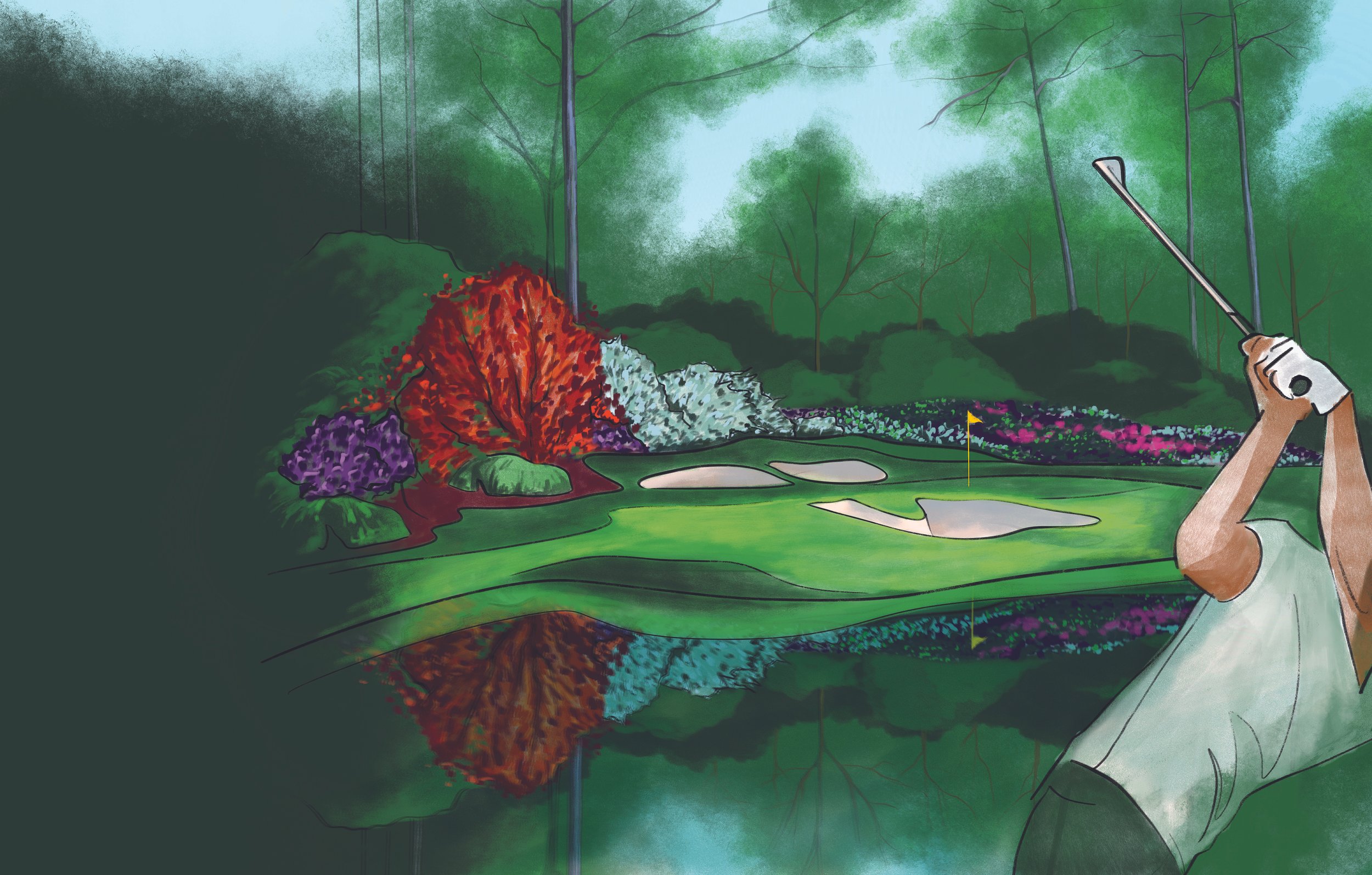
Over a stretch of holes that today bears greater symbolic resemblance to Cerberus – the three-headed hound of Hades guarding the underworld – by definition ‘Amen Corner’ covers the approach to the 11th, ‘White Dogwood’, the entirety of the 12th, ‘Golden Bell’, and the tee shot of the par-five 13th, ‘Azalea’. It's a cruel place to play, because as often as not the wind whips the flags – just a short pitch apart – in opposite directions. Plenty of great golfers have made fools of themselves down at Augusta’s lowest point.
Where its appearance has largely stayed the same since 1934, the 11th has been lengthened three times since 2002 and now plays 520 yards. It has been the most difficult hole on the course in any era, averaging 4.304 strokes. And despite the field’s technological and physical advancements, it remains the hardest on course, with a scoring rate of 4.386 in 2025.
With the long par-four presenting such a physical challenge of distance, the 12th marks more of a soul-searching psychological analysis. So much so that Jack Nicklaus, six-time Masters champion, called Golden Bell “the hardest tournament hole in golf”.
Only a par-three, and the shortest on the course, its 155-yards should be a stock shot for most. But when the pin is in the middle, tucked up by the front bunker, there’s all of nine yards of green to aim for. And to get the ball there means crossing Rae's Creek, landing short of the two sand traps at the back, which leave a downhill shot onto a downhill green. With the aforementioned water staring you right in the face.
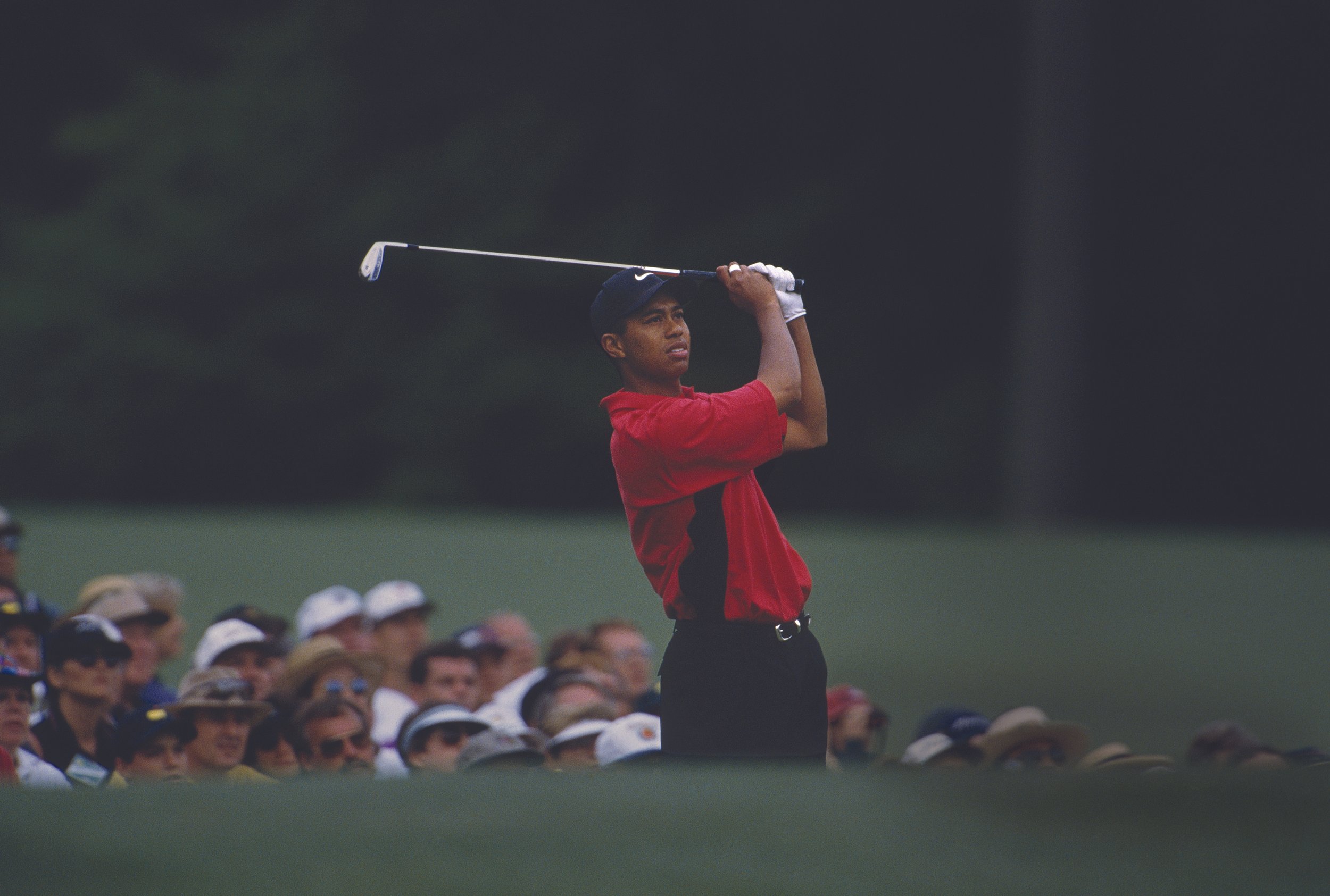
Even Tiger Woods – himself a five-time Masters champion in 1997, 2001, 2002, 2005, and 2019 – has registered a 10 on this postage stamp of a hole. His showing on the final Sunday in 2020 resulted in a closing card of 76.
“It will fool you, because the wind circles in those trees. The caddie's got to have some idea of the type of shot his player is thinking about hitting and make suggestions from that. It can go from a nine iron to a four iron. Some strong guys will even hit a pitching wedge these days.”
And despite this being his worst score on a single hole in professional golf, the 15-time Major champion does not stand alone. Sam Snead, who himself won seven majors, once took an eight at the 12th. So did Billy Casper, winner of the Masters and two US Opens. The pick of the bunch, though, will always be Tom Weiskopf, who finished second at Augusta four times. He took a full 13 at the 12th in 1980, still the record. Putting the ball in the water off the tee, the American then took five goes at pitching it from 60 yards. The first four went in the water. He ‘bounced back’ with a seven on the same hole the very next day.
Sat down in front of the telly as a hobbyist, with a different kind of wind in one’s proverbial sales, the unversed might look at this particular challenge and wonder what all the fuss is about. The peaceful surroundings, framed by Augusta's colourful azaleas, are a far stretch from the crashing Pacific on the 7th at Pebble Beach, the rolling heather-swept dunes at Lahinch, or even the islet 17th at TPC Sawgrass. Each aforementioned example enough to send a case of the shivers, or shanks, down mid-handicappers’ spines.
In an attempt to explain why Golden Bell presents such a challenge, Veteran caddie Carl Jackson – who was on the bag at every Masters tournament between 1961 and 2010 – has to be the best person to listen to. Ahead of his final showing at Augusta in 2015, with some 54 tournaments under his belt, he said "you've got to think about the wind direction, whether it's a sunny day, is it consistent, whether you got to lean on something?
“It will fool you, because the wind circles in those trees. The caddie's got to have some idea of the type of shot his player is thinking about hitting and make suggestions from that. It can go from a nine iron to a four iron. Some strong guys will even hit a pitching wedge these days.”
Further explaining the psychology of this otherwise straightforward 150-or-so yards, two-time Masters champion Ben Crenshaw thinks he has the answer. "It's immensely, almost alarmingly, quiet," the now 74-year-old said of the atmosphere on the pear-shaped green. "The only thing you can hear is your heartbeat and the heartbeats of your fellow players and caddies.
“All throughout the first nine, the players are trying to get a few strokes to cushion themselves before they go into the corner,” Crenshaw explains. “They know what can happen there, and they know what has happened there.”
Despite their challenges, the three holes have offered moments to the golfing world worth celebrating. The 13th is where fate starts to change for most. Still in view for those patrons on the 12th tee – such is the beauty of its location – Bubba Watson’s dogleg-cutting slice-drive helped secure his second green jacket here in 2015. And no shot looms larger in the corner's lore than Phil Mickelson’s ‘Miracle’ from the pine straw in 2010.
As it was, when the leftie came trudging up from the tee for to find his mispositioned ball, he sat one shot behind then- world number one, Lee Westwood. Both he and the Yorkshireman were deep in the pines and when Westwood could only ‘take his medicine’ it looked like the Californian had even less room to work with.
The longer Mickelson and then-caddie Jim 'Bones' Mackay stood talking, the more obvious it became that the perennial risk-taker – gambler even – had something else in mind. “If I'm going to win today, I have to hit a great shot under a lot of pressure,” you can hear Mickelson say through the TV. Now some 16 years on. “I'm going to do it right now.”
That great shot was a six-iron, 206 yards, downhill, over water, out of pine straw, through a gap between two trees that Mackay maintains to this day was no wider than a sleeve of balls. The ball landed softly four feet past. Despite missing the putt (it's a daft game), that was Mickelson's turning point on the way to his third green jacket. Westwood finished second. Again.
Despite its worshipful name, then, Amen Corner offers both a slice of heaven and, depending on how a player has negotiated those seven (ish) shots, a pit of golfing hell. In its very nature as ‘a thing’ the turn has become something else entirely, so much so that its reputation now feeds itself. In this impossibly small theatre the rules of the game, subtleties of weather, and human fallibilities have been well tee’d up through its 90-year history, and there’ll no doubt be more of that over the next.
So next time you watch some of the world's best roll back into the water at 12, just remember: Mildred Bailey had it right all along. “If you ain't livin’ right, there's no use shoutin’ in that Amen Corner”. Being the game’s best on reputation alone won't save your soul when the wind starts swirling over Rae's Creek.