

As It Happened…
Andy Afford takes a look at Rory McIlroy at the Masters through time. But is it Oscar-worthy?
Rory McIlroy’s relationship with Augusta National reads like a classic ‘will-they-won’t-they ’80s rom-com. Years of near-misses, fallouts and missed chances, and then finally the green‑jacket of all ‘getting together’ scenes – his metaphoric airport departure gate – happening last time out. It was a sporting catharsis that completed McIlroy’s slam in 2025. But the truth is, did we really know that they were meant for each other all along?
The love story that kept us all sleepless in Seattle,
left us restless in Notting Hill,
before making us all realise that it was,
in fact, love, actually…
Here's the love story that kept us all sleepless in Seattle, left us restless in Notting Hill, before making us all realise that it was, in fact, love, actually…
April 2009: Rookie stripes
(T20)
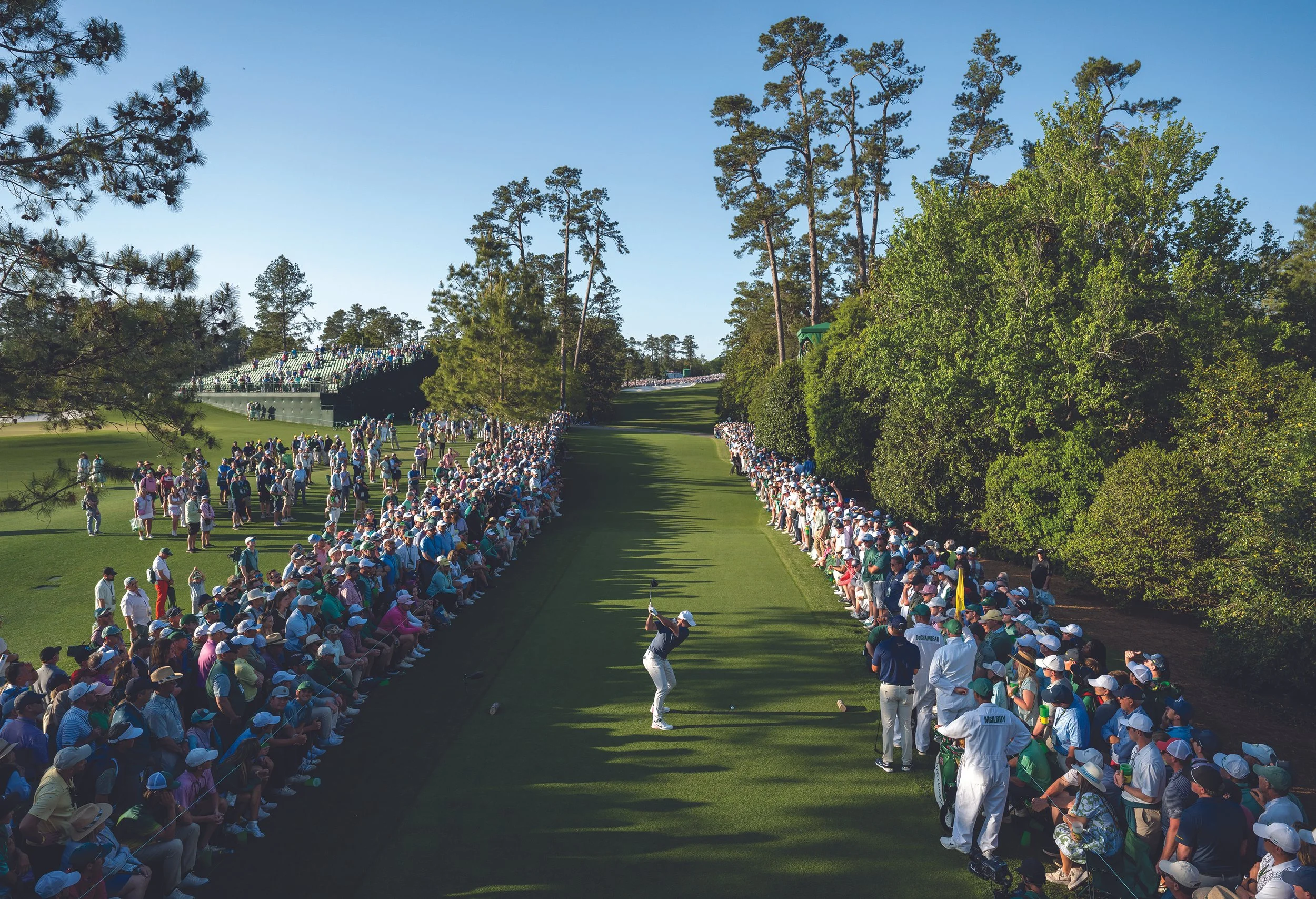
A 19‑year‑old from Holywood, County Down, arrives at Augusta as golf’s next big thing. Chubby-in-the-face, he’s all whip-cracking swings and fearless disregard for consequence. The curly-haired Northern Irishman finishes tied 20th. But in doing so, flashes a few outrageous iron shots, walking away looking good on-screen, but not really understanding what just happened. What he’d learnt was the stuff the cameras don’t let you see. That’s the severity of the slopes, the paucity of ‘safe’ areas on the greens, and the impact of the gusty Georgian breeze.
April 2010: First cut is the deepest, literally
(MC)
Year two is far less poetic. Or romantic. He misses the cut. A reminder that Augusta soon forgets you and is not impressed by potential alone. You need the ‘chops’ to back it up. He discovers the course’s far less benign ‘other personality’. The one that punishes even minor lapses in distance control and green‑reading.
April 2011: The nightmare on any street
(15)
April 7–9, 2011
The 54‑hole lead. By Saturday night he is aged 21, leading the Masters by four, swinging like Frank Sinatra, smiling like Errol Flynn, before resting up ready for the green jacket that feels almost pre‑measured, if not pre-ordained.
Through three rounds he has driven the course imperiously and treated the back nine like any other. Certainly not the sport’s most-pressurised last lap of the track, that it surely is.
April 10, 2011
He ‘hits’ cabin fever at 10. To say that Sunday begins with nerves does it little credit. A wobbly opening hole leads to an early bogey, but a 20‑footer at 7 briefly restores the illusion of calm and the reinstatement of the trademark fist pump. Then the 10th tee happens: a wild hook into the trees, the ball finishing between the rarely seen Peek and Berckmans cabins, a part of Augusta usually reserved for maintenance staff and those soaraway aerial shots. McIlroy finds himself caught on camera looking like an actor who has not only forgotten his lines, but how to act altogether. The triple‑bogey seven that follows lays claim to his round. By the time he leaves the 11th green, the lead has gone completely. As can happen. The swing has gone, which rarely happens. And the television narrative has forgotten him, for now, as ‘that bloke who could have been a contender’. Focus is on Tiger Woods and Charl Schwartzel.
A pulled tee shot into Rae’s Creek at 13 and more errors on the way home leave him signing for an 80 – his highest round at Augusta. What had previously looked somewhere between an Oscar campaign and a full-blown coronation proved neither. He’s reduced to being just another young player walking up 18, shoulders slumped, beaten by the loftiness of his own ambitions.
April 2012: The Hangover
(T40)
The physical scars – if there were any – have healed. The mental ones are not even as much as surfacing. A tie for 40th is the sort of middling finish that, on any other course, would be shrugged off as just another weekend. At Augusta – where every question is now framed by ‘2011’ – it reads like a visit that didn’t need to happen, when a quiet year in therapy and the odd metaphorical part in an off-Broadway play and a B-movie or two would have served better purpose.
April 2013: Back in the pack
(T25)
Another cut made, another weekend without even the sniff of true contention, let alone an ‘Oscar nomination’. But there is a renewed sense of recalibration: a player first learning how to hit conservative shots to aggressive pins, rather than the other way round. He’s appreciating other cast members and what their needs are. Least of all the course itself, which is in effect this movie’s lead character.
April 2014: Statistically excellent, narratively muted
(T8)
McIlroy’s 2014 major season will be remembered for Hoylake and Valhalla, not Augusta. At the Masters, he posts a tie for 8th – his best finish there to that point – in a week where he never quite threatens the leaders but quietly proves he can now stack four respectable rounds on the course that once undid him. He’s back in the game. He’s more comfortable on stage. He’s starting to appreciate it’s an ensemble piece and not a monologue.
April 2015: First real charge for a nomination
(4th)
Now a multiple major champion and world number one, he arrives in 2015 with the media machine humming. The papers are saying that this is the week Rory begins chasing Grand Slams of his own. A final position of fourth suggests proximity, but the reality is a back‑door top‑five – good golf, late surge, never quite in winner Jordan Spieth’s orbit.
2016 – 2017: Serial contender
(T10, T7)
These are the years where McIlroy becomes an Augusta constant. He’s Hollywood A-list. A winner elsewhere and always on the first three pages of the leaderboard, always requiring one fewer loose nine holes. Tied 10th in 2016, tied seventh a year after – these are numbers that would delight most players, but for Rory, do they only serve to deepen the sense of unfinished business? He has, essentially, made a string of good films, they’ve done brilliantly at the box office, he’s made a ton of cash from doing something he could surely have only dreamed of, but…
April 2018: The Sunday with (not Oliver) Reed
(T5)
If 2011 is his disaster movie, 2018 is the what‑if remake. McIlroy begins Sunday in the final group with American Patrick Reed, one shot back, the storyline primed for redemption. An early missed short putt on 2 sets the tone; off the tee he is erratic, irons a fraction off, the putter streaky rather than surgical. He closes in a tie for fifth, hands in pockets, offering congratulations with the body language of a man who knows the script is right for him. He got in shape for the role. He’d learnt the part – he’d done his research, but he fumbled his lines. Augusta – like an Oscar – was it beyond him?
April 2019: The weight of expectation
(T21)
By now, every Masters preview includes the same paragraphs: the 2011 collapse, the improving record, the missing jacket. A tie for 21st feels like treading water; he plays well in patches but never lands the run of holes that turns a Thursday or Friday into a statement.
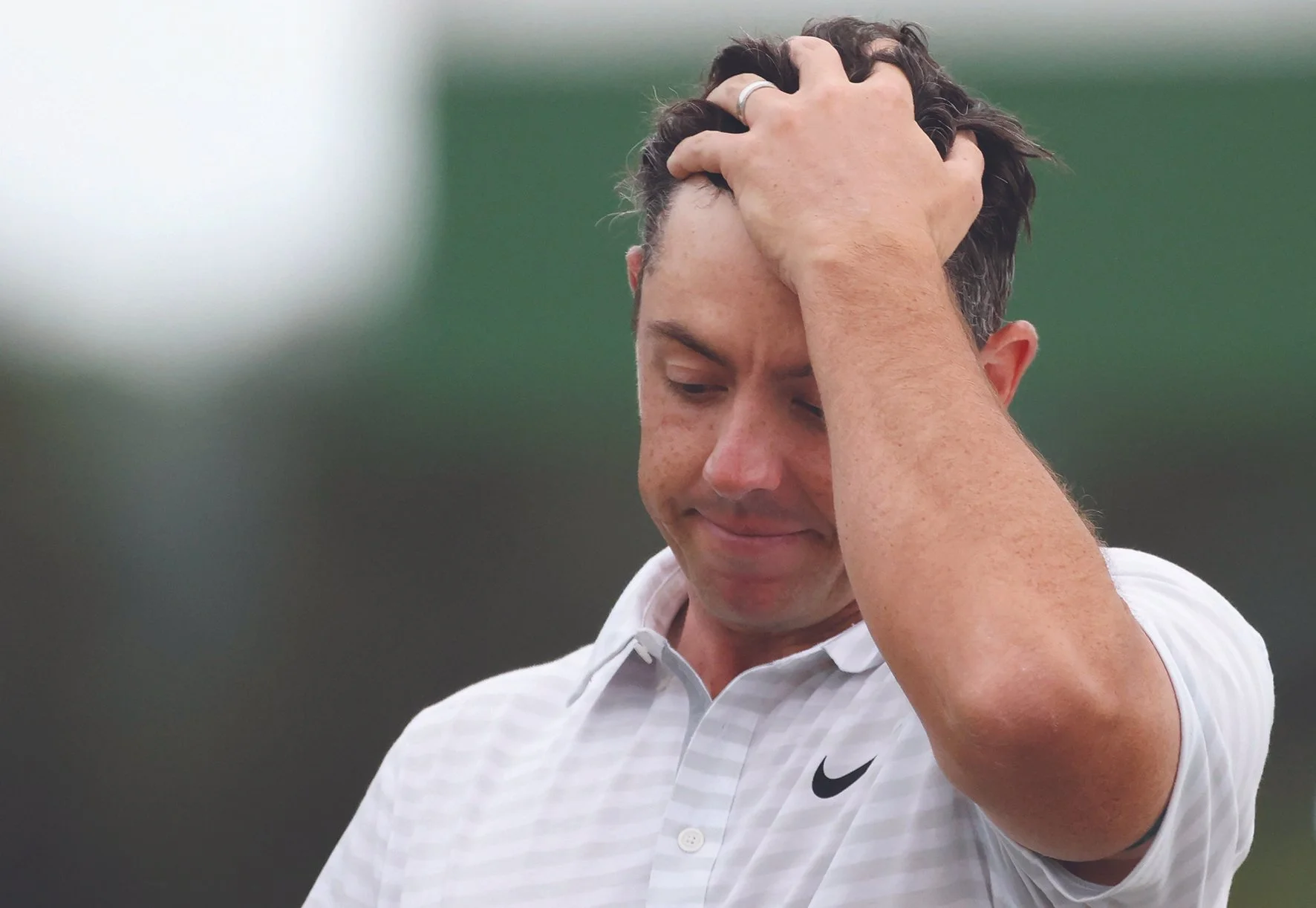
“There were times over the last decade when I wondered, ‘Is this ever going to happen for me again?’… I was aware that my window was narrowing a bit.”
April 2022: The 64 that felt like a win. Almost.
(2)
An April final round 64 on Sunday and second place. If golf allowed artistic merit awards, this round is it. It’s an Oscar nomination, playing a characterful role in a quirky story that everyone liked, but didn’t see coming. Think Travolta in Pulp Fiction.
Starting well off Scottie Scheffler’s lead, McIlroy shoots that final‑round 64, his lowest ever at Augusta and still his lowest Masters round on record.
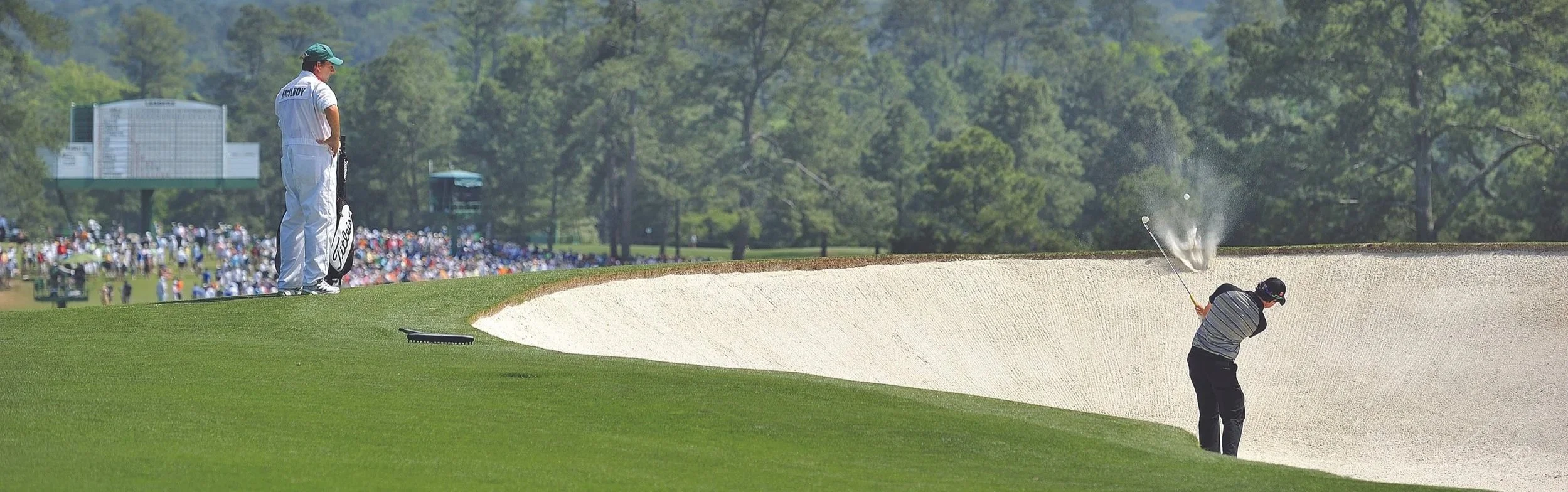
The crescendo of it all is the holed bunker shot on 18, a shot that saw the ball climb the slope, take a huge the break, and drop as the crowd goes boom! Rory spinning away in celebration. He finishes runner‑up, but not in a bad way. He’s three behind Scheffler, but on this occasion – and for the first time in a moment – the green jacket feels less like ‘the enemy’ and more attainable if the cards again fall.
April 2023: Another missed cut
(MC)
After the 2022 fireworks, 2023 is a cold splash of reality. Reviews aren’t good and there is no buzz. McIlroy misses the cut again, his third Augusta weekend off since 2010. The pattern is now almost cruelly clear: when the form looks irresistible, Augusta often says no. Or is it the other way around?
2024: A holding pattern
(T22)
The 2024 edition brings a tie for 22nd, nothing disastrous, nothing transcendent. For a player still chasing the career Grand Slam, it feels like stasis reached. It was the kind of week that’s forgotten the moment the patrons leave the property.
2025: The Grand Slam surely
(1)
Thursday–Saturday
The familiar build. By 2025, the Masters is no longer just another major for McIlroy; it has become the missing chapter. The missing award on the mantel. And the only tournament between him and a career Grand Slam. He plays his way into the lead with three days of composed ball‑striking, taking a two‑shot advantage into Sunday. This is now a numerical echo of 2011 that nobody can resist mentioning. Is it to be his Shawshank – which everyone wants – or will it prove something else which no-one wants?
Sunday 2025: Double bogey, déjà vu
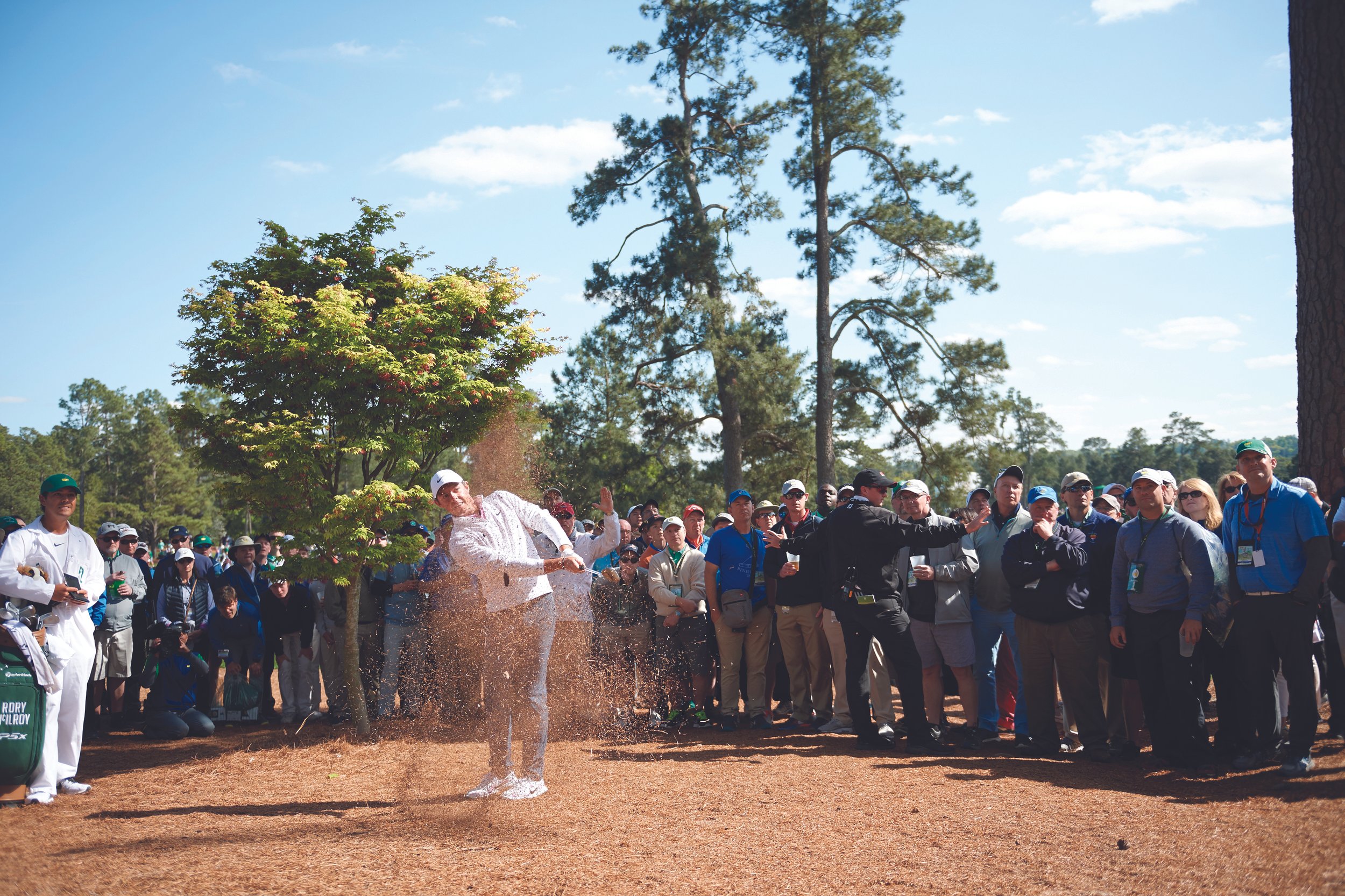
The final round opens with a jolt: a double bogey at the 1st, the hard-fought overnight lead suddenly disappeared, and the ghosts of a decade earlier drifted in from the pines. Nay, the cabins. A five-shot lead after 10 would evaporate into a three-way tie as his par putt on the 14th somehow remained above ground. How could he ever recover? McIlroy’s answer was an iron into the 15th, bent around pine trees from 209 yards, surely one of the finest in his life. Any life, for that matter.
But the Grand Slam-hopeful proceeds to squander his cushion over the closing six holes. This all sits in the context of Ryder Cup team-mate Justin ‘Rosie’ Rose mounting a charge from seven back, carving out a 66 that drags the tournament towards potential playoff at 11‑under.
Magnolia Drive, once again, has forced McIlroy to live the full horror‑movie sequel. The ‘film’ is a classic in its scripting. A lost lead, a surging challenger, and a back nine where nothing comes easy. But this time – instead of the opposite – he does just enough. One birdie from the closing two was needed to avoid a playoff. There, Rose would not be short of motive – the Englishman lost in extras to Sergio Garcia in 2017, of course.
McIlroy delivered that on 17 but wobbled on the last. It all comes down to a bogey at 18 for a 73 that feels like a narrow escape rather than a collapse, and the tournament resets over the same stretch of turf where so many of his nightmares began.
The Playoff: Four feet to history
The playoff returns to the 18th. McIlroy’s approach under Grand Slam pressure is laser‑sharp, finishing close enough to give him a look at birdie while Rose’s putt slides by on the right. Standing over four feet of sloping glass-like Bermuda grass, Rory has in his hands not only the Masters, but a place alongside Sarazen, Hogan, Player, Nicklaus, and Woods as the sixth man to complete the modern career Grand Slam.
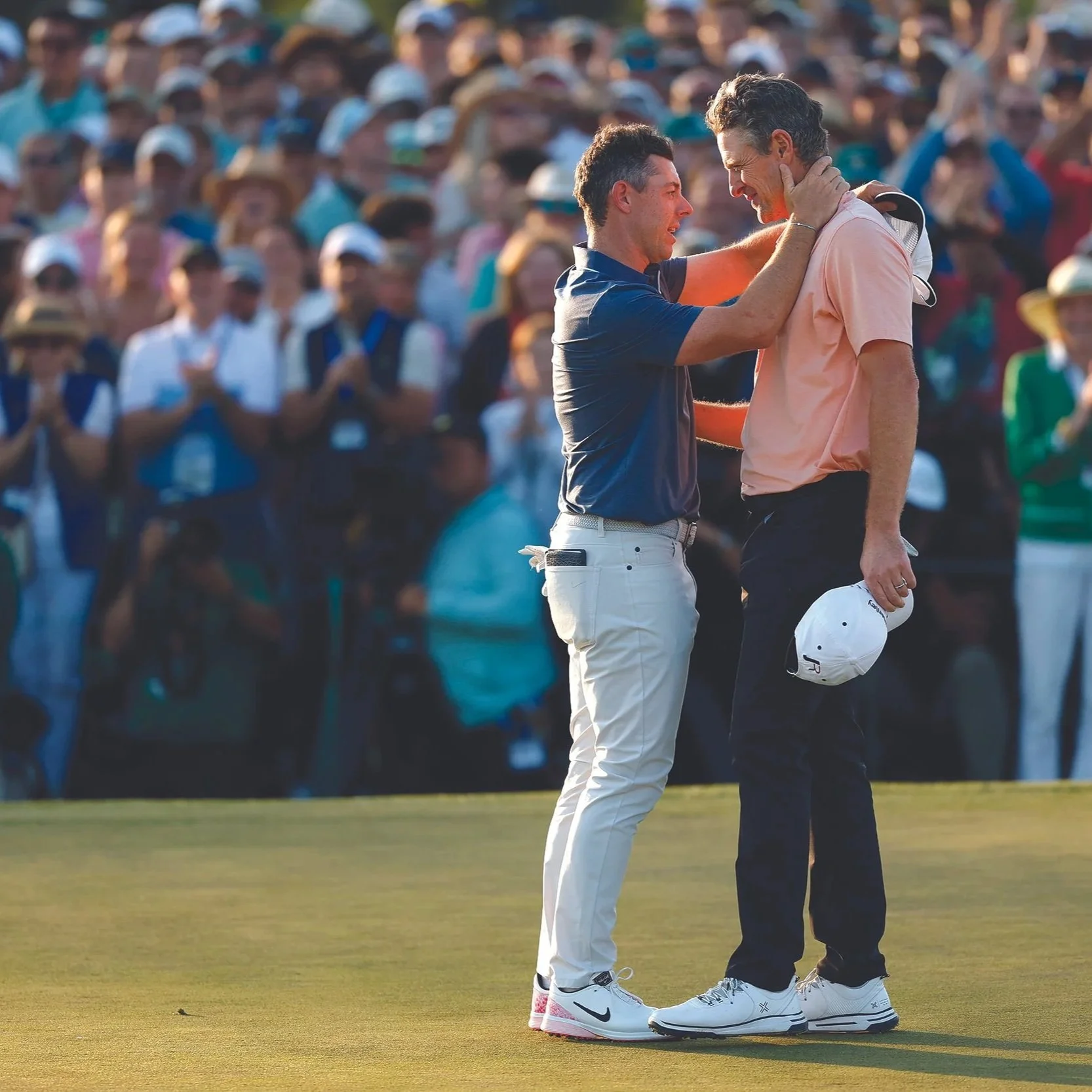
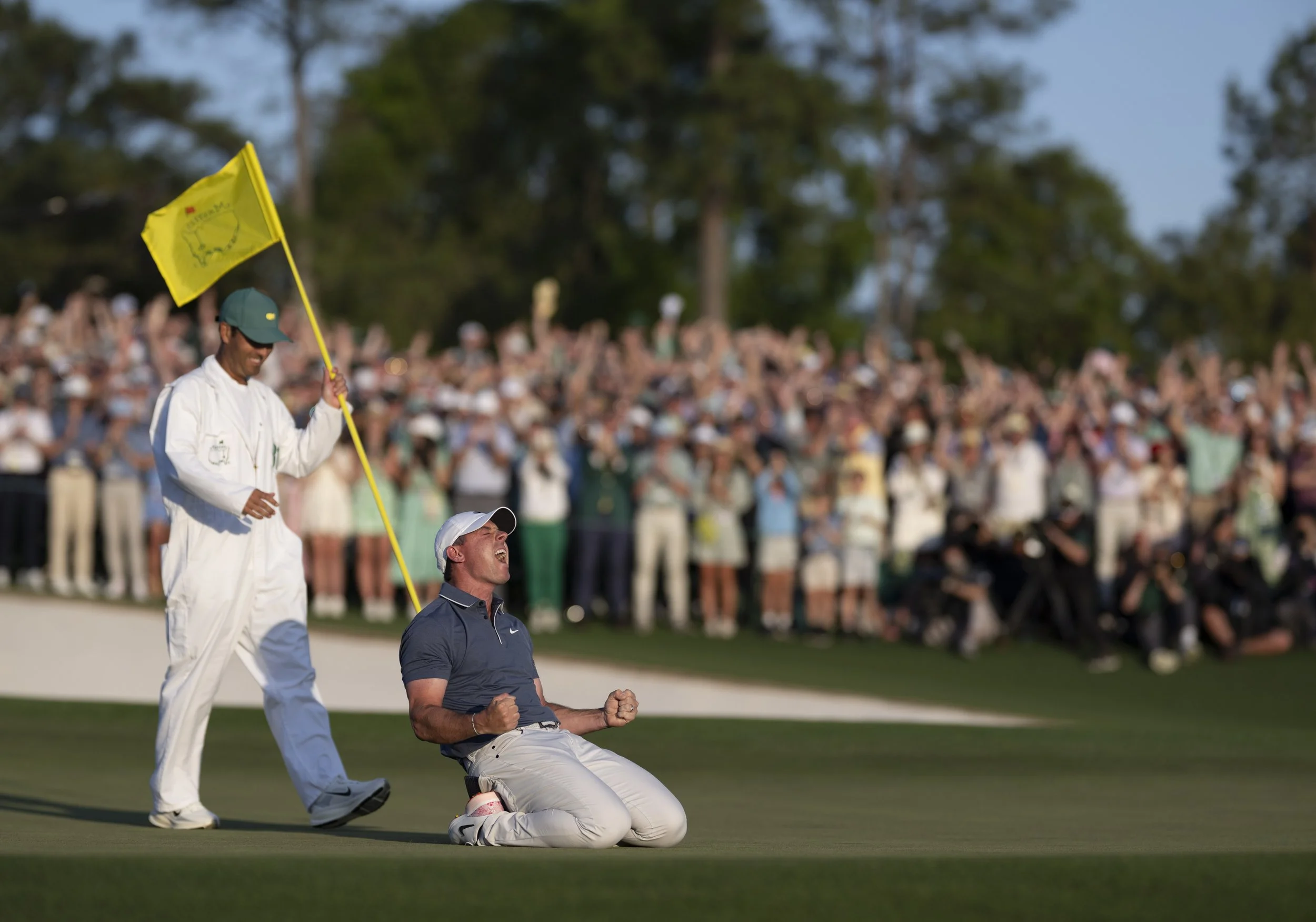
The putt never looks anywhere but dead centre. When it drops, he collapses to the turf in tears, body shaking, years of frustration pouring out. He’s now 35. After 11 years of trying, Rory McIlroy finally slips on the green jacket and turns the site of his most haunting failure into the scene of his defining triumph. His Oscar moment.
Postscript Review
Heading into the title defense, McIlroy’s Augusta ledger says that across 17 appearances, he has missed cuts in 2010, 2021 and 2023. Has one win, one runner‑up, four top‑fives, seven top‑tens, and around $4.4 million in Masters earnings. With a scoring average a shade over 71; bookended by a low of 64 and a high of 80. This statistic says it all about Augusta. If not our leading man. Neither managed to define him, where putting in the work did. “I started to wonder if it would ever be my time,” McIlroy admitted in the Butler Cabin in 2025. He was not the only one.