

Gary Player
The Masters, The South African, And What Came Next…
Andy Afford rattles off Augusta’s difficult history with its own past through the global lens of one country’s participation.
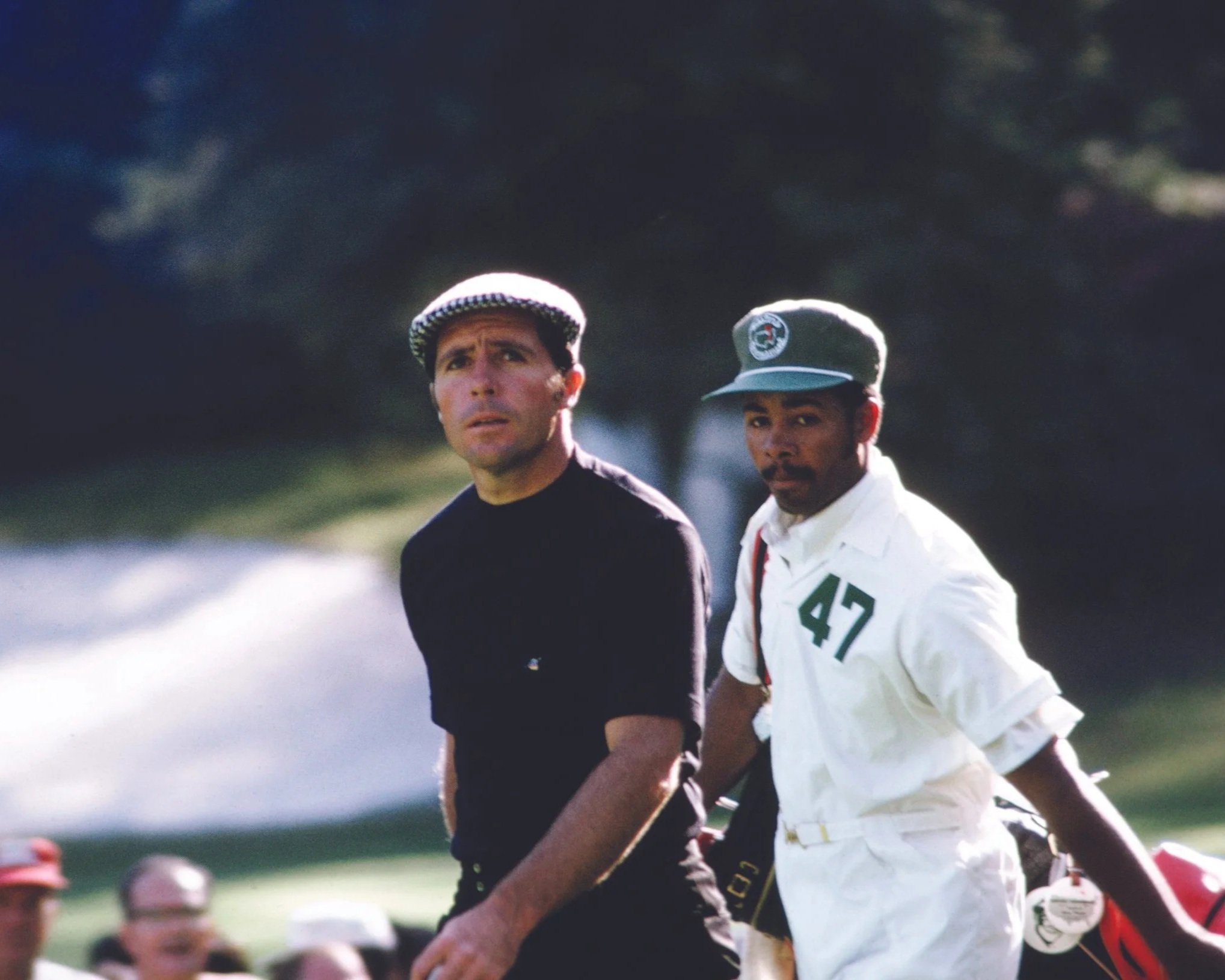
When Gary Player first drove down Magnolia Lane in the late 1950s, Augusta National was both a dream and a contradiction for any South African. The club did not admit Black members and had never invited a Black player to compete.
Black caddies were required for competitors, yet Black professionals such as Charlie Sifford – a standout turn of the day – were kept out of the field despite their ranking on tour. For Player, when thinking about what was happening ‘back home’, apartheid was tightening its grip. First formalised in 1948, it was now shaping every aspect of sport. Be it segregated golf clubs, restricted access to facilities, or the growing international boycott that ostracised South African teams from the Olympics, international tours, and other global events.
Golf sat awkwardly within that landscape. Made only viable by the individual, as opposed to representation of the collective. White South African professionals could travel, sign up to the PGA Tour, and, if they were good enough, qualify for the Masters. Leaving Black South African golfers to build their own parallel world at clubs like Alexandra in Johannesburg that were founded as early as the 1920s. But their chances of seeing Augusta – or pretty much anywhere else – as competitors were zero. So, when Player teed it up in 1957, he arrived not just as a foreign curiosity but as the face of a country many in sport were beginning to shun.

Gary Player in the creek during the 1978 Masters Tournament at Augusta National Golf Club
Gary Player’s Masters file is its own greatest hits album. It lists 52 starts, a record 23 consecutive cuts made from 1959 to 1982, and 15 top‑10 finishes that embedded him into the tournament’s permanent cast list. The highlights of that dominance run as follows… Three wins, across 1961, 1974, 1978, that made him the first international champion at the course, and later became only the third man to complete the career Grand Slam (now six).
The 1961 victory served to turn the tournament’s geography inside out. Player, 25, opened with 69, followed it with a 68 to tie fan-favourite, Arnold Palmer, then built a four‑shot cushion through three rounds before closing with 74 and having to wait while Palmer, the king of American golf, stumbled home. It left Augusta with its first champion from outside the United States. And maybe one they didn’t want, in a white South African, ‘representing’ a country whose racial regime was hardening.
In 1974, Player added a second green jacket with a performance that underlined his reputation as a global star, a man who saw himself as an ambassador for South Africa even as its government became a pariah. Four years later, at 42, he produced one of the great Augusta charges: a closing 64 that overhauled 16 players and tied the record for the largest final‑round comeback in Masters history. That 1978 win made him, at the time, the oldest Masters champion. And completed what would end up as a trio of victories that has stood as the high‑water mark for South African golf at Augusta for prevailing decades.
Widely regarded as one of golf’s most driven and disciplined figures, it would be his relentless fitness regime and global schedule that carried him to nine major championships. Born in Johannesburg in 1935, he turned professional at 17 and built a career defined by that hard work.
A strong belief in the power of positive thinking, he was an early adopter of the mantra. Citing books like Norman Vincent Peale’s classic ‘The Power of Positive Thinking’ as an influence on his own mindset. With more than 160 professional victories across six continents, few could argue with its success.
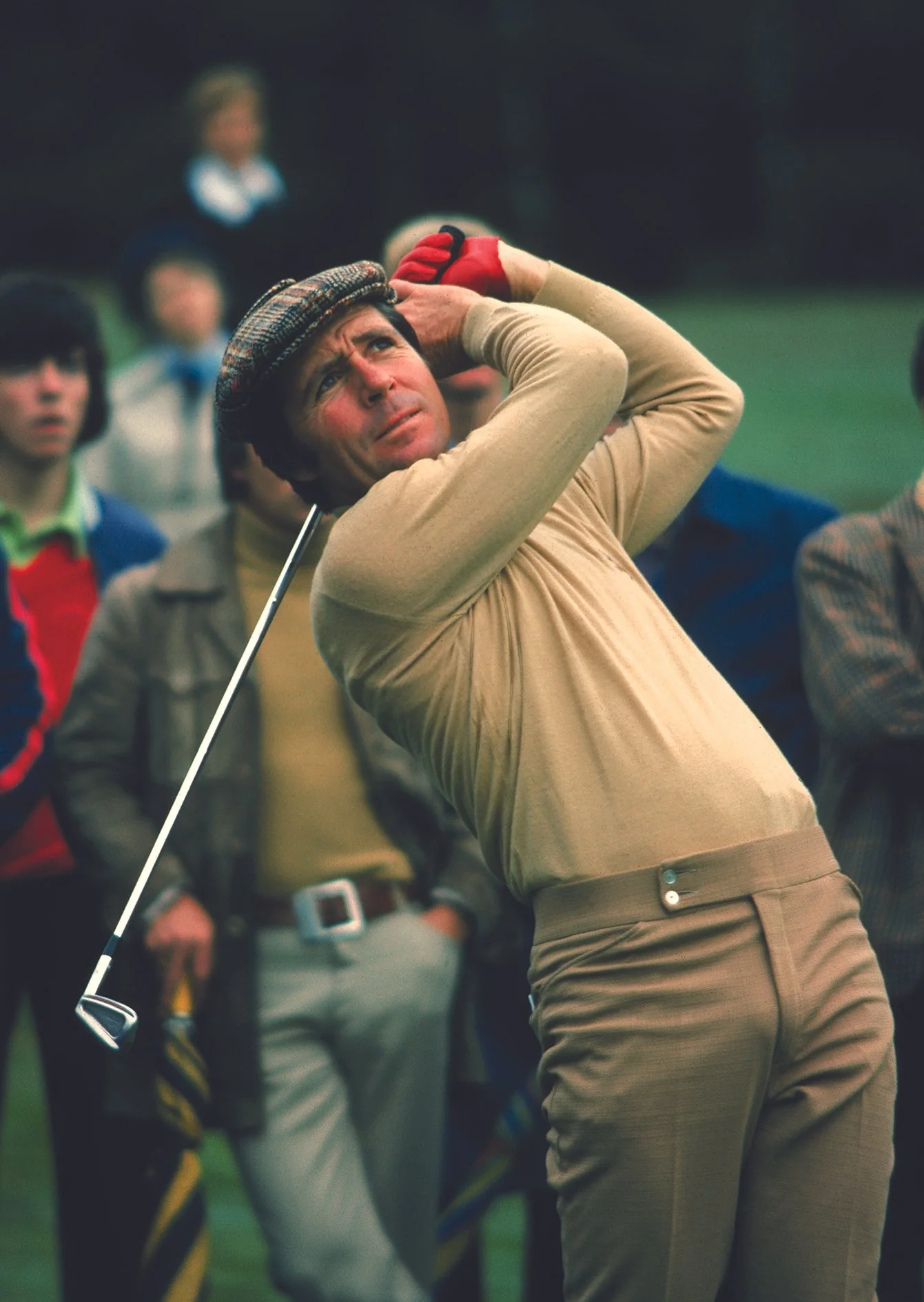
On course, Player was admired and occasionally a polarising figure. Among fellow professionals, Gary Player was respected for his work ethic and record, but not universally beloved. He was popular with many fans for his competitiveness, short game and work ethic, but he also attracted criticism for his ‘South African-ness’. Within the game, such was his record and output that he is generally grouped with Jack Nicklaus and Arnold Palmer as part of what is described collectively as the ‘Big Three’, the trio drove golf’s television‑era boom in the 1970s under the shared management of sports impresario, Mark McCormack. The shared history made them frequent partners in made‑for‑TV events and promotional tours.
Off the course, Player founded The Player Foundation (also referred to as the Gary Player Foundation) in 1983 to support education for underprivileged children, notably funding the Blair Atholl Schools complex near Johannesburg.
In his personal life, Player married Vivienne Verwey (sister of fellow South African golfer Bobby Verwey) in the 1950s, and they had six children together, the marriage lasted more than six decades until her passing in 2021.
“For almost all of apartheid’s lifespan, the South Africans who appeared at the Masters looked like Player. They were white, often from privileged golfing backgrounds, sometimes transplanted in Europe or the United States to keep their careers insulated from the boycott.”
For almost all of apartheid’s lifespan, the South Africans who appeared at the Masters looked like Player. They were white, often from privileged golfing backgrounds, sometimes transplanted in Europe or the United States to keep their careers insulated from the boycott. While the country was banned from the Olympics from 1964 and squeezed out of many team sports entirely, individual golfers could still qualify via the PGA Tour and the major championship entry criteria.
Meanwhile, Augusta’s own racial barriers were only slowly eroding. Black men had long served as the tournament’s caddie corps, guiding champions around the course yet barred from the membership rolls and, until Lee Elder’s 1975 appearance. Charlie Sifford, whose trailblazing PGA Tour career should have made him a fixture at the Masters, never received an invitation.
Back in South Africa, Black golfers were systematically excluded from elite facilities, forced to form their own clubs and tournaments in townships and on the fringes of white cities. The history of Black golf there only began to appear in mainstream records in the late 20th century, a delayed recognition of talent that had been boxed out ‘by law’.
By the time Ernie Els arrived at Augusta in the 1990s, the flag next to his name meant something different. Apartheid had ended in 1994; South Africa had rejoined the Olympic fold and re‑entered the sporting mainstream. Els, tall and loose‑limbed, came as part of a new wave of global professionals who could live anywhere, play everywhere, and carry a different image of his country. One that was still complicated, but no longer officially segregated.
Els never won the Masters, and that is part of why his Augusta record is fascinating. Across his career he finished runner‑up twice and stacked multiple top‑10s, often with a style that seemed tailor‑made for the course: high, soft irons, a patient temperament, and a major‑championship pedigree that included two U.S. Opens and two Open Championships. On the roll‑call of South Africans at Augusta, Player has the jackets, but Els embodies the image – if nothing else – of a should-be champion.
Louis Oosthuizen represents another twist in the South African Masters narrative, as the player whose game flashed at Augusta in a way that seemed destined to produce a green jacket, only for the story to hinge on a single playoff swing.
Oosthuizen arrived at the 2012 Masters already a major champion, having taken the Open at St Andrews in 2010 with a runaway performance. At Augusta that year he produced one of the most unforgettable shots in tournament history, carding an albatross at the par‑5 second, a 4‑iron that tracked the flag, landed on the front of the green and rolled into the cup. It was the first double‑eagle at that hole in Masters history and catapulted him into the lead on a final day where the tournament often rearranges itself.
He would end the week tied at the top, only to lose in a sudden‑death playoff to Bubba Watson, the American’s hooked wedge from the trees on the 10th becoming his defining shot. On paper it was another South African near‑miss, and another echo of Els. Oosthuizen’s Masters résumé since then reads like that of a consistent contender, but biding his time as a LIV ‘defect’, the 43-year-old won’t represent his nation at this year’s event. A reality he says “stings”, obviously.

South Afirca’s Christo Lamprecht at The Club, Indian Creek.
South Africa’s Masters story doesn’t stop with those three names, even if the question of who has actually worn the green jacket narrows the cast list. Gary Player’s three wins stand as the foundation; decades later, Trevor Immelman’s 2008 victory and Charl Schwartzel’s 2011 charge, with four closing birdies, added two more jackets to the national haul. Schwartzel’s win came exactly 50 years after Player’s first, a neat piece of symmetry.
As of the current crop, there is no South African ranked inside the World’s top 50 – that exists as the cut-off point for Masters qualification. Jayden Schaper, resides as the Rainbow Nations’ current leading light, the 24-year-old carrying the flag for South Africa at World Number 54. Schwartzel – also a LIV representative – and the long-hitting 21-year old Aldrich Potgieter (qualified as a winner on the PGA Tour) could be the nation’s only representatives on the card this year.
Those playing now unfold in a different world from the one Player first inhabited. By Immelman’s win in 2008 and Schwartzel’s in 2011, Augusta had long since welcomed its first Black member, opened its gates to a more diverse membership, and seen Tiger Woods – himself the first Black Masters champion – blow apart some of the club’s most stubborn artefacts and affectations.