

la Catastrophe
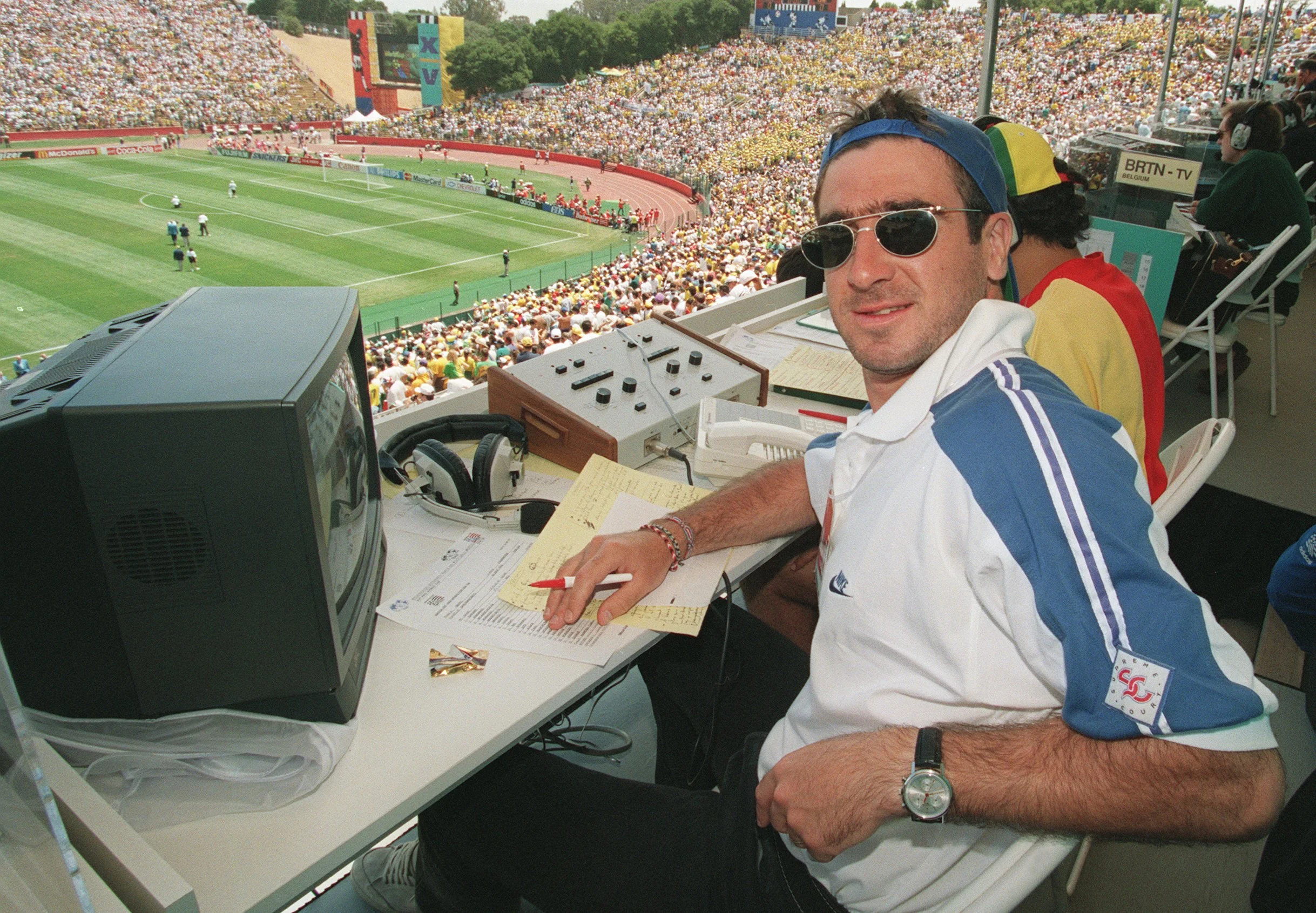
In this extract from No Show: The World Cup Teams That Never Were, James Bennett revisits the brutal qualifying campaign that denied Eric Cantona, Jean-Pierre Papin & co. their place on the world stage.
There is a parallel universe where Eric Cantona led France to World Cup glory in the USA in 1994, beating Germany, Italy and Brazil along the way to a remarkable triumph. Where Jean-Pierre Papin was jointly awarded the Golden Boot with Oleg Salenko. Where Marcel Desailly and Laurent Blanc began a course to establish themselves as the greatest centre-back partnership in international football history. Where, when he died in 2020 at the age of 73, Gérard Houllier was celebrated as one of the great modern managers, who took French football to new heights with a talented squad and banished the memories of the Marseille match-fixing scandal of a year before.
But as an enticing a prospect as that sounds, it remains one of international football's great fantasy alternate timelines. It wouldn't be until four years later that a very different France side would finally win the trophy that had eluded them for so long on home soil. But all that did was raise more questions about why it hadn't happened sooner, with all the great players and managers that France had possessed in the relatively recent past.
1994 was meant to be the culmination of eight years of rebuilding the national team into a force at the highest level. France had been muddling through international football for much of the previous decade without ever really gaining much traction. It was a huge contrast to the first half of the 1980s, a period of immense promise that was arguably never fully realised. Two runs to the World Cup semi-finals in 1982 and 1986 – where each time they were beaten by West Germany – sandwiched the team’s greatest triumph up to that point: a home victory in the 1984 European Championships.
Up until this point, the team had been led both spiritually and creatively by Michel Platini, who had established himself as one of the greatest players in the world. A technically gifted and energetic attacking midfielder, Platini dominated European football. With three Ballons d’Or between 1983 and 1985, he was widely recognised as the best player in the world. But after his retirement in 1987 at the age of 32, France’s form plummeted, failing to qualify for the 1988 Euros and the 1990 World Cup, and crashing out of the 1992 Euros at the group stage. The suggestion that their 1980s run would lead to the formation of a dynasty disappeared.
Talent should not have been an issue. The team’s standout figure throughout the late 1980s and early 1990s was Papin, a rare survivor from the 1986 team. JPP had developed into one of Europe’s most prolific strikers, famed for his collection of spectacular volleys which would become known as Papinades. He won the Ballon d’Or in 1991 while at Marseille before a record-breaking transfer to Serie A with AC Milan in 1992, the first with a fee of over £10 million.
Supporting Papin was his some-time Marseille team-mate Cantona. Supremely gifted, tenacious, combative and incredibly self-assured, Cantona was the heir to Platini’s number 10 jersey as a goal-scoring deep-lying attacker, but it wasn’t until he fled France for England, initially with Leeds United and then Manchester United, that he truly marked himself out as an elite level forward, feared and revered in equal measure. For a time, Cantona’s star was so bright that he was one of the most famous players in the world.
This was despite only limited success outside of domestic football. Prior to 1994 World Cup qualifying, his international career had been headlined by a suspension from the national team for referring to coach Henri Michel as a ‘sac a merde’ in a post-match interview. During the 1992 Euros, he failed to score.
But it wasn’t only in attack that France could boast world-class players. In Laurent Blanc, they possessed a talented sweeper who would become a leader at the back. Emerging alongside him was group of solid defensive players from Marseille’s dominant club side, including Basile Boli, Jocelyn Angloma, a young Marcel Desailly, and Didier Deschamps, who would blossom into one of Europe’s leading midfield anchormen.
The ingredients were there for France to rise again. All they needed was a guiding mind. Gérard Houllier had made his name in the 1980s as one of the most tactically astute French coaches. He led Paris Saint-Germain to their first ever French title in 1986 before being recruited as the national team’s technical director and assistant coach two years later. Following Platini’s departure after the 1992 Euros, he was promoted to head coach, tasked with leading France back to the World Cup in 1994 and building the foundations for the 1998 finals, which France was confirmed to be hosting in July 1992.
The qualifying draw handed them some tricky matches. Sweden were the headline draw, having qualified for the semi-finals of the Euros ahead of France in their group, but it was a group with no particularly weak teams: there were 1990 qualifiers Austria, an emerging Bulgaria led by Barcelona star Hristo Stoichkov, and two middling teams in Israel and Finland. Nonetheless, with two spots to qualify, France could be confident of making it to the USA.
However, a wake-up call came in September 1992. France arrived in Sofia to open their campaign to face a Bulgaria team that had already enjoyed a positive start to theirs, having beaten Finland in Helsinki. But even then, few would have expected what would follow: two first-half goals in eight minutes – a penalty from Stoichkov and a deflected effort from Krasimir Balakov that looped over goalkeeper Bruno Martini – gave the home side a shock 2-0 win.
But despite this early blow, France rebounded well, winning their next four games as an electric partnership formed between Cantona and Papin. It seemed the poor start may have been an aberration, and with Bulgaria losing to Sweden and Austria in quick succession, their spot in the USA looked increasingly assured.
The visit of Sweden in April looked to be the decisive match in the group. With Papin absent, attacking responsibilities fell to Cantona and the explosive David Ginola of Paris Saint-Germain, one of the most charismatic front lines in football history. They were needed too: just 14 minutes in, Boli’s defensive header was fumbled by inexperienced goalkeeper Bernard Lama, and it allowed Martin Dahlin to sneak in and give Sweden a shock lead. But when their midfield general Jonas Thern left the field injured, they quickly lost control of the match. By half-time, France were level: Ginola, bursting in behind the Swedish defence, was clattered to the ground by Patrik Andersson, giving Cantona the opportunity to score from the penalty spot.
It looked as if the teams were destined for a draw until seven minutes from time: a deep cross from Angloma found the outstretched Cantona, whose volleyed effort was fumbled into the net by goalkeeper Thomas Ravelli, sending the crowd and bench wild. For now, Eric was a hero on both sides of the Channel, with Manchester United on the verge to win the first Premier League title, France on course to qualify for the World Cup, and him playing a key role in both. This was perhaps the high watermark of his international career.
It would be another four months before France played again. In that time, the club season ended with victory for Marseille in the first Champions League Final against AC Milan, with Boli scoring the winning goal. However, this would soon be overshadowed by the emergence of an astonishing match-fixing scandal which would see them stripped of the French league title. While French domestic football was reeling, the national team’s group rivals played catch-up. When France headed to Stockholm in August, both they and Sweden had ten points from six matches, while Bulgaria had nine from seven.
In a tense match at Råsunda, the scores remained level for 77 minutes before a moment of magic broke the deadlock. Receiving the ball on the left flank, midfield engine Franck Sauzée drove forward towards a retreating Swedish defence and blasted a shot beyond Ravelli into the top corner. France were now on the brink, but they had a few more minutes to hold out. They held on until the 89th minute, when Thern found himself in space with the ball at his feet in the centre of the pitch, and pierced an incisive through-ball through the heart of the French defence to find Dahlin, making a rapid break off the shoulders of the centre-backs. Receiving the ball just inside the area, his first and only touch was to delicately loft it over the on-rushing Lama. It was a point saved for Sweden, but one lost for France, their first momentum-check since their opening defeat.
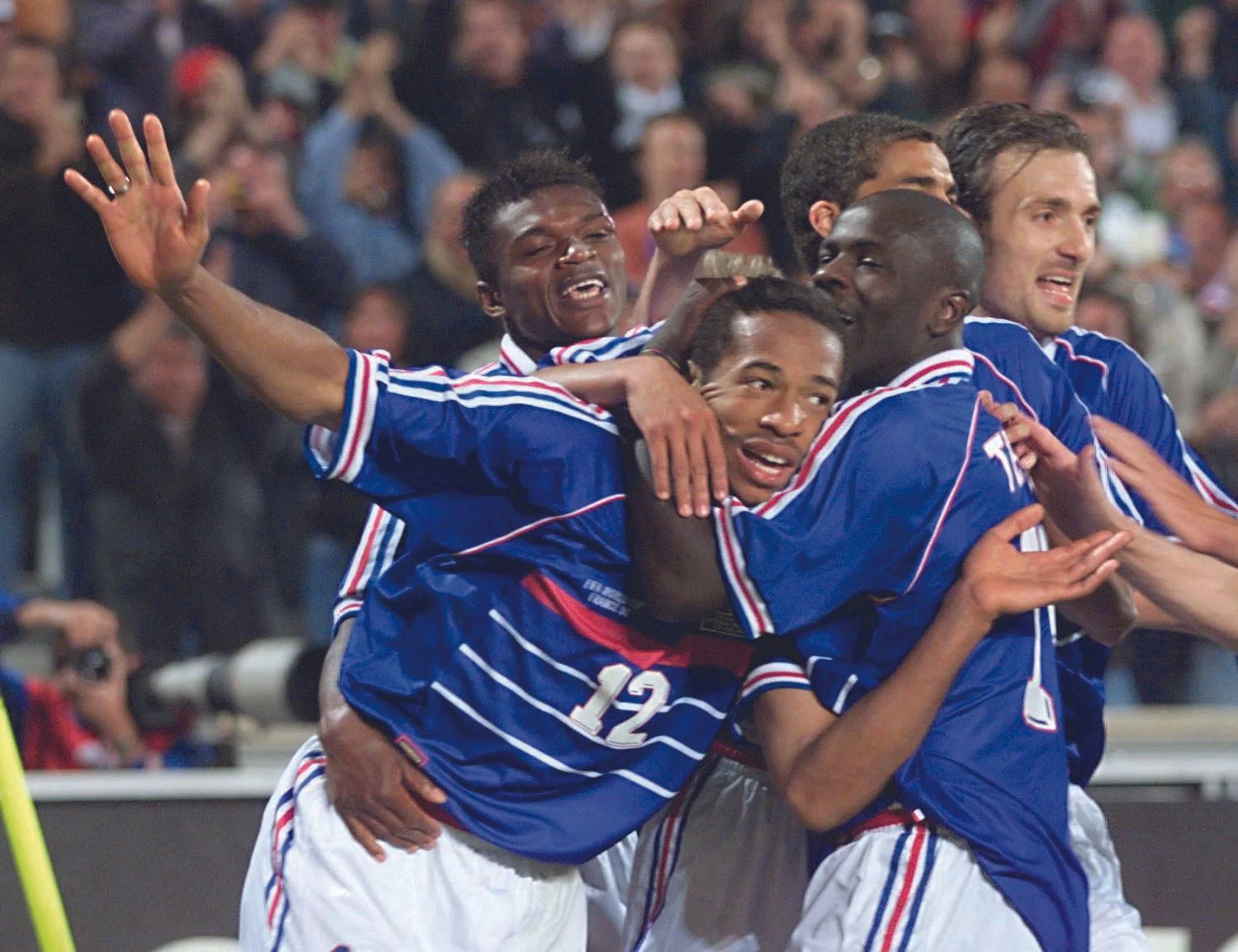
The above image features the ultimately victorious French World Cup squad of 1998. And to think they didn’t qualify the tournament before…
Even so, avoiding defeat on the road was still a positive result, and they followed it up two weeks later with a win over Finland in Tampere. Perhaps more importantly, it came the same day that Bulgaria and Sweden drew in Sofia, leaving France a point ahead of Sweden and three ahead of Bulgaria with two matches to go, both of which were at home. Time to bring out the champagne bottles?
Israel were yet to win a match in the group when they arrived in Paris in October. With memories of their 4-0 win in Tel Aviv still fresh, Houllier named an attacking side, selecting Cantona, Papin and Ginola in a bid to seal qualification in style. Even Pelé was in attendance to see what was expected to be a historic moment.
In an ominous turn of events, Israel made the early breakthrough. 20 minutes into the match, Liverpool’s Ronny Rosenthal shrugged off Blanc to reach the byline and send in a hanging cross that was met by Reuven Atar, who dived to nod the ball back across goal to striker Ronen Harazi, finding him within easy reach of a tap-in. Screams and gasps could be heard from the home fans: this was not in the script.
Nerves would be settled 11 minutes later. Ginola, always a livewire in attack, drew in Israeli defenders on the edge of the box and slid a pass sideways to the advancing Sauzée, who met it with a low drive into the net. This was more than matched for style just before half-time, when Ginola cut in from the left and curled a spectacular swerving strike into the far top corner. This was what Pelé had come to see.
The match remained settled for much of the second half, and as the end drew nearer, Les Bleus looked comfortable enough that the FFF probably had the phone number of the nearest French travel agent ready to go. But with seven minutes left, Rosenthal once again burst through the French defence, dodging a lunging tackle from Blanc that only served to bring his own team-mate Lizarazu to the ground. Desailly was able to baulk him, but the ball trickled through to Harazi, whose shot was acrobatically saved by Lama. Future Premier League star Eyal Berkovic reacted first to deftly volley the ball beyond the goalkeeper and a defender. Desailly reached for it with his left foot, but could only play it into his right leg, and the ball trickled agonisingly over the line.
Worse was to follow. Deep into added time, as France desperately heaved the ball forward in search of a winning goal, they were caught on the break. Again, it was Rosenthal who sprinted past Desailly and Blanc to chip in another cross from the byline. As in the first half, it was met by Atar, who half-volleyed it above Lama into the net. Roars turned to jeers and whistles.
Despite their collapse, France welcomed Bulgaria to Paris in November knowing that a draw would take them to the World Cup. The visitors, meanwhile, needed to win. Their own nerves would not have been helped by Emil Kostadinov and Lyuboslav Penev having visa issues; it was later revealed by that the pair were illegally smuggled into France by goalkeeper Borislav Mihaylov and former international Georgi Georgiev, both of whom played for French club FC Mulhouse.
The raucous atmosphere at the Parc des Princes couldn’t bely the anxiety amongst both sets of players. Adding to the tension, play was halted early on courtesy of the most French of pitch invasions: a cockerel managed to find its way onto the pitch and proceeded to run around before eventually finding its way back into the crowd. The nervousness of both teams was palpable.
Half an hour in, France managed to lift themselves above the tension. Deschamps lofted a long ball into the penalty area, and Papin nodded it down for Cantona to smash past Mihaylov. Cantona leapt onto an advertising hoarding, his arms aloft. The home fans celebrated with relief as much as joy. But both would be short-lived.
When you’re in a tense match and you need to avoid defeat, the last thing you should do is concede an equaliser immediately after scoring. It invites a particular level of pressure and anxiety that inevitably leads to retreat. And so it was here: just six minutes after conceding, Bulgaria found themselves with a corner on their left. Balakov’s delivery was perfect, and Kostadinov rose to meet it and power a header past Lama.
However, as the second half progressed, it looked as if the match might peter out in frustrating fashion for the Bulgarians. France were visibly cautious and sank deeper, but despite their unease, their position seemed relatively comfortable: the visitors were being overcome by their own desperation and fatigue.
However, as in 1982 and 1986, France would be suffer a cruel twist of fate. In the 90th minute, France won a free kick in the right corner of the Bulgarian half. It was passed short to Ginola. The idea was obvious: keep it in the corner, run down the clock, book tickets to the USA. Except it wasn't obvious to Ginola. He immediately whacked the ball into the box, massively overhitting it. Right-back Emil Kremenliev collected and fed the ball forward. In the end, it was the combination of the two players that shouldn’t even have been in the country for the match that decided it: Penev lofted the ball through the French defence to Kostadinov, who fired a shot onto the underside of the bar and into the net.
French players slumped to the turf, distraught and disbelieving. Bulgarian commentator Nikolay Kolev yelled ‘God is Bulgarian!’ In the moment, it was hard to argue against him.
For France, the fallout was immediate. Much of the attention focused on Ginola for his late error, including from his coach. ‘He sent an Exocet missile through the heart of French football,’ said Houllier after the match. ‘He committed a crime against the team.’ When he announced his resignation soon after, he said ‘with only 30 seconds remaining we were there but we got stabbed in the back and at the worst possible time.’ It was the start of a feud that would last until Houllier’s death. Ginola later said ‘it is something which will haunt me for the rest of my life.’ In 2012, he attempted to sue Houllier for slander and defamation for disparaging remarks made in a book, but the lawsuit was dismissed.
The reality was France’s failure went far beyond Ginola’s overhit cross, as unwise as it may have been in the heat of the moment. The team had two matches to secure a single point that would have taken them to the World Cup and led in both, only to fumble them late on. It would prove to be a hugely formative moment in the story of the national side; it was, in a sense, the end of French football’s innocence.
Houllier's replacement with Aimé Jacquet signalled something profound: a complete change of philosophy that has since lasted through two World Cup victories to the present day. Gone was the swashbuckling style that had characterised the France team since the days of Platini; Jacquet instead chose to build a hard-working unit, constructed around a solid defence.
The flair players did not survive the transition. Papin fell out of favour as his club form dipped following disappointing moves to AC Milan and Bayern Munich. Ginola was used sparingly off the bench until 1995, by which time he had escaped the jeers of the French crowds for a successful stint in England’s Premier League. Cantona, meanwhile, had initially been appointed as Jacquet’s captain, but following an infamous assault on a fan at Selhurst Park in January 1995, he was banned from football for eight months. By the time he returned, the national team had moved on without him. Instead, it would be built around the prodigious creative talents of Zinedine Zidane, who picked up his first cap in August 1994. Deschamps, the player Cantona dubbed ‘the water carrier’, became the new captain, typifying the new style Jacquet introduced.
The 1994 France team was a great loss to the World Cup. They undoubtedly would have thrived in a tournament dominated by mercurial talents like Stoichkov, Roberto Baggio, Gheorghe Hagi and Romario. The fact that both Sweden and Bulgaria reached the semi-finals suggests that they could have achieved similar feats; France would indeed later beat Bulgaria 3-1 during Euro ‘96.
Instead, a moment of madness in the last minute of the last qualifier became a Sliding Doors moment for the ages. They were another victim of the fine margins of qualifying in an era of fewer spots in the finals, where a good team could go from potential contenders for overall glory to cancelling the hotel bookings with a couple of momentary clangers in key games. Their success in the years later made up for it, but it meant that we never got to see Cantona and Ginola at the highest level. Those who remember watching them in English football in the 1990s know that was a travesty.