

Prime Time
Is Deion Sanders the NFL’s most influential player of all time? A genuine two-sport start, as well as an offensive and defensive force, it’s hard to argue otherwise. Sam Bowles states the case for the player.
Away from stats and winners' medals (two Super Bowl rings, in this instance), there are only a handful of players who can lay claim to defining the era in which they played. For the '90s, Deion 'Prime Time' Sanders carries that distinction. The nickname, appropriate as it is, was given by a school friend after a 36-point basketball game in North Fort Myers, Florida.
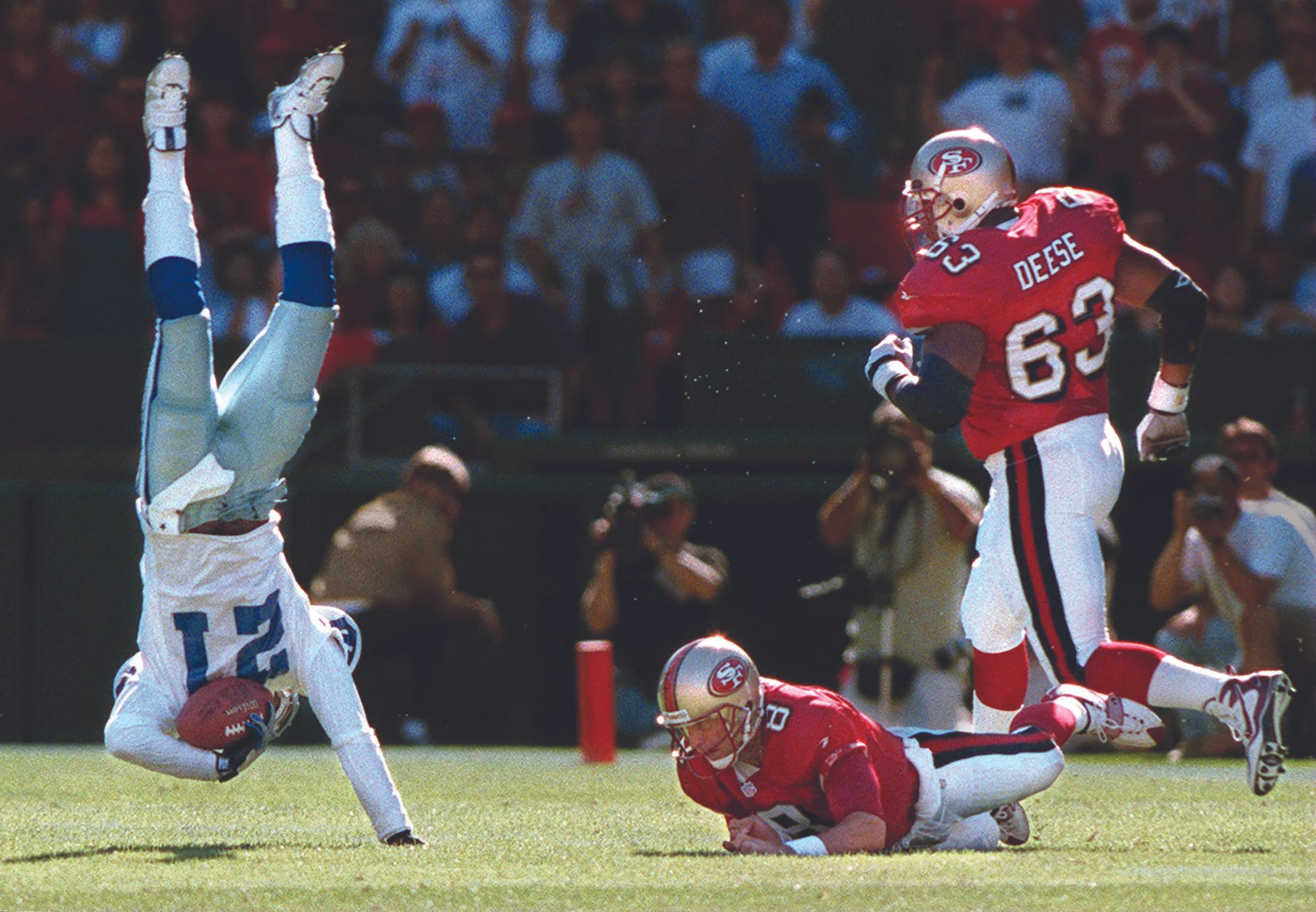
More than three decades after he first made his NFL debut, his name – and that moniker – still conjures an image as vivid as any. Those are pictures, flashback even, of near-impossible speed, seemingly effortless interceptions and calamitous defenders trailing in his wake. All backed up by the unmistakable confidence that made 'Neon Deion' one of the brightest personalities the game has ever produced.
It would be easy to remember Sanders primarily for the spectacle. His confidence bordered on theatrical, his post-game interviews were as entertaining as his performances on the field, and his flair for attracting attention often placed him at the centre of American football's biggest conversations. Jumping to the 'glory days', however, possibly overlooks the foundation upon which that image was built. Behind every celebration lay hours of preparation, meticulous film study and an instinctive understanding of the game that separated him from almost every player of his generation. Sanders was not simply fast – although he still stands as one of the fastest men ever to play in the NFL. He possessed an extraordinary ability to anticipate plays before they unfolded, trusting his judgement so completely that he often appeared to know where the football was going before the quarterback himself had made that decision.
His career also spanned pivotal time in the evolution of professional sport. During the late 1980s and into the '90s, television had transformed athletes into global celebrities. The endorsement opportunities expanded dramatically and those who ran the sport began to recognise the commercial value of personalities – as well as performances. Sanders understood this changing landscape better than anyone. Long before social media allowed athletes to build personal brands, he realised that charisma and entertainment could become a competitive advantage. The result was a player who seemed equally comfortable shutting down the League's best receiver as he was appearing in major advertising campaigns.
What made him unique at the time, however, was that the over-the-top public persona never overwhelmed the football. Every ounce of swagger had to be justified on Sunday, and almost every week he delivered. Quarterbacks became reluctant to throw in his direction, receivers accepted afternoons of frustration as passes disappeared elsewhere. Fans came to understand that whenever Sanders touched the football, something extraordinary might happen. Standing six-feet-and-one-inch tall, there have been faster players, stronger players and perhaps even more statistically productive defensive backs, but few have ever altered the emotional atmosphere of a game in quite the same way. The possibility of brilliance seemed to accompany him onto the field.
That combination of elite performance and unmistakable personality had been developing during his time at Florida State University, where he established himself as one of the country's most gifted all-around athletes. Football may have provided the biggest stage, but it was not his only talent. He excelled in baseball and on the running track, displaying rapid acceleration. It was noted that he not only posessed the physique of an athlete, but seemed to perform better under pressure. The bigger the occasion, the more relaxed he appeared to become.
“Deion loved Deion before anybody else did”
Andre Rison - Atlanta Falcons teammate & Super Bowl winner with the Green Bay Packers ANDRE RISON
The First NFL Draft
By the time the Atlanta Falcons selected Sanders with the fifth overall pick in the 1989 NFL Draft, expectations were already immense. The franchise – waivering the traditional route of bagging a quarterback – believed it had acquired an exceptional defensive back, capable of transforming its fortunes. Cornerbacks had traditionally earned respect through quiet efficiency. The best of them often disappeared from broadcasts because opposing quarterbacks simply stopped throwing in their direction. Sanders accepted that challenge but rejected the anonymity that usually accompanied it. If quarterbacks wouldn't test him, he would find other ways to let the crowd know he was there. When the ball was eventually thrown his way, he intended to make them regret it.
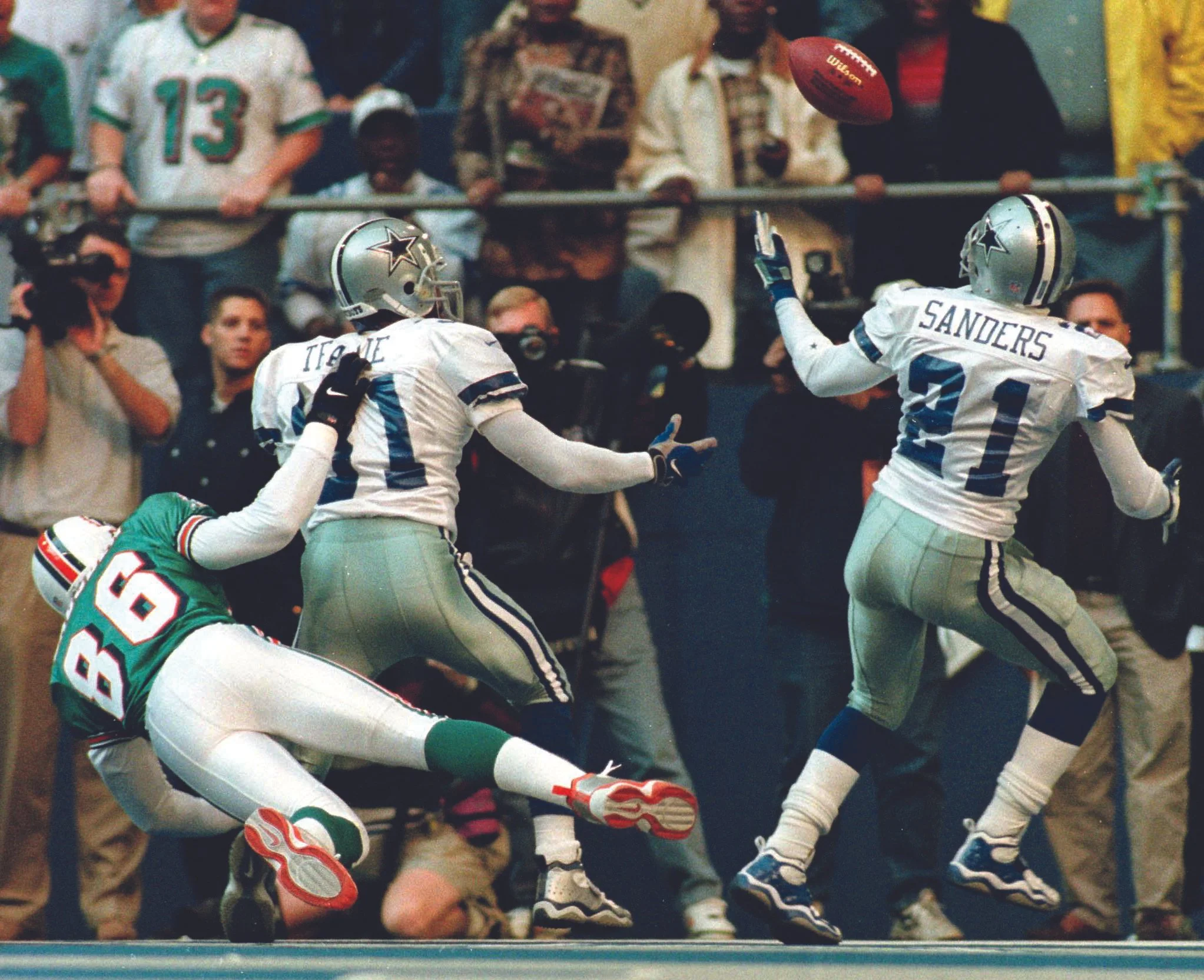
Atlanta became the proving ground for everything that would later define the 'Prime Time' legend. The Falcons were still searching for sustained success as a franchise, but they provided Sanders with the opportunity to develop without the suffocating expectations that surrounded some of the more established teams. Almost immediately he demonstrated why scouts had considered him such an extraordinary prospect. His closing speed was breathtaking, allowing him to recover even when receivers appeared to have gained a step. His agility made changing direction seem almost effortless. Before long, some of the League's finest wide receivers were discovering that creating separation against Sanders was one challenge; keeping possession of the football afterwards was another entirely.
What truly distinguished Sanders, though, was what happened after the interception. Most defensive backs viewed a turnover as the successful conclusion of their work, content to secure possession before being tackled. Sanders saw something different. To him, an interception represented an offensive opportunity, and he attacked the open field with the instincts of an elite running back. And loved the attention it brought. Teammates quickly learned to transition from defenders into blockers because they understood that Sanders' first thought would be to go for a touchdown. Fans came to anticipate those moments with growing excitement.
Sanders reportedly studied footage of his opposition obsessively, searching for the smallest clues that revealed a quarterback's intentions. He learned to recognise formations and patterns almost instinctively, allowing him to anticipate rather than simply react. The risks he took occasionally resulted in completed passes, but they more often produced spectacular interceptions, reinforcing his reputation as the NFL's premier cover corner. His raw speed might have earned him a place in the League, but preparation and football intelligence were transforming him into a top player.
Still Hitting Homers
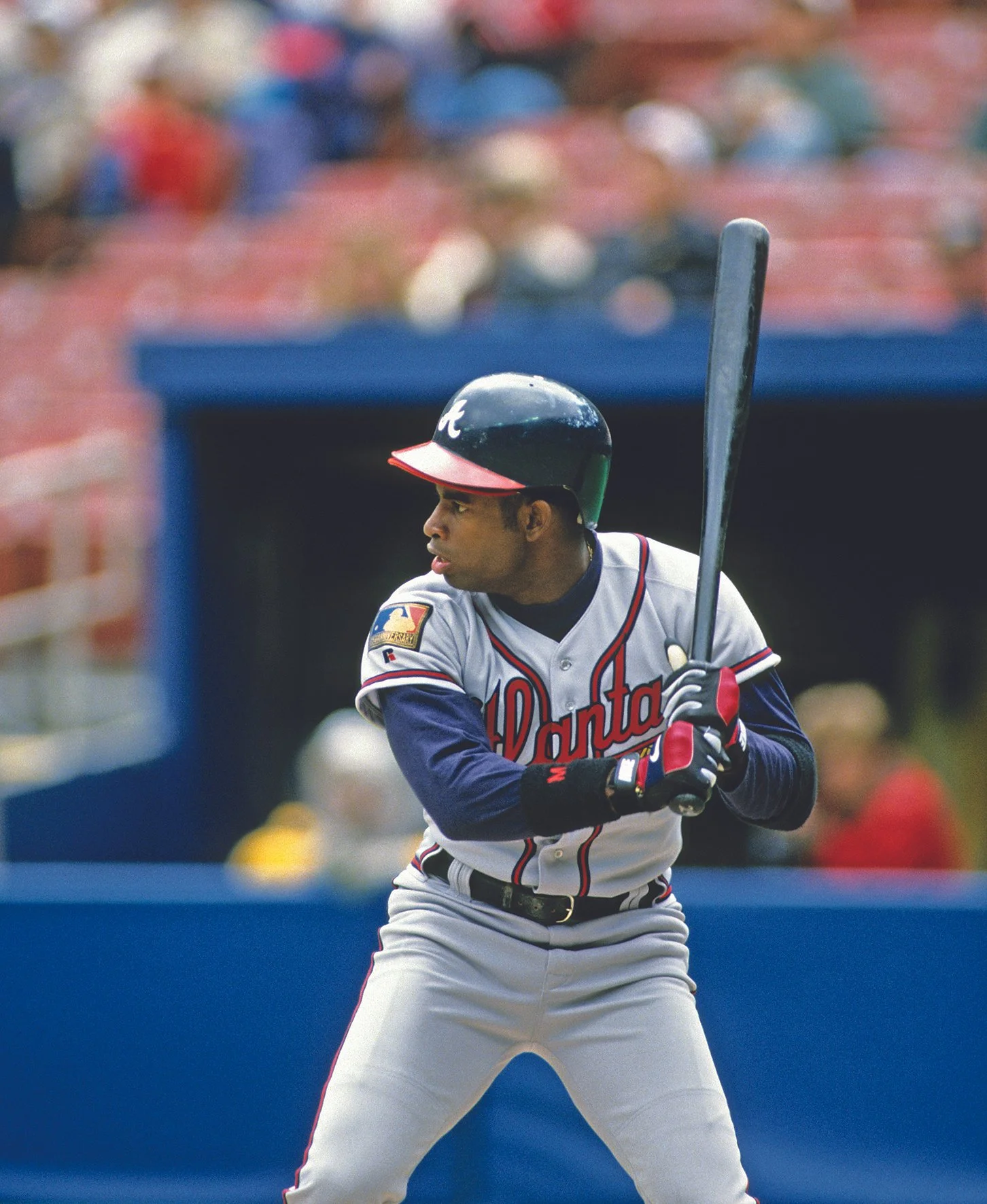
Deion Sanders' profile continued to rise in ways that would have seemed almost impossible for most professional players. For many, summer in the US means baseball, and when the football season concluded he exchanged shoulder pads for a baseball uniform, becoming one of the very few athletes in modern history capable of competing professionally at the highest level in two sports almost simultaneously. Somehow Sanders balanced the demands of careers as an explosive football player and as a Major League outfielder. Rather than diluting his reputation, the dual-sport career enhanced it. Always on screen it reinforced the growing perception that ordinary limitations did not apply.
He had signed for the New York Yankees straight out of college, and played two seasons before transferring to the Atlanta Braves – where he found home.
Back in the NFL, Sanders had – by the early '90s – become one of the league's biggest attractions, and a player whose presence alone could change the atmosphere inside a stadium. While opposing coaches built game plans around avoiding him, media outlets were drawn to his exuberant behaviour – keen to describe his latest exploits.
His career had reached a crossroads: Atlanta had introduced the league to 'Prime Time' but it was becoming increasingly clear that his ambitions extended well beyond the Georgia-based franchise. The next move would provide the stage upon which his extraordinary talent evolved into championship success.
The Making of an Icon
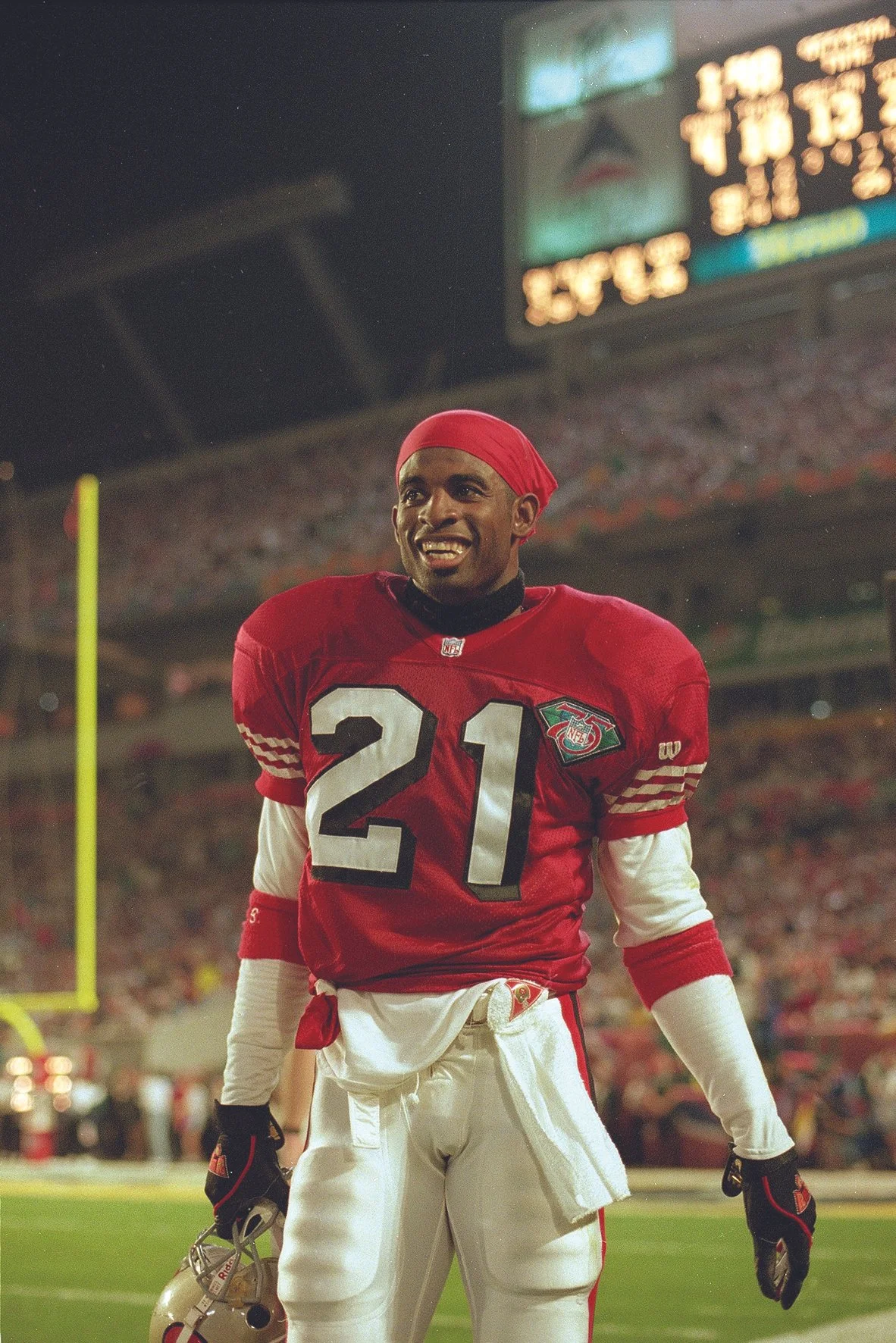
The 1994 season arrived, Sanders already established as the finest cover corner around, with quarterbacks somewhat accustomed to treating his side of the field as forbidden territory. It was a time where receivers measured successful afternoons not by catches or touchdowns, but simply by surviving four quarters against him. Yet for all his brilliance, one achievement still eluded the now-27- year-old. Sanders had become one of the NFL's biggest stars without reaching the summit that ultimately defines every great career: winning a Super Bowl.
The San Francisco 49ers believed they possessed a championship roster that required only one final ingredient. A hit of seasoning, if you will. Perhaps Sanders was that player. Throughout the early '90s they had repeatedly collided with the Dallas Cowboys, whose dominance had become the defining storyline of the National Football Conference. Steve Young, Jerry Rice and Co. had repeatedly fallen just short against Jimmy Johnson's side, and the organisation recognised that the narrow margins separating victory from defeat might be bridged with one decisive player. Sanders represented exactly that. His arrival in California was not viewed as the acquisition of another Pro Bowler, but as a signing capable of tipping the balance of power within the conference. Especially with the aforementioned Johnson –back-to-back Super Bowl winner – now replaced by the fresher-faced Barry Switzer in Dallas.
What followed remains one of the greatest individual seasons ever produced by a defensive player. Sanders moved through games as though he were operating a fraction of a second ahead of everyone else on the field. His six interceptions only hinted at his dominance. More revealing was the reluctance of opposing quarterbacks to challenge him at all. Entire sections of the field disappeared from offensive game plans as coaches searched desperately for alternatives, only to discover that avoiding Sanders often played directly into the hands of the rest of San Francisco's defence.
His performances earned him the NFL Defensive Player of the Year award, a remarkable accomplishment for a cornerback in an era when pass rushers typically dominated the conversation. Yet Sanders' greatest contribution came during the NFC Championship Game against the Cowboys. Sanders helped neutralise Dallas' explosive passing attack as the 49ers secured a dramatic victory, before comfortably defeating the San Diego Chargers in Super Bowl XXIX. After years of dazzling individual performances, the cornerback finally possessed the championship ring that completed his résumé and cemented greatness.
Some players would have been content to remain exactly where they were. Sanders had become a champion in San Francisco, won the league's highest individual defensive honour and with it, his place among football's elite. Instead, he made a decision that shocked the NFL.
He joined the Dallas Cowboys.
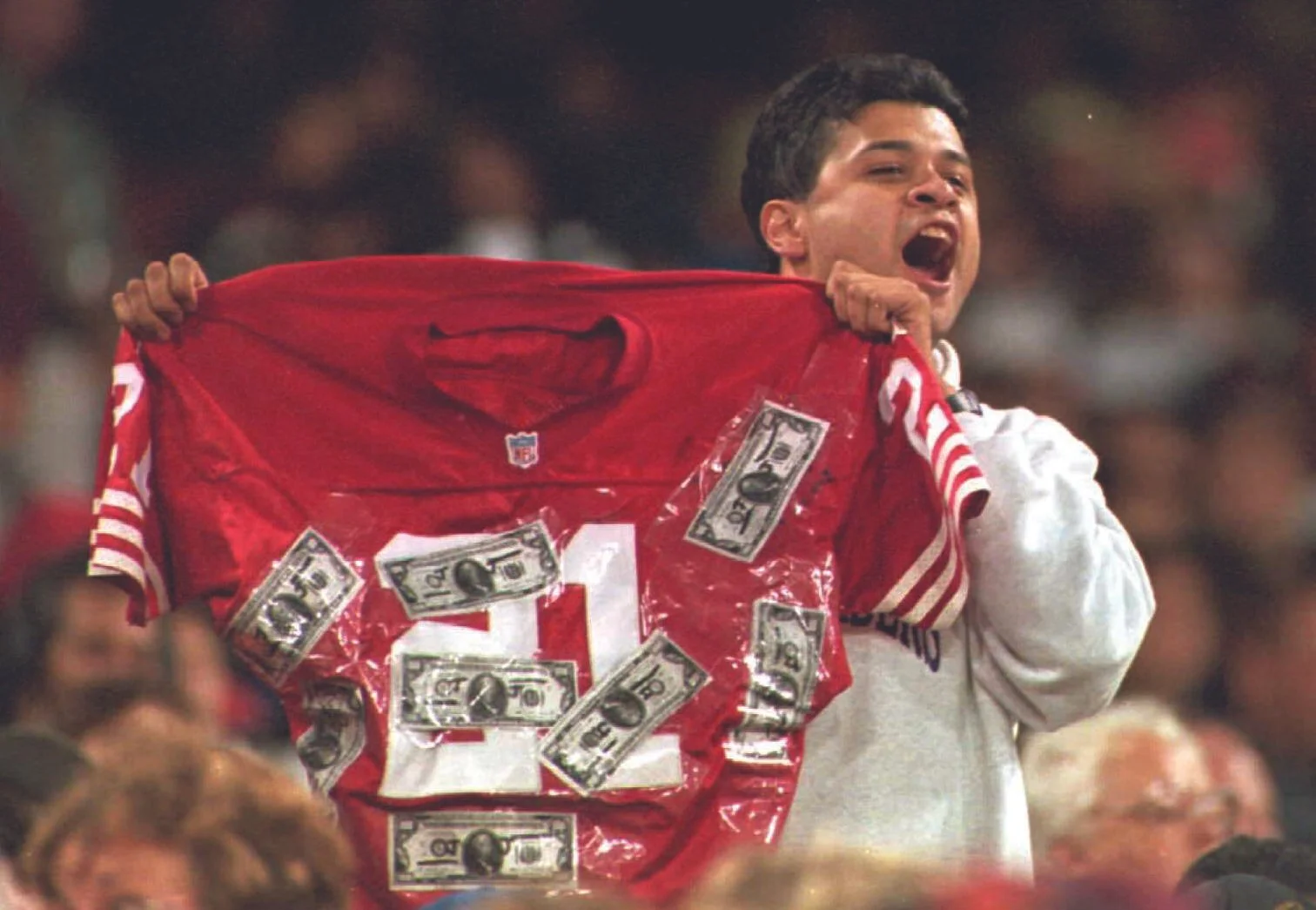
“They don’t pay nobody to be humble. Some people will come out to see me do well. Some people will come out to see me get run over. But love me or hate me, they’re going to come out.”
Cowboy Time
From the outside, the move appeared almost unthinkable. Dallas and San Francisco had become the defining rivalry of the decade, trading conference championships in games that felt every bit as significant as the Super Bowl itself. Yet owner Jerry Jones had watched Sanders dismantle his team's championship ambitions firsthand and reached a conclusion that reflected both his competitive instinct and his willingness to think differently. If the best defensive player in football could not be beaten, he should simply be brought to Texas instead.
What enticed Sanders was a seven-year contract worth approximately $35 million – one of the richest ever awarded to a player at the time, who was not a quarterback. It represented a declaration of intent. Jones was signalling that the Cowboys had no interest in merely remaining among the league's best teams; they intended to become number one. At a time when franchises typically built their identities around quarterbacks, running backs or pass rushers, Dallas invested heavily in a cornerback because this cornerback was himself a game-changer.
The timing could hardly have been more dramatic. The Cowboys already resembled an all-star team. Quarterback Troy Aikman brought calm precision to the offence, Emmitt Smith was rewriting the record books with his consistency at running back, wide receiver Michael Irvin played with unmatched competitive fire, and the offensive line had earned a reputation as the finest unit in football. Dallas possessed stars in almost every position, yet Sanders' arrival somehow elevated the glamour even further. 'America's Team' had acquired the League's biggest personality, and the marriage felt strangely inevitable.
No NFL franchise attracted greater national attention during the '90s than the Cowboys. Every game seemed to carry heightened significance and generate headlines. Sanders thrived in that environment. Pressure had never intimidated him and if anything, it energised him. As it did in college. Joining Dallas placed him under the brightest lights in American sport, exactly where he believed he belonged.
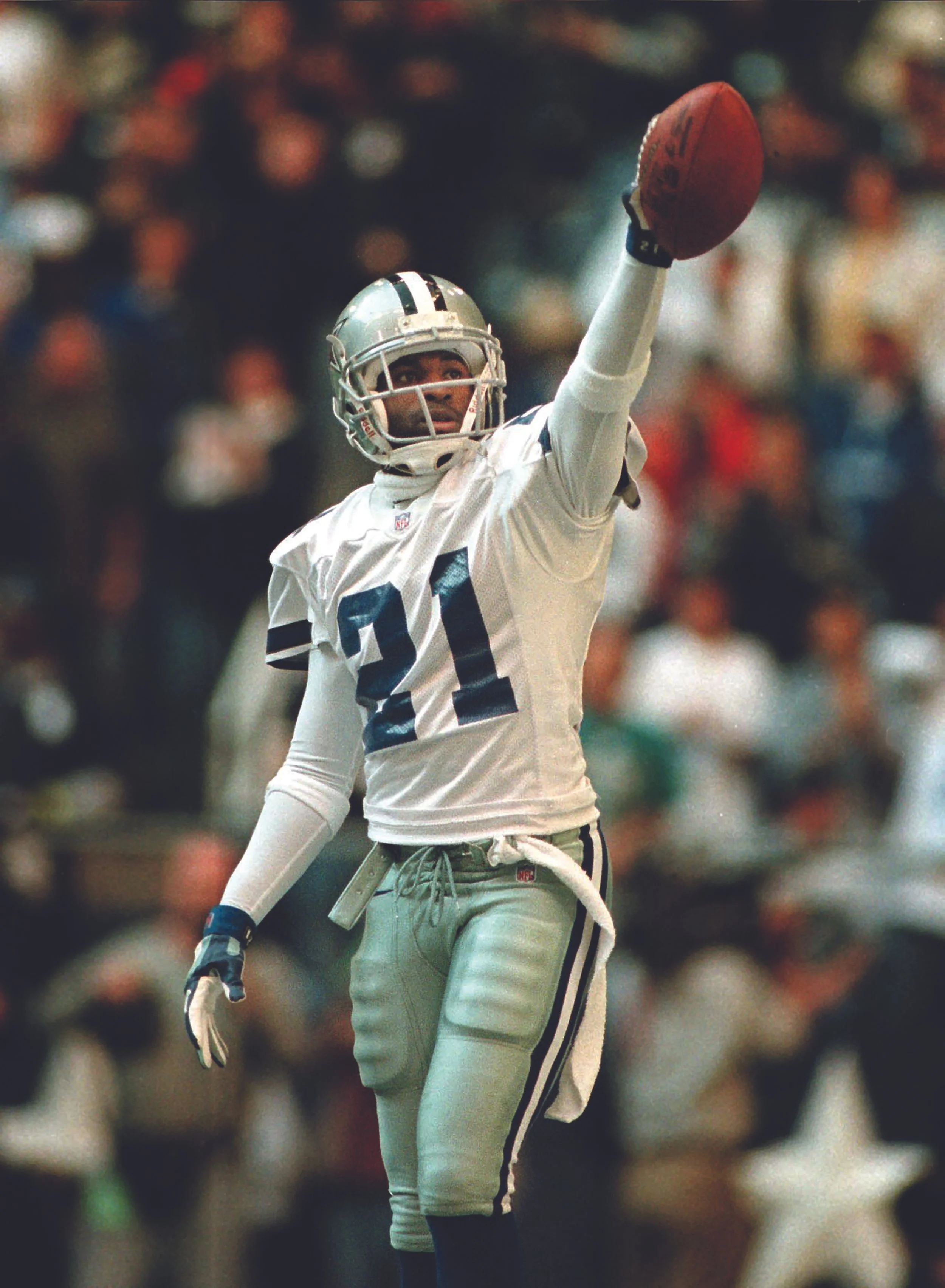
His impact was immediate and Sanders finished the regular season with six interceptions. The true measure of his value lay elsewhere. Elite receivers again disappeared from games because quarterbacks continued to refuse to test Sanders in one-on-one coverage. The Cowboys' pass rush was the real benefactor, with opponents holding the football longer in search of safer options. His presence transformed an already formidable defence into one of the most balanced units in footballing history.
Teammates discovered that the confidence displayed in public was supported by an extraordinary work ethic behind closed doors. Wide receiver Michael Irvin, himself hardly lacking in self-belief, spoke repeatedly about Sanders' commitment to preparation. He said that sessions watching past games went on for hours as Sanders searched obsessively for habits that might reveal an opponent's intentions.
Troy Aikman admired Sanders for different reasons. The quarterback recognised that while 'Prime Time' often dominated headlines, he also understood precisely when to set the performance aside and concentrate entirely on football. Once meetings began or practice started, the entertainer disappeared. What remained was an intensely focused professional whose attention to detail rivalled anyone in the team. Sanders never asked teammates to embrace his personality; but he did want them to match his commitment to excellence.
The Cowboys completed the regular season with a 12-4 record before embarking on another playoff run that culminated in a Super Bowl appearance against the Pittsburgh Steelers. With half the field belonging to Sanders, the Cowboys advanced 27-17 the victor
For the cornerback, it was a second consecutive Super Bowl championship with two different franchises – an achievement almost without precedent. Coaches spoke openly about his ability to change entire game plans, while younger defensive backs increasingly viewed him as the standard against which every elite corner would be measured.
Football however, represented only part of Sanders' Dallas soap opera. The city became an extension of Sanders phenomenon. Dallas in the 1990s celebrated success with unapologetic enthusiasm, and Deion embraced it wholeheartedly. He had an expansive home in an affluent suburb, with luxury cars and all the trimmings. His tailored suits, jewellery and flambouant image became as familiar as his jersey number.
Unlike many athletes who separated their professional and personal identities, Sanders appeared entirely comfortable allowing the two worlds to overlap. He pursued sponsorship opportunities with the same confidence he showed in football. Expanded his business interests and was a regular presence on television. Long before phrases such as 'personal brand' became common vocabulary, Sanders understood that a sportsman's influence could extend into entertainment, fashion and entrepreneurship without affecting competitive credibility. In many ways his visibility made him even more compelling.
“It wasn’t an act - that fool believed every damn work he said.”
Michael ‘The Playmaker’ Irvin - Dallas Cowboys Wide Receiver
However, despite the glitz and glamour that surrounded his life, teammates were quick to emphasise that there was another side to Sanders... charitable work throughout Texas, supporting programmes focused on education and opportunities for disadvantaged young people.
For supporters of the Cowboys, Sanders came to symbolise everything the franchise aspired to represent during the Jerry Jones era. Excellence, confidence, entertainment and relentless ambition. Dallas already possessed championship pedigree before his arrival, but Sanders elevated them to another level.
Season after season he earned Pro Bowl selections and First-Team All-Pro honours as he continued to frustrate the League's finest receivers. By the time Deion Sanders left Dallas at the end of the 1999 season, the NFL itself was beginning to change. The Cowboys dynasty that had dominated the first half of the decade was giving way to a new generation of contenders, while many of the players who had defined the era were entering the latter stages of their careers. Sanders remained one of the League's premier defensive players, but the team around him no longer possessed the same aura it once had. His move to Washington in 2000 represented another lucrative opportunity and another fresh challenge, yet it lacked the sense of occasion that had accompanied his arrival in Dallas.
Sanders continued to perform at an elite level in the capital – in a team assembled with lofty ambitions, that had invested heavily in experienced veterans. The results however never matched the spending. Coaching changes, inconsistency and organisational instability prevented the team from fulfilling its promise, and Sanders found himself experiencing unfamiliar surroundings as the team failed to make a serious bid for the championship. His personal standards remained remarkably high, but even he could not transform the fortunes of an entire franchise.
At the conclusion of the 2000 season, Sanders announced his retirement, seemingly bringing one of football's most remarkable careers to an end. Like many elite athletes, however, he soon discovered that walking away from competition was easier said than done. Four years later, he was persuaded to reignite his playing career with the Baltimore Ravens. A very different environment from the glamorous stages of Dallas or San Francisco. The Ravens' identity centred on discipline, physicality and one of the fiercest defences in the game. Sanders was no longer the breathtaking athlete who had terrified quarterbacks, but he no longer needed to be. Experience, anticipation and leadership had replaced some of the raw speed and younger players quickly recognised his value. His final two seasons served less as a farewell tour than as proof that intelligence and preparation could compensate even as athletic gifts inevitably faded.
A second bite at retirement
When Sanders retired for real at the end of the 2005 season, his numbers alone secured place among football's immortals: 53 interceptions, nine defensive touchdowns, eight Pro Bowl selections and six First-Team All-Pro honours. His induction into the Pro Football Hall of Fame in 2011 merely a formality. Many believe he set the standard by which every cornerback is now judged.
For a while, it appeared that a career as a broadcaster and analyst would be his calling. As charismatic behind in front of the camera as he had been on the field he combined insight with an air of confidence. Yet full retirement never seemed entirely compatible with someone whose competitive instinct had shaped him. The spotlight remained familiar, but observation was never likely to satisfy a man who had spent decades influencing events rather than merely describing them.
“He’s the cockiest son of a bitch I’ve ever met… But damn, he could back it up.”
Charles Barkley - 11-time NBA all-star basketball player
Back to School
Sanders accepted the head coaching position at Jackson State University in 2020, leading to mixed reactions across college football. Some viewed the appointment as a landmark moment for those colleges and universities that had historically, had a higher proportion of black students, believing that one of sport's biggest names could bring attention to schools that had often struggled for national recognition. Others were less convinced, suggesting that celebrity alone could not compensate for the demands of the job. Recruiting, player development, programme management and leadership, critics argued, required a very different skill set from playing the game.
Sanders approached those doubts in the only way he had ever known. Rather than attempting to lower expectations, he embraced them. From his first day on campus, he spoke about changing perceptions of what Jackson State could become. Elite recruits who might previously have overlooked HBCU (Historically Black Colleges and Universities) programmes suddenly found themselves considering places. Television cameras arrived in greater numbers, and attendance increased. Media coverage expanded and Jackson State became one of the most discussed programmes outside the traditional college football powerhouses.
Positive results also followed. Conference championships arrived, recruiting standards improved and players developed under a coach who combined the credibility of a Hall of Fame career with an ability to communicate directly to a generation of athletes raised in an entirely different sporting landscape. Sanders had forced the wider sport to reconsider assumptions about where elite talent might choose to play – and how visibility could transform a school's fortunes almost overnight.
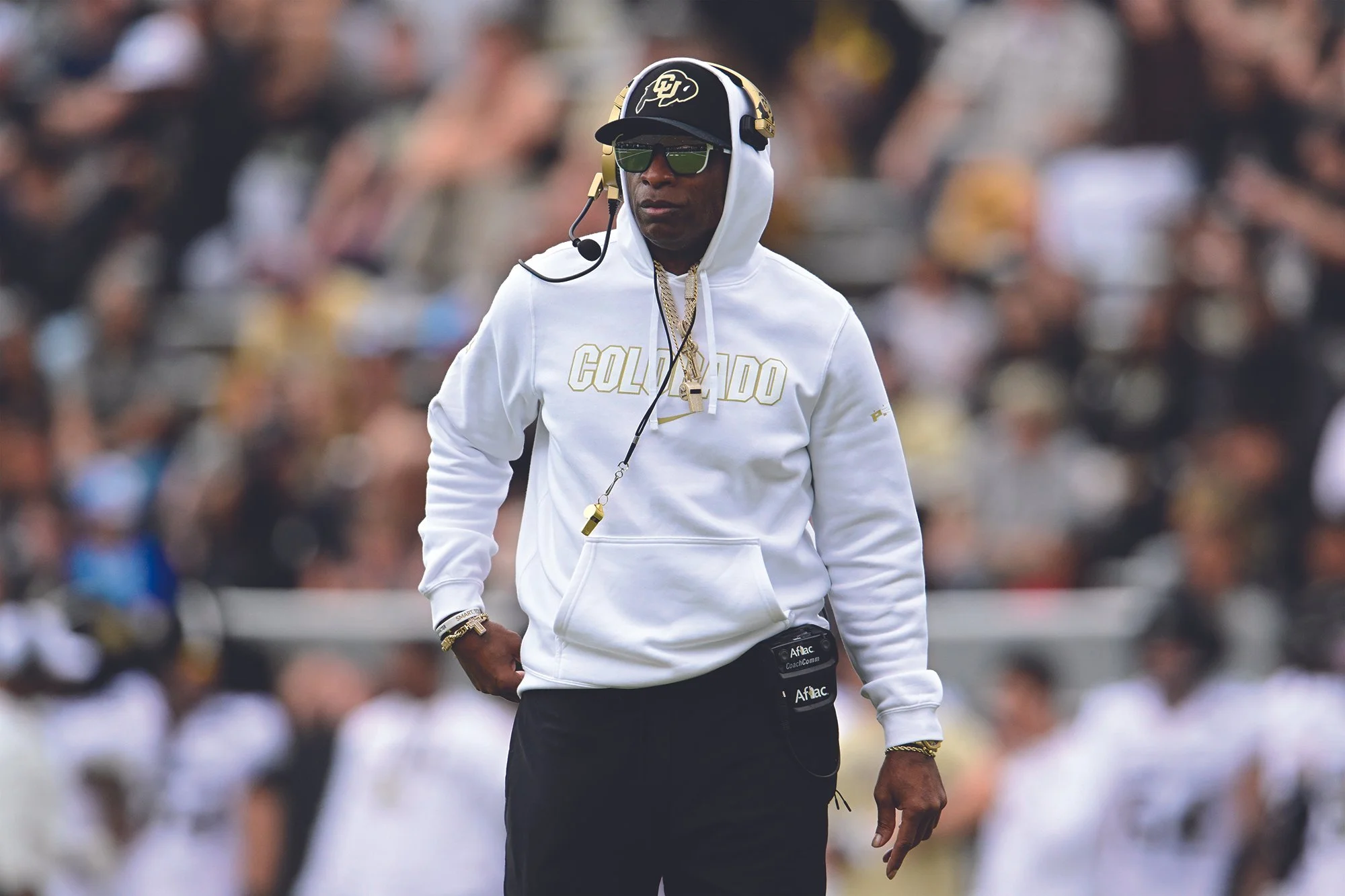
His departure for the University of Colorado at the end of 2022 generated another wave of debate. Colorado had endured years of decline, becoming one of the least competitive programmes among the major conferences. Sanders inherited a struggling team with a culture in need of reconstruction. His methods were uncompromising, with returning players told they would have to compete with the talent he intended to recruit. And transferring new talent became one of his primary tools for accelerating the rebuilding process.
To supporters, the approach reflected honesty and ambition. Modern college football had changed dramatically, they argued, and Sanders merely accepted that player movement had become commonplace. Others viewed the strategy differently, questioning whether such sweeping changes undermined loyalty and long-term development.
The start of his first season in Boulder intensified those debates, after Colorado's remarkable victory over national finalist TCU immediately became one of the biggest sports stories in America. Television audiences soared, celebrities appeared on the sidelines, ticket sales increased and, for a brief period, the Buffaloes became college football's most compelling attraction. Sanders' arrival –gold whistle in tow – seemed to validate every bold promise he had made.
The season that followed proved more complicated. Injuries, shortcomings in offense and the scale of the rebuilding task gradually became apparent as Colorado struggled to be consistent against stronger opposition. For some observers, those defeats represented the inevitable puncturing of excessive hype.
Sanders however, true to character, did not retreat from public view. Instead, he continued recruiting aggressively, reshaped the roster once again and insisted that the long-term vision remained unchanged. Subsequent progress and improved competitiveness followed. Whether Colorado ultimately reaches championship level remains a question for the future, but few would dispute that Sanders has already restored national relevance to a programme that had long disappeared from the sport's biggest conversations.
His coaching career has also highlighted the same contradictions that accompanied his playing days. Admirers see an innovator willing to challenge outdated assumptions about recruitment and player empowerment. Detractors argue that the attention surrounding him can sometimes be a distraction, questioning whether the spectacle overshadows the substance. Very few figures in modern football consistently provoke such passionate discussion, because very few possess Sanders' unique combination of competitive credibility, media presence and cultural influence.
Whether admired or criticised, Sanders has never accepted the notion that sport should remain unchanged simply because it has always operated a certain way. Few people have done more to shape the conversation around football over the past four decades.
'Prime Time' was not merely the nickname for an electrifying cornerback or a marketing slogan, it became a philosophy rooted in confidence and conviction.